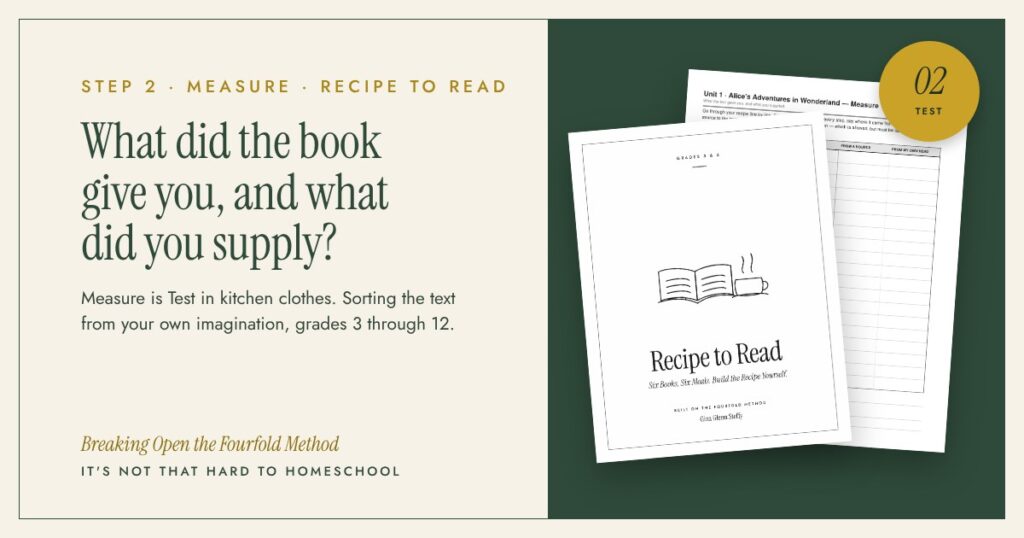
Breaking Open the Fourfold Method · Recipe to Read · Grades 3–12 · Step 2 of 4
This post contains affiliate links. If you buy through them, It’s Not That Hard to Homeschool may earn a small commission at no extra cost to you.
In our last Recipe to Read post, a fifth grader copied out every sentence about food in the Alice unit, word for word. She found the “large dish of tarts” at the trial. She found the Queen who “made some tarts, All on a summer day.” And she noticed something odd: the book never says what jam was in them.
Then she built her recipe. Raspberry jam. Shortcrust pastry. Twelve little open tarts.
Here’s the question that comes next: how much of that recipe came from Lewis Carroll, and how much came from her?
That’s the second move in Recipe to Read. The book calls it Measure, and it says plainly that “Measure is the one that matters most in this book.”
This is the next post in our series opening up the Fourfold Method one step at a time, using the actual pages children fill in. Today it’s Recipe to Read, for grades 3 through 12, and step two.
Free guide
Your child can be sure a book said something it never said.
Our free guide walks you through the four moves of the Fourfold Method and how they turn what your child reads into something they keep. It works in every subject, at every age, kitchen included.
Get the free Fourfold guideMeasure is Test, in kitchen clothes
Recipe to Read uses the same four moves as our other books, under names that make sense at the stove: Gather, Measure, Fold In, Serve. Measure is what the other books call Test.
The book asks one question at this step: “What did the text give you, and what did you supply? Separate them.”
Then it explains why that’s harder than it sounds:
“Your mind fills gaps without informing you. You will be certain a book said something it never said, and you will be able to picture the detail vividly.”
Recipe to Read, “Why Measure is the hard one”
Every reader does this. We picture a character’s face, a room, a color of jam, and a week later we’d swear the author described it. Measure is where your child learns to catch it. And in this series, the book points out, “it has consequences you can taste.”
What it looks like on the page
The Measure page asks your child to go through their recipe “line by line. For every ingredient and every step, say where it came from.” Each decision goes in one of three columns: from the text, from a source, or from my own head.
Here’s what that page might look like for our fifth grader and her jam tarts:
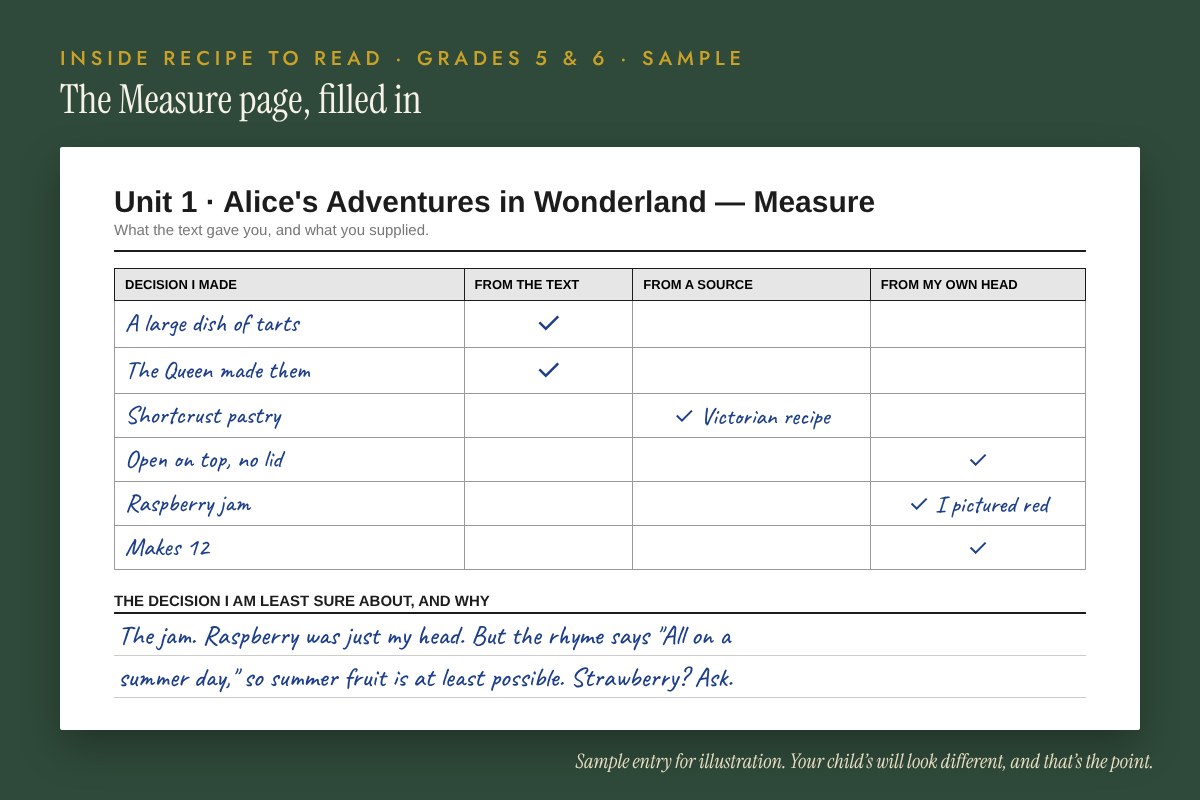
Look at how much landed in the third column. The tarts, the dish, and the Queen are Carroll’s. The pastry came from a Victorian recipe she looked up. But the raspberry, the twelve, and the open tops came from her own head.
That’s not a failure. The book is clear. Anything your child can’t trace to the text or to a period source “is your own invention,” and that “is allowed, but must be labelled.” The third column is honest. The mistake would be leaving it empty.
And then there’s the last box: The decision I am least sure about, and why. Our student picked the jam, and then noticed something on her own. The rhyme says the Queen made her tarts “All on a summer day.” Summer fruit, then. She still doesn’t know the flavor, but now she has a reason for her guess. That’s what close reading feels like from the inside.
Measure grows with your child
The same six books come back at every level, and the Measure page grows up with them.
Grades 3 & 4: The book says, I filled in
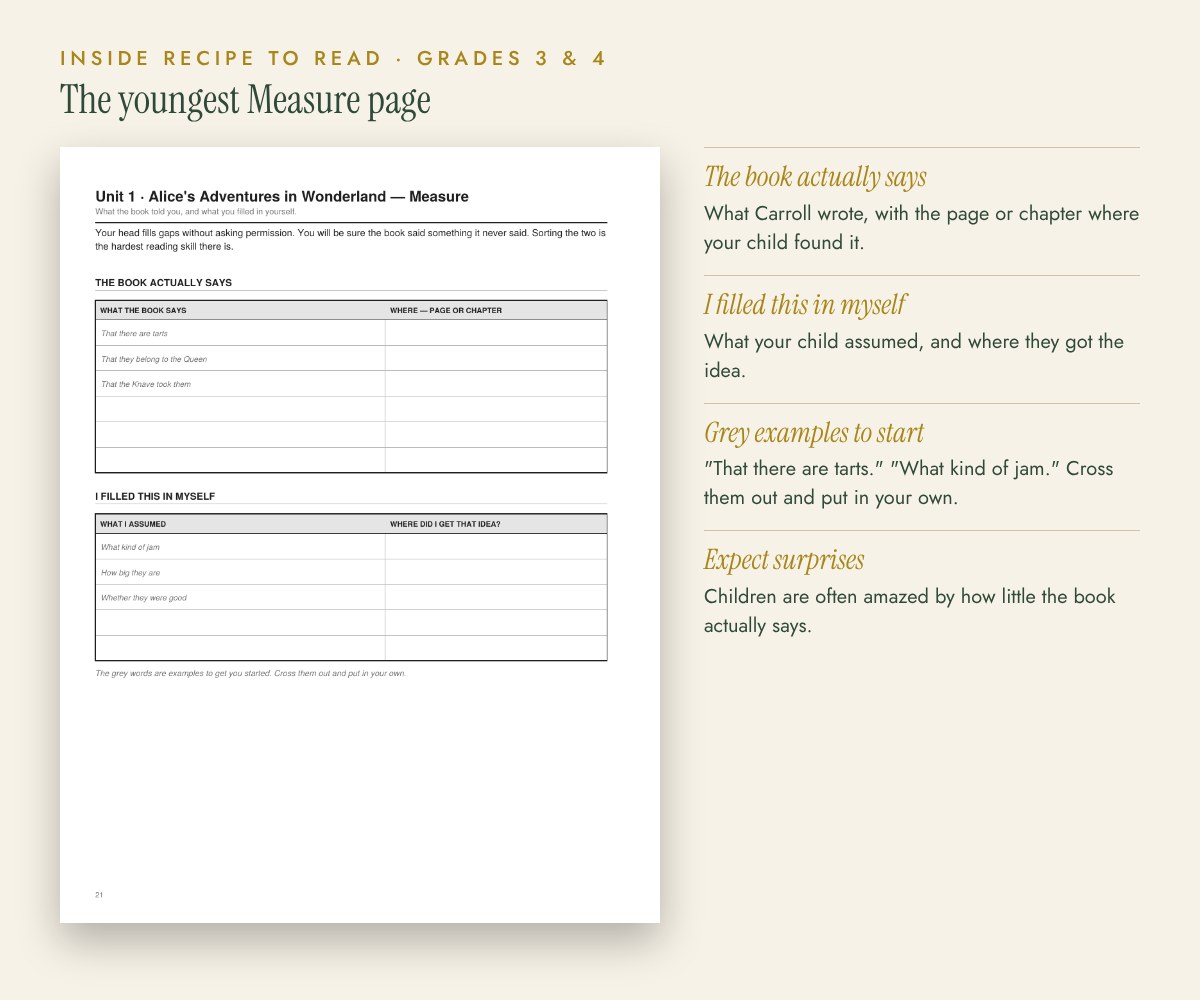
The youngest level splits the page in two: The book actually says and I filled this in myself, with a column for “where did I get that idea?” The page opens kindly: “Your head fills gaps without asking permission.” Grey examples get your child started: that there are tarts on one side, what kind of jam on the other. “Cross them out and put in your own.”
Grades 5 & 6 and 7–9: Three columns
Text, source, or my own head, for every ingredient and every step. The parent notes call it “the page that does the teaching.”
High School: Supports, permits, excludes
Teens make a finer cut: “Distinguish what the text supports, what it permits, and what it excludes. These are three different claims.” Carroll supports tarts. He permits raspberry jam. Does anything in the text exclude it? That one question is the beginning of literary argument.
Measure is Compare & Contrast
If you know Lisa’s 5 Common Topics, the book places Compare & Contrast right here: “What the book said against what you assumed. Later levels compare the same scene across books and periods.”
“Even if you’re watching a movie together, you could just have these conversations about the movie. Let’s define what we were talking about, or what is the relationship to this person or that person?”
Lisa Nehring, It’s Not That Hard to Homeschool podcast
Measure works at the movies too. Ask your child what the film showed and what they just assumed. You’ll both be surprised.
How to help without hovering
- Ask “Where does it say that?” Then let them look. This is the book’s own fix when a child can’t find anything for Measure: “Do not give the answer.”
- Treat the third column as a win. A full “my own head” column means your child noticed their own imagination at work. That’s the skill.
- Expect surprises. The parent notes for the youngest level say exactly that. Children are often shocked by how little the book actually says.
- Cook after Measure, not before. Once the recipe is sorted, the cooking becomes a test of the reading. “The cooking is the reward; the layers are the learning.”
- Ask for 15, not 5. A recipe has more decisions than it looks. As Lisa says, “Anybody can come up with five. But when you start saying 15 to 20 to 30, you have to really start thinking very creatively.”
Resources for the Measure step
The middle column, “from a source,” is where a good bookshelf helps. These are the books we’d reach for.
- The Annotated Alice by Lewis Carroll, with notes by Martin Gardner. The whole book with notes in the margins explaining what Victorian readers knew. A wonderful model of separating the text from what we bring to it.
- Mrs Beeton’s Book of Household Management (Oxford World’s Classics, abridged). One of the period cookbooks the workbook points to. A real Victorian source for the middle column.
- The Little Women Cookbook by Wini Moranville. Recipes and food history from the March family’s world. Compare it to what your child built from the text alone.
- Robinson Crusoe (Dover Thrift). The barley bread unit is the one where the author does give the method. Defoe describes the whole process, from planting to baking, and the book asks why this author, unlike the others, doesn’t hold back.
- Page Markers. One color for “the book says,” another for “I assumed.” Younger readers love sorting with flags.
All six novels and many period cookbooks are free online at Project Gutenberg, Michigan State’s Feeding America collection, and the Library of Congress. You’ll find more on our Amazon storefront, including The Kitchen Is Our Classroom.
Next up: Fold In
Gather tells your child what the book says. Measure sorts out what they added. Next time we’ll open Fold In, the move the other books call Connect: “What was the world like when this was written, and what did that make possible?” For Alice, that means Victorian tea parties, and why Carroll had his tea party break every rule.
From our shop
Six books, six meals, every level
Recipe to Read: The Complete Series, Grades 3–12 · $49
All four levels in one download, so siblings can read and cook the same books together at their own depth. Or buy one level: Grades 3 & 4, Grades 5 & 6, Grades 7–9, or High School.
See what’s insideNext step
When your reader is ready for a literature class
True North Academy’s classes build the same habits of close reading and careful thinking, with a teacher and classmates to discuss the books with. Live online, accredited, and built for homeschool families.
Explore True North Academy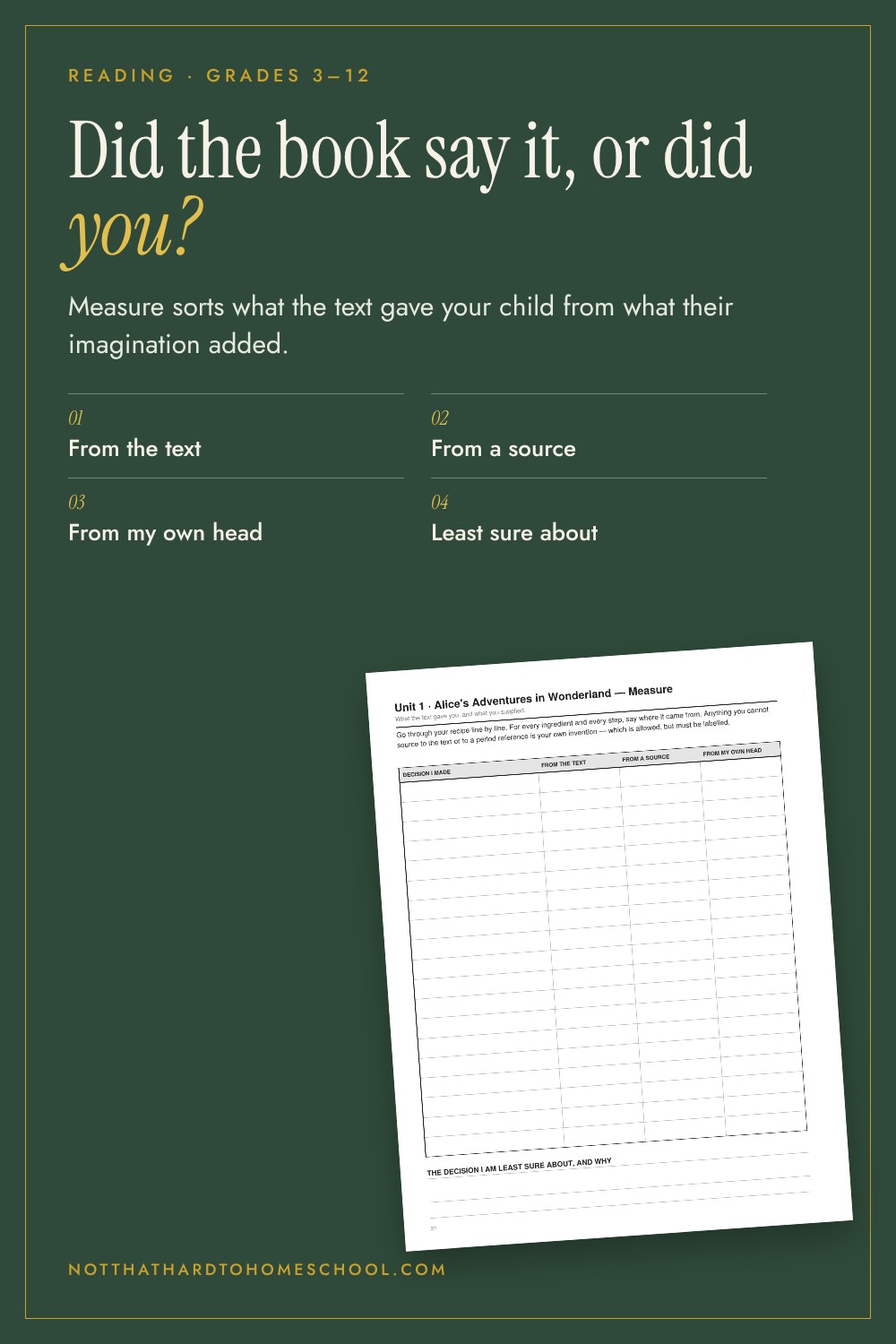
Save this to Pinterest for later.

Lisa Nehring and her husband, Dr. David Nehring, a Clinical Psychologist, and Biblical Scholar speak together on a wide variety of topics, including education, classical education, vision, mission, parenting, marriage, and more.
New here? Start with our free guide, The Fourfold Method: A Guide for Homeschool Families. Four simple moves that help your children keep what they learn, in every subject and at every age.
- Did the Book Say It, or Did You? The Measure Step in Recipe to Read - November 10, 2026
- Why Then, and Who Benefited? The Test Step in a Commonplace Book - November 9, 2026
- What Would Prove You Wrong? The Test Step for High School Science - November 8, 2026


