


Authors describe food. They almost never give you a recipe.
Dickens spends a paragraph on the Cratchit pudding and not one measurement. Building a workable recipe from a literary description means separating what the text actually says from what your mind supplied. That’s the foundational skill of close reading, with a result you can taste.
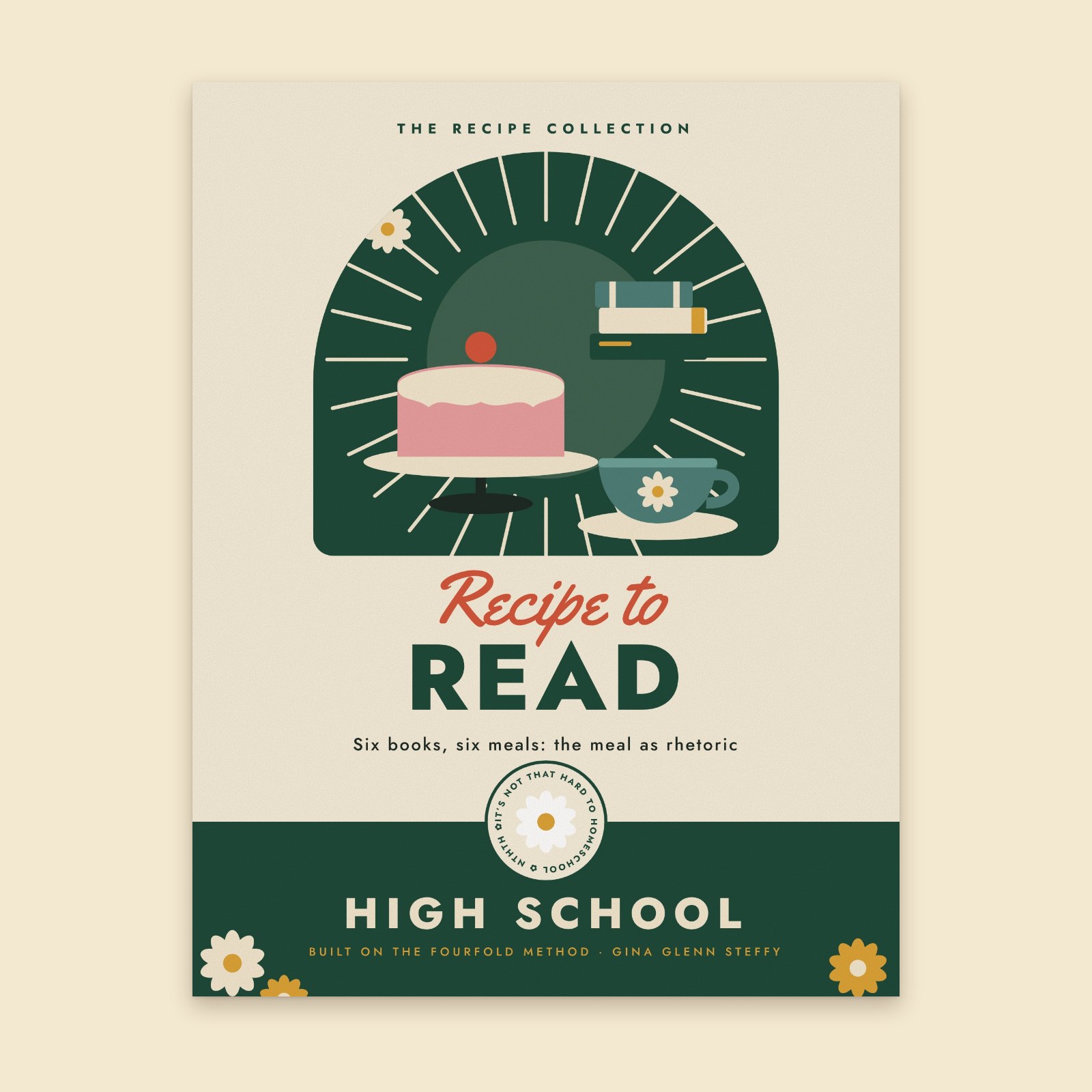
Recipe to Read: High School uses six classic books, all free to read: Alice’s Adventures in Wonderland, A Christmas Carol, Little Women, The Wind in the Willows, The Secret Garden, and Robinson Crusoe. The same six appear in every volume with harder questions each time, because coming back to a book you love with better tools is what literary study is.
At this level the cooking is evidence and the analysis is the work. Your student reconstructs with full documentation, then writes about what each scene is doing in the book: structurally, rhetorically, and in its period.
Is this a good fit for your family?
- Yes, if your child reads but doesn’t really notice what’s on the page.
- Yes, if you want literature that gets your kids into the kitchen.
- Yes, if you want classic books without buying a stack of guides.
- Yes, if you need a literature course with a course description for the transcript.
- Maybe not, if you want a reading program for any book on your shelf. This is built around six specific classics.
By the end, your student will be able to
- Reconstruct a dish from primary sources with an auditable change log
- Distinguish what a text supports, permits, and excludes
- Write a literary argument that answers the strongest objection
- Analyze Dickens as rhetoric, Carroll’s nonsense as a system, and Defoe’s documentary realism
- Compare all six texts in a capstone essay
How a unit works
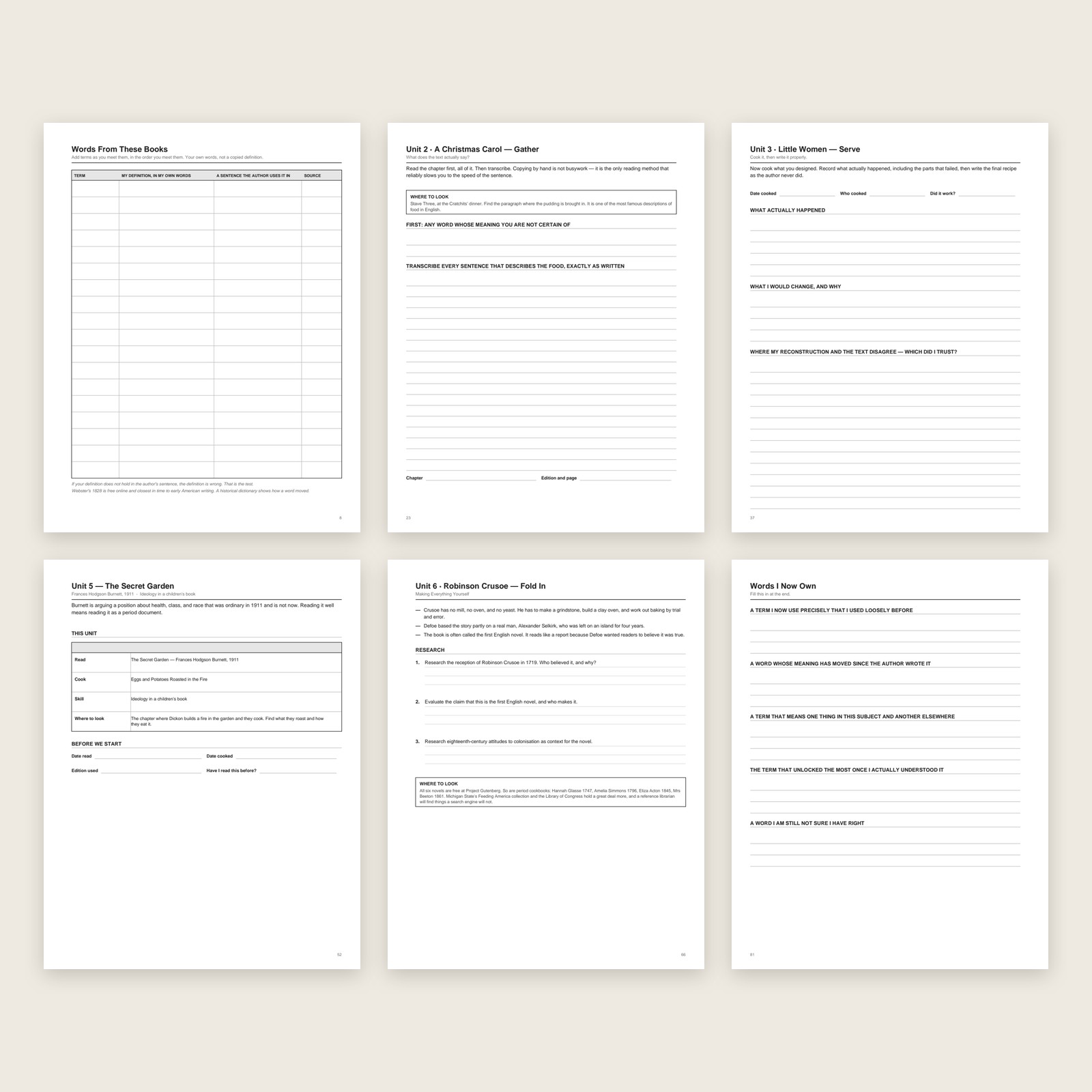
Every unit follows the same steps, so you always know what comes next:
- Read and transcribe: By hand, exactly.
- Build the recipe: No recipe is given. Your student decides and defends.
- Measure: What the text supports, permits, and excludes.
- Analyze: An argument with textual evidence that addresses the strongest objection.
- Look back: Reading History pages compare today’s work with earlier volumes.
Work at your own pace. A unit can take one week or several, depending on how deep you go. Pairs with Recipe to Write: High School.
What you’ll need
- This PDF and a printer (black and white is fine)
- The six books (free online, or from your library)
- Your kitchen and basic ingredients
What’s inside
- Six units on the same six classic texts
- Reconstruction from primary sources with a change log
- Measure pages: what the text supports, permits, and excludes
- Literary analysis with argument, evidence, and the strongest objection
- Dickens as rhetoric, Carroll’s nonsense as a system, Defoe’s documentary realism
- Reading History pages
- Vocabulary and period source guidance
- A comparison capstone using all six texts
- A course description page for your transcript
- A page for you in every unit
- A separate 27-page Parent Guide with step-by-step coaching, answer samples and writing instruction for every unit
Includes a Parent Guide
Every purchase comes with a 27-page Parent Guide, a separate PDF written for you, not your student. It walks you through your child’s book unit by unit, so you always know what to prepare, what to ask and what a good answer sounds like.
- Before you start: a short prep checklist and an opening line you can read aloud.
- Step by step: how to help with Gather, Test, Connect and Commit, with check-in questions and what to listen for.
- What good work looks like: sample strong answers, and the most common stumbling point to watch for.
- Every level side by side for each book, with cook-day steps, reading lists and the hard part at each level, so one parent can teach several children.
Writing is built in
Each level writes about the book at its own pace: retellings for grades 3–4, paragraphs with a detail from the book for 5–6 and 7–9, and analytical paragraphs with quotes for high school. The Parent Guide shows you how to coach it: a named writing skill for every unit, sentence starters for each level, sample strong answers, what a helpful note sounds like, and a simple rubric for paragraphs and essays. You don’t have to be a writing teacher.
See inside the Parent Guide (free sample) →
Why it works
Every unit follows the Fourfold Method in kitchen clothing: Gather the food sentences, Measure what the text says against what you assumed, Fold In the world the book came from, and Serve it in your own words. Your child remembers the book because they tasted it.
Questions moms ask
Do I need to know how to teach writing?
No. The writing is built into every unit, and the Parent Guide shows you how to coach it: what to expect at each level, sentence starters, what a helpful note sounds like and a simple rubric.
Do I need to buy the books?
No. All six are in the public domain and free to read online, and most libraries have them.
Can siblings at different levels work together?
Yes. Every volume uses the same six books, so the whole family can read and cook together while each child works at their own level.
Does it count for high school credit?
It can count toward an English or literature credit, and it includes a course description page for the transcript. You award the credit.
Can I use it with more than one child?
Yes. Your family license lets you print as many copies as your household needs, for every child, every year.
Who wrote it?
Gina Steffy, creator of the Fourfold Method, who homeschooled her four children from kindergarten through graduation.
What you receive
- A printable PDF, 96 pages including the cover, 8.5 × 11 inches, designed to print clearly in black and white on a home printer.
- Parent pages on how learning works in layers, including how the Fourfold Method fits with Lisa Nehring’s 5 Common Topics.
- A family license: print as many copies as your household needs, for every child, every year.
- Your file is available only from the download page. It is not sent through a link in your order confirmation email, so please download it from the download page.
A first edition, shaped by the families who use it
This is a first edition, and we would love your help making the next one better. If a page is unclear, something is missing, or an idea would work better at your table, please tell us. Every purchase includes free updates. When a new edition is released, you will receive it at no additional cost.
Looking for something else?
Everything in our shop is an instant, printable download, with a family license and free updates.
Curriculum · Fourfold Studies · Bundles · Getting Started · High School Records · Browse the whole shop →
Ready for the next step?
Continue with Baking, a self-paced, one-credit high school course from True North Academy built around hands-on bakes.


Reviews
There are no reviews yet.