

Breaking Open the Fourfold Method · Science · Step 2 of 4
This post contains affiliate links. If you buy through them, It’s Not That Hard to Homeschool may earn a small commission at no extra cost to you.
Last time, we opened the Gather box in the Fourfold science journal. (If you missed it, start with that post here.) Before touching any equipment, your student found out what was already known, and where each piece of it came from.
Now they need a hypothesis. Most students write one the way they’d fill in a blank: “I think the heavier one will be faster.” Then they run the lab, and whatever happens, happens.
The science journal asks for more than a guess. It asks for the reasoning behind the guess, and then one more thing that most students have never been asked: what result would prove you wrong? As the journal puts it, “A hypothesis nothing could disprove is not a hypothesis.” This is the second move in the Fourfold Method, and it’s called Test.
This is the second round of our series opening up the Fourfold Method one step at a time, one subject at a time, using the actual pages students fill in. Today: high school science, step two.
Free guide
One method for every subject, labs included.
Our free guide walks you through all four moves (Gather, Test, Connect, Commit) and how they turn a lab into something your student actually understands. It works in every subject, at every age.
Get the free Fourfold guideWhat “Test” means in science
The journal describes it this way: “What do you predict, and why? State the reasoning behind the prediction, not just the prediction. Then state what result would prove you wrong.”
So in science, Test has four parts:
- The prediction. What will happen, as specifically as your student can say it.
- The reasoning. Why they expect that. This comes straight out of the Gather box.
- What would prove it wrong. The result that would make them change their mind, decided before they see any data.
- A fair test. Keeping everything the same except the one thing being tested, so the result actually means something.
The third part is the one that makes this real science. Deciding ahead of time what would count as being wrong keeps your student honest when the data comes in.
The same entry, one step later
Each entry runs across two facing pages, with Gather at the top of the left page and Test right under it. The Test box asks: What do you predict, and why? State the reasoning, and what result would prove you wrong.
Remember our student getting ready for the pendulum lab, who ended the Gather box with, “I don’t get why the weight doesn’t matter”? Here’s that entry with Test filled in:
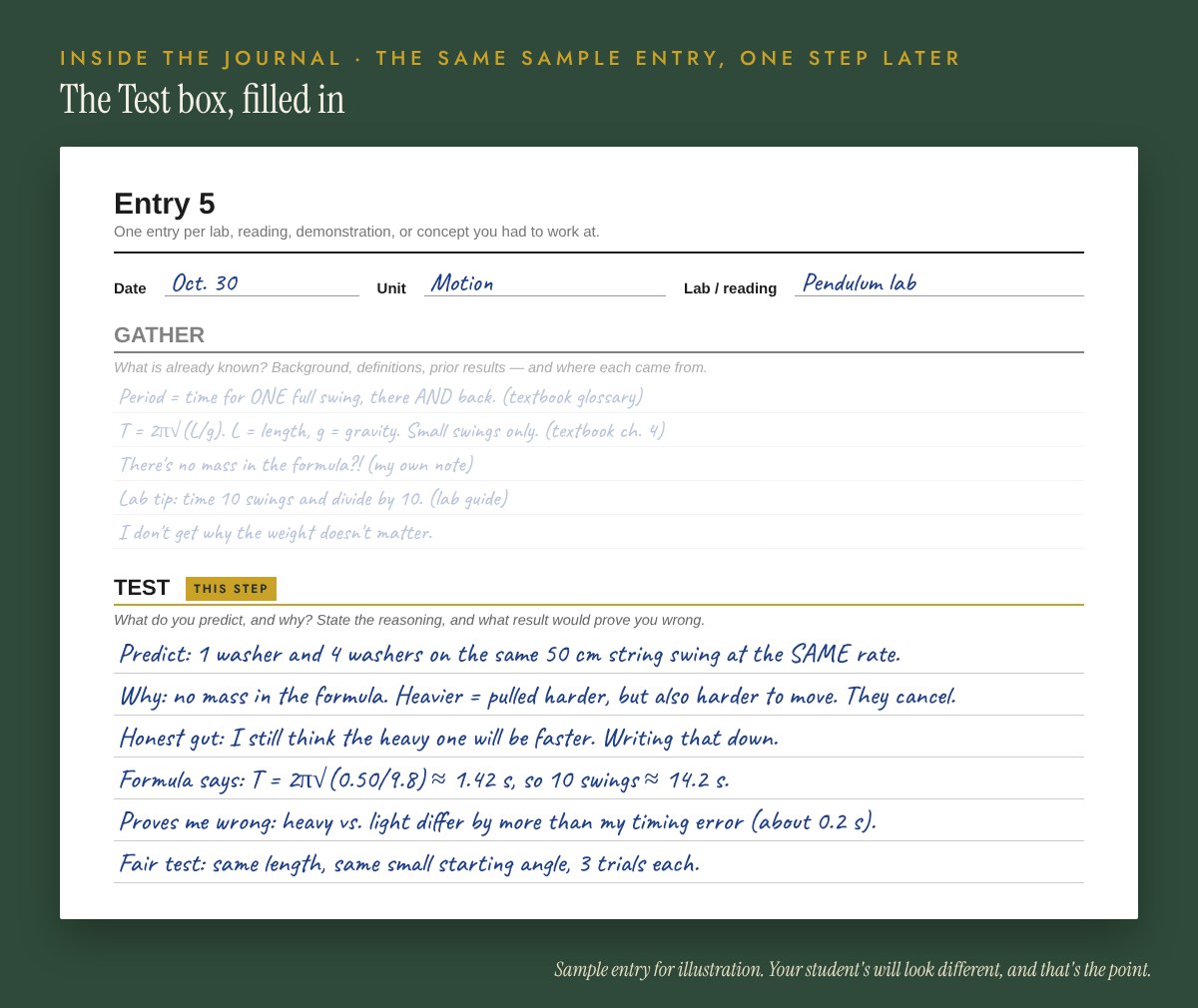
Look at the third line: “Honest gut: I still think the heavy one will be faster. Writing that down.” The formula says one thing. The student’s instinct says another. Instead of hiding the instinct, they wrote it down. Now the lab isn’t just following steps. It’s a contest between the formula and their gut, and they’ll find out which one wins.
Then look at the line that starts “Proves me wrong.” The student worked out how long ten swings should take, and decided before the lab that a difference bigger than their own reaction time would count. That’s the whole scientific method in one sentence.
More pages that do the testing
1. The Lab Report
The page opens with: “Fill the first three sections before you touch anything.” In the Gather post, we filled in the first two. The third is pure Test: Hypothesis and reasoning: what I predict, why, and what would disprove it.
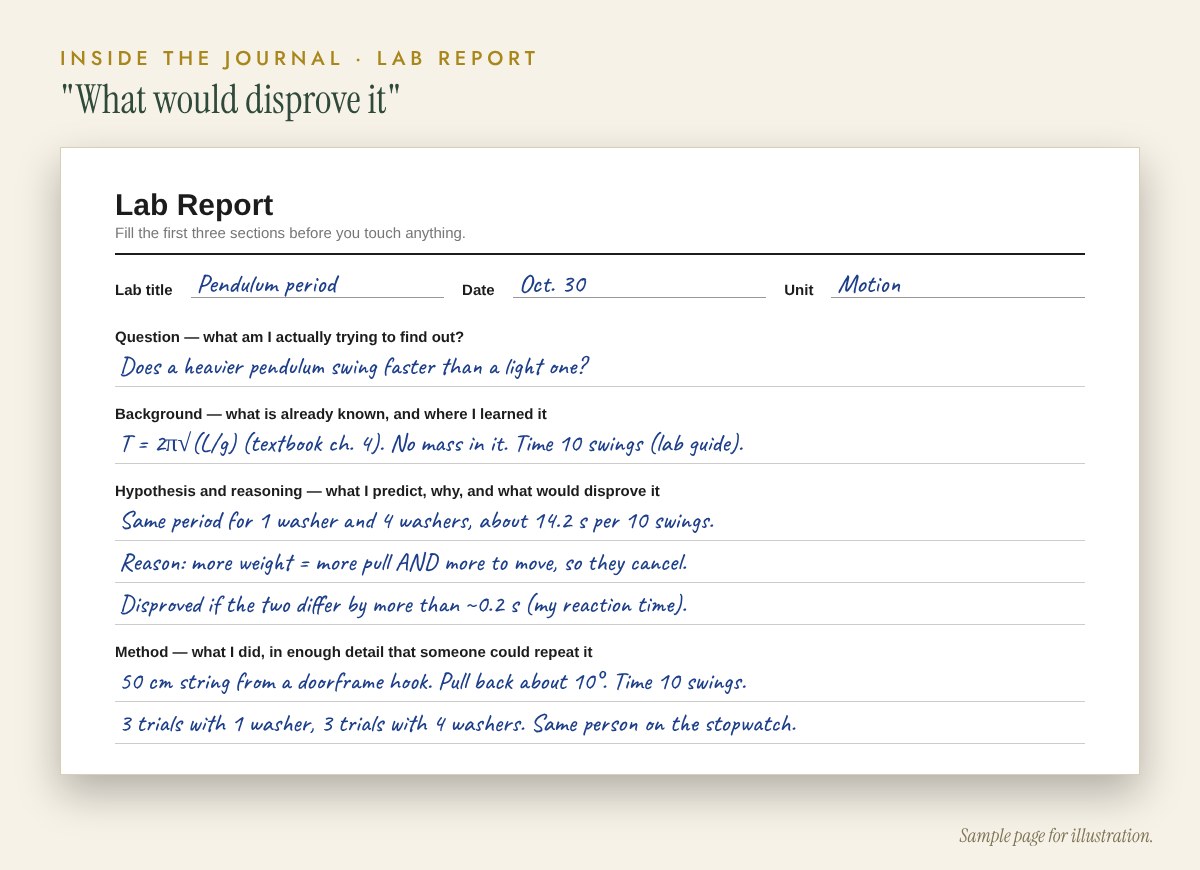
The data page that follows keeps the testing honest. There’s a box for Sources of error, and the conclusion has a phrase most lab sheets leave out: “including what I honestly cannot conclude from this.”
2. Concept Study
For ideas that aren’t labs, the Concept Study page tests in a different way, with two boxes side by side: Where it holds and Where it breaks down. The pendulum formula is a great example. It works for small swings and starts to fail for big ones. Knowing where an idea breaks is part of knowing the idea.
3. Questions I Cannot Yet Answer
“Keep this running all year. Cross them off as they resolve. Some will not.” When a test raises a new question instead of answering the old one, it goes here.
A claim against the evidence
If you know Lisa’s 5 Common Topics, this is where Compare & Contrast lives. The journal puts it in Test: “One source against another, a claim against the evidence.” In a lab, that’s literal. The prediction goes on one side, the data goes on the other, and your student compares them honestly.
“Anybody can come up with five. But when you start saying 15 to 20 to 30, you have to really start thinking very creatively about the problems and doing some critical thinking.”
Lisa Nehring, on asking students for 15 to 30 points instead of five
Try it with sources of error. Five are easy: the stopwatch, the string, the angle. Fifteen will turn up the one that actually changed the result.
A hammer and a feather
The idea behind the pendulum lab goes back to Galileo: heavy and light objects fall at the same rate if nothing else, like air, gets in the way. It’s hard to see on Earth, because a feather floats.
In 1971, astronaut David Scott tested it on the Moon. Standing on the surface during the Apollo 15 mission, with a camera rolling, he held up a geologic hammer and a falcon feather and dropped them at the same time. With no air to slow the feather, they hit the ground together. Scott told the people watching back home that Galileo had been right.
Galileo made a prediction that could have failed. Three and a half centuries later, someone checked it in the most dramatic way possible, and it held. That’s what a good hypothesis is supposed to be able to survive.
The physicist Richard Feynman put the other half of it well. “The first principle is that you must not fool yourself,” he told a graduating class in 1974, “and you are the easiest person to fool.” Writing down what would prove you wrong, before the data comes in, is how you keep from fooling yourself.
How to help without hovering
- Ask “How do you know?” Then wait. That’s the journal’s own fix when a student skips Test. The waiting is the hard part. Let the silence do the work.
- Ask “what would change your mind?” If your student can’t answer before the lab, they don’t have a hypothesis yet.
- Celebrate a wrong prediction. A student whose gut lost to the formula learned more than one who guessed right.
- Let them be wrong on paper. The journal says it plainly: “Test is where you are allowed to be wrong.” A prediction that turns out false is a good entry, not a failed one.
- Don’t grade the Test box. “A journal full of only correct conclusions is a journal where no thinking happened.” Grade the finished essay or lab report later, if you grade at all.
Resources for the Test step
You don’t need any of these to use the journal. But if you want a small shelf that teaches a high schooler to test ideas honestly, these are favorites.
- “Surely You’re Joking, Mr. Feynman!” by Richard Feynman. Funny, curious stories from a Nobel physicist. The last chapter is his famous talk about not fooling yourself.
- Can Science Explain Everything? by John Lennox. An Oxford mathematician and Christian explains what science can test, what it can’t, and why faith and careful science belong together. Short, clear, and written with older teens in mind.
- Galileo’s Daughter by Dava Sobel. The story of Galileo told through his daughter’s letters. A beautiful look at the man who tested what everyone already believed.
- The Cartoon Guide to Physics by Larry Gonick and Art Huffman. Real physics, including pendulums and motion, explained in comics. A friendly way to check the reasoning behind a prediction.
- Mistakes Were Made (But Not by Me) by Carol Tavris and Elliot Aronson. Why people defend their beliefs even when the evidence turns against them. A great companion to the “what would prove me wrong” line.
You’ll find more on our Amazon storefront, including our High School Science Lab at the Kitchen Table list.
Next up: Connect
Test asks your student to predict and to check. Connect asks where else this idea shows up: in other units, in other subjects, in the kitchen and the backyard. Next time we’ll open the Connect box, where a single lab becomes part of how your student sees the world.
From our shop
Every page in this post, ready to print
Science: A Fourfold Lab & Study Journal for High School · $15
Twenty-six entry spreads, nine full lab reports, observation logs, graphing pages, concept studies, and a course description page that goes straight onto the transcript. Works for biology, chemistry, physics, or any lab science.
See what’s insideNext step
When your teen wants a science teacher, too
True North Academy’s science classes build the same habits of careful observation and honest conclusions, with a teacher who checks the reasoning, not just the answer. Live online, accredited, and built for homeschool families.
Explore True North Academy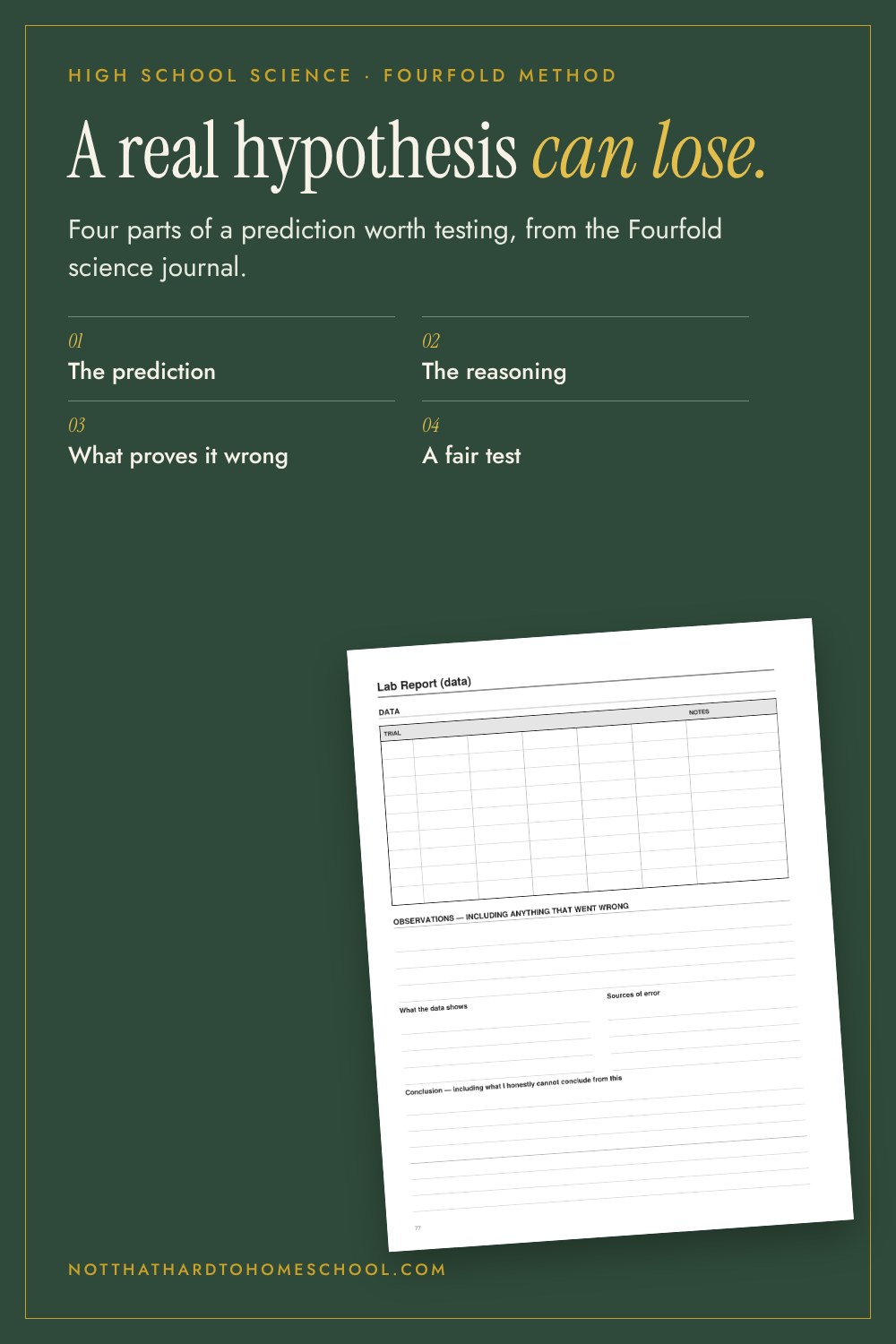
Save this to Pinterest for later.

Lisa Nehring and her husband, Dr. David Nehring, a Clinical Psychologist, and Biblical Scholar speak together on a wide variety of topics, including education, classical education, vision, mission, parenting, marriage, and more.
New here? Start with our free guide, The Fourfold Method: A Guide for Homeschool Families. Four simple moves that help your children keep what they learn, in every subject and at every age.
- What Would Prove You Wrong? The Test Step for High School Science - November 8, 2026
- Why Then, and Says Who? The Test Step for High School History - November 7, 2026
- Are You Convinced? The Test Step for High School Literature - November 6, 2026


