
Breaking Open the Fourfold Method · Literature · Step 1 of 4
This post contains affiliate links. If you buy through them, It’s Not That Hard to Homeschool may earn a small commission at no extra cost to you.
Your teen finished the chapter. You ask what it was about, and you get a shrug and “some people went to a ball.” They read every word. They just didn’t come away with much.
Most of the time that isn’t a reading problem. It’s a gathering problem. Nobody asked them what they needed to know before the book could make sense: who wrote it, when, what kind of book it is, and what the strange words meant to the people who first read them.
The Literature journal in our Fourfold line opens every entry with exactly that question. It’s the first of the four moves in the Fourfold Method, and it’s called Gather.
This is the second post in our series opening up the Fourfold Method one step at a time, one subject at a time, using the actual pages students fill in. Today: high school literature, step one.
Free guide
Help your teen remember the books they read in March, not just the week they read them.
Our free guide walks you through all four moves (Gather, Test, Connect, Commit) and how they turn reading into something your student keeps. It works with any book on your shelf.
Get the free Fourfold guideWhat “Gather” means when your student is reading literature
The journal puts it this way: Gather is “everything you needed to know to read this well. The author, the period, the form, a word you looked up, a reference you did not catch the first time.” Then the important part: “Write down what you found and where you found it, including the things that are still unclear.”
In practice, that comes down to four kinds of gathering:
- The author. Who wrote this, and what was their life like when they did? A novel written by a twenty-something in a country parsonage reads differently once you know that.
- The period. What did the first readers take for granted that we don’t? Money, class, marriage, faith, law. Old books lean on all of it without explaining.
- The form. Is this a novel, a play, an epic poem, a sermon, a set of letters? The form tells you how to read it.
- The words and references. The word that didn’t mean then what it means now. The Bible verse or myth the author expected you to recognize.
Notice what’s missing from that list: what the book means. That comes later. Gather is about getting the reader ready, not about the big essay question.
What it looks like on the page
Every entry runs across two facing pages, Gather and Test on the left, Connect and Commit on the right. The Gather box asks: What did you need to know to read this well? Author, period, form, context, anything you looked up, and what is still unclear.
Here’s what a filled-in Gather box might look like for a student partway through Pride and Prejudice:

Look at the word this student flagged: condescension. Mr. Collins can’t stop praising Lady Catherine’s “condescension,” and a modern reader hears an insult. In Austen’s day it was a compliment. It meant a person of high rank being gracious to someone below them. Read it the modern way and you miss the joke entirely, which is that Mr. Collins is groveling.
The journal warns about exactly this: “You understand every sentence and miss the argument, because one word was carrying a meaning you did not know it had. Nothing announces the error. You simply come away with a different book than the one that was written.”
And look at the last line: “Still unclear: why is Mr. Bennet so calm about losing the house?” That’s not a weak entry. It’s the best line on the page, and it’s exactly what the next step, Test, will chew on.
More pages that do the gathering
Beyond the entry spreads, the Literature journal has pages built for this step.
1. Work Study
“One per major text. Fill in over the course of reading, not at the end.” The top of the page is pure Gather: title, author, published, form, period or movement, and what you’re reading it for. Then two boxes side by side: What happens and Context worth knowing.
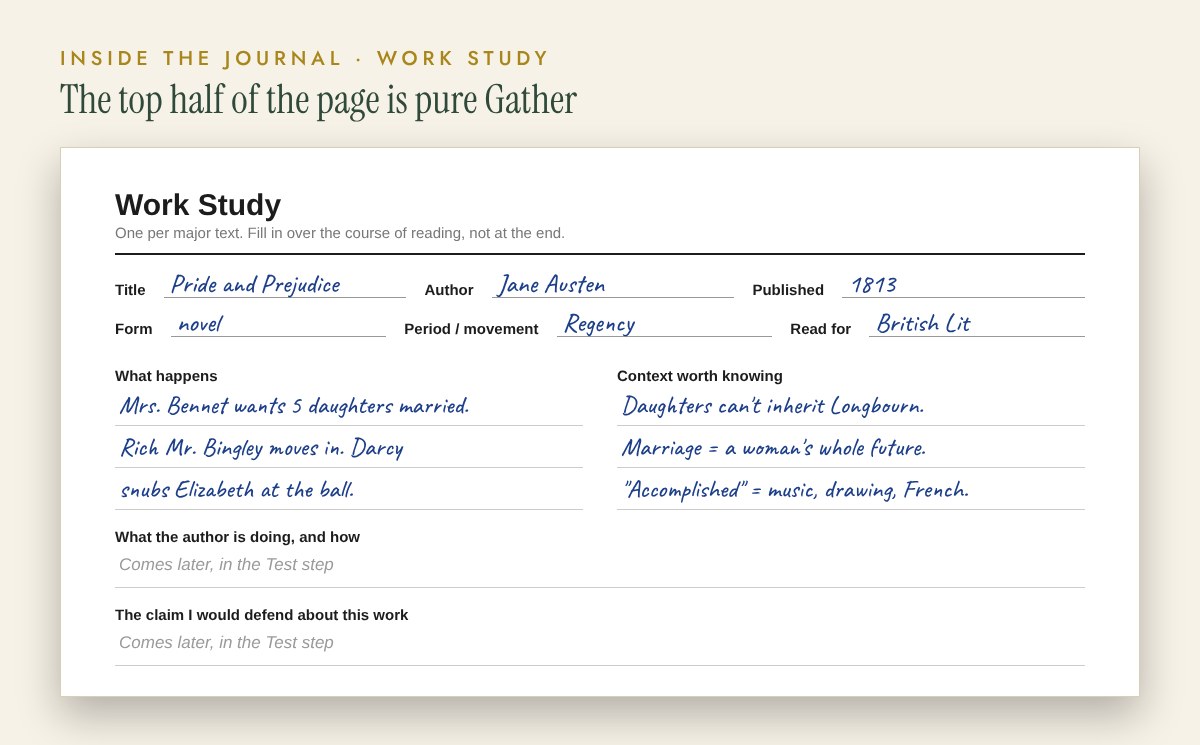
Those two boxes sitting next to each other is the point. Plot is what happened. Context is why it mattered to the people inside the story. A student who fills in both is reading the book the author actually wrote.
2. Literary Terms
“Write the definition in your own words, then an example from something you have actually read.” Not a glossary to memorize. A student who can point to the irony in chapter 14 owns the word irony in a way a flashcard never gives them.
3. Terms
Three columns: the term, my definition in my own words, and a sentence the author uses it in. Underneath, the journal gives the test: “If your definition does not hold in the author’s sentence, the definition is wrong.” This is where condescension and entail go.
4. Passages Worth Keeping
“Copy out the lines that stopped you, with the work, and why.” Copying a passage by hand is one of the oldest ways of reading closely. It forces your student to slow down to the speed of the sentence.
5. Works Read This Year
Every text, in order, with author, form, period, and dates. It’s a gathering page for the whole year, and as the journal notes, it “doubles as the reading list on your transcript.”
Gathering starts with the words
If you know Lisa’s 5 Common Topics, you’ll recognize this. The first topic is Definition, and in the Fourfold Method it lives right here in Gather. The journal puts it plainly: “Define the terms of the subject before anything else.”
“Start with definition, because definition is so great and it’s simple.”
Lisa Nehring, It’s Not That Hard to Homeschool podcast
Older books are full of words that have drifted. The journal gives a few: “Nice once meant precise. Want meant lack. Condescension was a virtue.” And in literature specifically, “romance, novel, and wit have all moved.”
That’s why a good critical edition is worth its price. The footnotes and background essays are a whole shelf of gathering done for you, and your student learns to check them instead of guessing.
How to help without hovering
- Ask for 15, not 5. If the Gather box is thin, ask for more. As Lisa puts it, “Anybody can come up with five. But when you start saying 15 to 20 to 30, you have to really start thinking very creatively.”
- Read the introduction second, not first. Let your student meet the book, then read the editor’s introduction and gather what they missed. They’ll notice more, and they’ll know what questions they actually have.
- Talk about it anywhere. Lisa says you can do this even with a movie: “Let’s define what we were talking about, or what is the relationship to this person or that person?”
- Don’t grade the Gather box. The journal says it directly: “Nobody is grading the journal.” An entry that admits confusion is worth more than one that performs understanding.
- Keep it small. One chapter or one discussion per entry. Small and finished beats large and abandoned.
Resources for the Gather step
You don’t need any of these to use the journal. But if you want a small literature shelf that helps a high schooler gather well, start here.
- Pride and Prejudice (Norton Critical Edition). The novel plus footnotes, background documents, and essays. Norton Critical Editions exist for most of the classics your student will read, and they’re built for gathering.
- How to Read Literature Like a Professor by Thomas C. Foster. A friendly, funny guide to the patterns and references authors expect readers to catch. Teens actually enjoy this one.
- The Well-Educated Mind by Susan Wise Bauer. For you as much as your student. Annotated reading lists by form, with notes on what to look for in each.
- The Oxford Dictionary of Literary Terms. Short, clear definitions for the Literary Terms page, so your student has something better than a search result to argue with.
- Mead Composition Notebooks. When the Passages Worth Keeping pages fill up, a plain composition book becomes the overflow.
You’ll find more on our Amazon storefront, including our Good Clean Books for Tweens & Teens list.
Next up: Test
Gather gets your student ready to read. Test asks what the book is doing and whether it works. Next time we’ll open the Test box: finding the theme and the technique, and learning that disagreeing with a classic, in writing and with reasons, is real literary thinking.
From our shop
Every page in this post, ready to print
Literature: A Fourfold Study Journal for High School · $15
Twenty-six entry spreads, work studies for major texts, passages worth keeping, comparison and essay planning pages, and a course description page that goes straight onto the transcript. Works for American, British, or World Literature.
See what’s insideNext step
When your teen wants a book club with a teacher
True North Academy’s literature classes build the same habits of close reading and real discussion, with a teacher and classmates who have read the same book. Live online, accredited, and built for homeschool families.
Explore True North Academy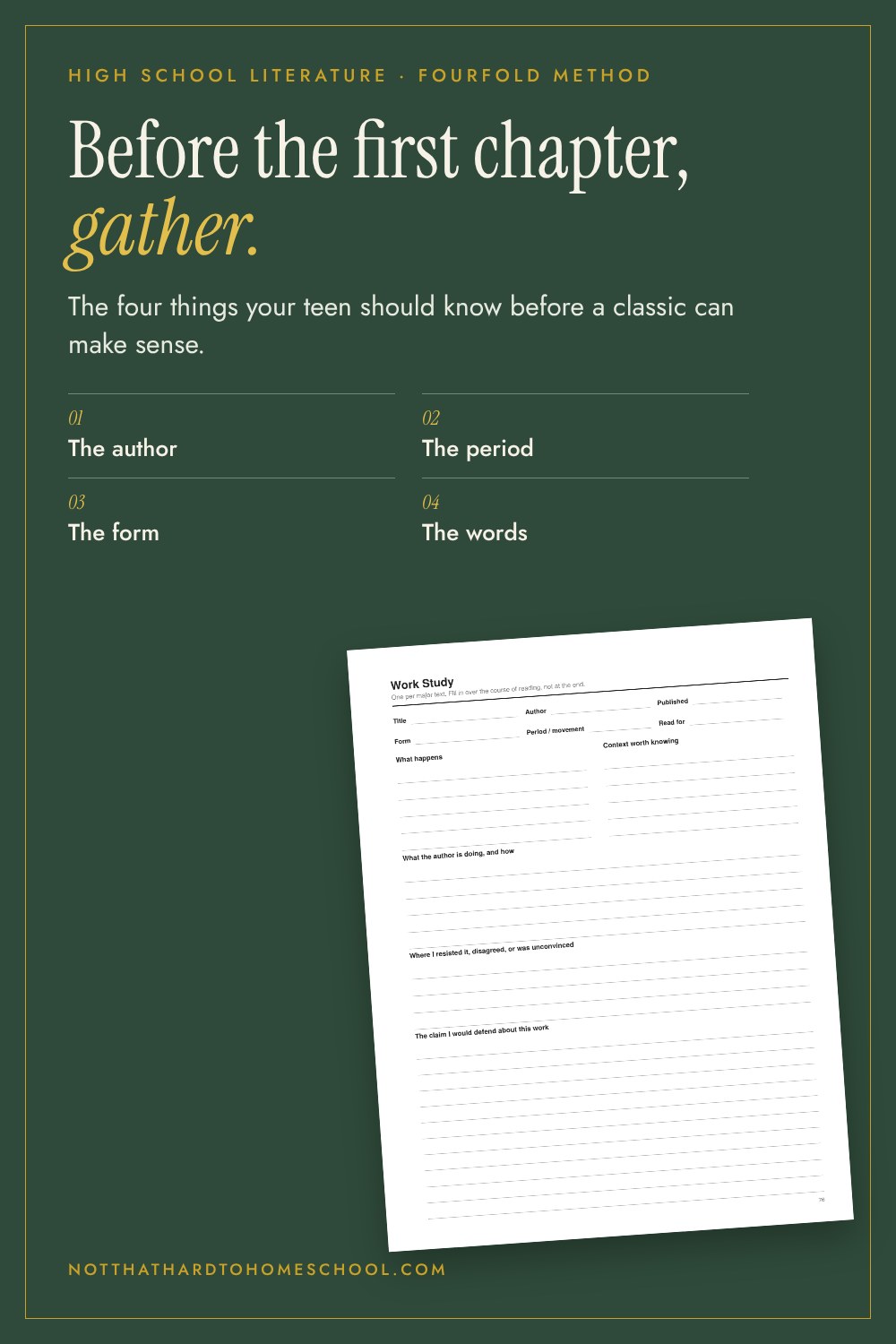
Save this to Pinterest for later.

Lisa Nehring and her husband, Dr. David Nehring, a Clinical Psychologist, and Biblical Scholar speak together on a wide variety of topics, including education, classical education, vision, mission, parenting, marriage, and more.
New here? Start with our free guide, The Fourfold Method: A Guide for Homeschool Families. Four simple moves that help your children keep what they learn, in every subject and at every age.
- The Snack Table, Ep. 1: I have four kids at four levels. How do I teach them all? - October 27, 2026
- Before the First Chapter: The Gather Step for High School Literature - October 27, 2026
- Where Good Writing Starts: The Gather Step for High School English - October 26, 2026


