
Breaking Open the Fourfold Method · English · Step 1 of 4
This post contains affiliate links. If you buy through them, It’s Not That Hard to Homeschool may earn a small commission at no extra cost to you.
“Go write an essay.” Most teenagers hear that, sit down, and stare at a blank page. Most of us assume the blank page is the problem. They need a better prompt, a tighter outline, a little more grit.
Usually the blank page isn’t the problem. The problem is that nobody asked them to collect anything before they started. They are trying to write out of an empty pantry.
The English journal in our Fourfold line says it plainly: “Good writing almost never starts from nothing. It starts from having read closely.” That’s the first of the four moves in the Fourfold Method, and it’s called Gather.
This post starts a new series. We’re opening up the Fourfold Method one step at a time, one subject at a time, using the actual pages students fill in. We’re starting with high school writing, and with step one.
Free guide
New to the Fourfold Method? Start here.
Our free guide walks you through all four moves (Gather, Test, Connect, Commit) and how they turn reading and writing into something your student keeps. It works in every subject, at every age.
Get the free Fourfold guideWhat “Gather” means when your student is writing
In most subjects, Gather means writing down what a source actually says. In writing, it means taking stock of what you’re working with before you write a single sentence of the draft. The journal names four things to gather:
- Purpose. What is this piece supposed to do? Persuade, explain, tell a story, ask for something? A student who can’t answer this will write a piece that wanders.
- Audience. Who will actually read it, and what do they already know and care about? This is the one teens skip most, because for years the only reader has been Mom with a red pen.
- Material. The facts, quotes, examples, and observations the piece will rest on, and where each one came from.
- Models. Pieces of writing that already do what your student is trying to do. A good writer reads like a carpenter looks at a well-built chair: how did they do that?
None of this is drafting. It’s the work that makes drafting possible.
What it looks like on the page
Every entry in the journal runs across two facing pages. Gather and Test sit on the left, Connect and Commit on the right, so the whole cycle is in front of your student at once. The Gather box asks one question: What are you working with? Purpose, audience, material gathered, and the models you are learning from.
Here’s what a filled-in Gather box might look like for a tenth grader writing a letter to the library board:

Look at the last line: “I don’t yet see what they would cut instead.” That isn’t a weak entry. It’s the most useful line on the page. The journal’s very first rule is do not wait until you understand something to start writing. Gather is where your student writes down what they found, including what confused them. That open question is exactly what the next step, Test, will chew on.
Four more pages that do the gathering
Beyond the entry spreads, the journal has pages built just for this step.
1. The Writing Project page
One per piece. Before any structure gets planned, your student fills in the title or prompt, the type of writing, the audience, the purpose, and the target length. It sounds simple. It also catches the essay that was going to be about “the Civil War” before it eats three weeks.
2. Studying a Model
This is the page we’d keep if we could only keep one. Your student picks a piece of writing they admire and takes it apart: what it does well, how it does it (sentence length, structure, word choice, what it withholds), and one technique they’re going to steal and where they’ll use it.
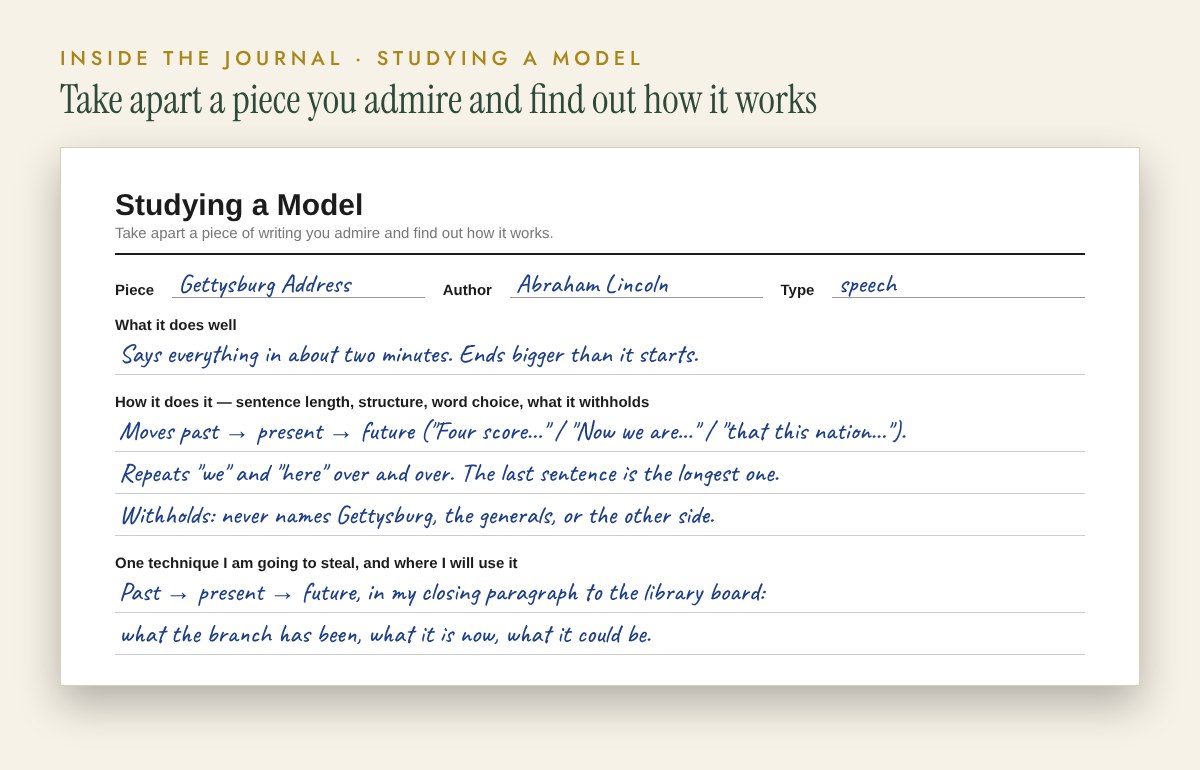
“What it withholds” is the question that wakes students up. Lincoln never names Gettysburg, the generals, or the other side. Once a student notices what a great writer left out, they start noticing what they can leave out too.
3. Terms
Three columns: the term, my definition in my own words, and a sentence the author uses it in. Underneath, the journal gives the test: “If your definition does not hold in the author’s sentence, the definition is wrong.”
4. Words Worth Having
Not a vocabulary list to memorize. These are words your student met in real reading and wants to use, with where they met it and a sentence of their own. Every writer has a word hoard. This is where it starts.
Gathering starts with the words
If you know Lisa’s 5 Common Topics, you’ll recognize this. The first topic is Definition, and in the Fourfold Method it lives right here in Gather. Before your student argues anything, they need to know exactly what their key words mean.
“Start with definition, because definition is so great and it’s simple.”
Lisa Nehring, It’s Not That Hard to Homeschool podcast
In the sample entry above, the student flagged “essential service.” The library board uses that phrase. If the student assumes they know what it means and they’re wrong, the whole letter argues past the board. Nothing will announce the mistake. The letter just won’t land.
For older American texts, Noah Webster’s 1828 dictionary is the closest in time to the language those writers used. It’s free online, and there’s a beautiful print facsimile in the resources below.
The oldest trick in the book
Benjamin Franklin taught himself to write this way. In his Autobiography, he describes taking essays from The Spectator, jotting short hints of what each sentence said, and setting them aside for a few days. Then, without looking, he rewrote the essay in his own words and compared his version to the original to find his faults.
He even turned some of the essays into verse and, once he’d forgotten the prose, turned them back, just to build a bigger stock of words to choose from.
That’s Gather (the hints), Test (the comparison), and Commit (the rewrite), about three hundred years before anyone named the moves. The “Studying a Model” page is a gentler version of the same exercise.
How to help without hovering
- Ask for 15, not 5. If the Gather box looks thin, ask for more material. As Lisa puts it, “Anybody can come up with five. But when you start saying 15 to 20 to 30, you have to really start thinking very creatively.”
- Ask “Who is this for?” first. Before purpose, before material. The answer changes everything else.
- Let them pick models they actually like. A sports column, a favorite novelist, a sermon, a speech. A model they admire teaches more than one they were assigned.
- Don’t grade the Gather box. The journal says it directly: “Nobody is grading the journal.” An entry that admits confusion is worth more than one that performs understanding.
- Keep it small. One piece, one model, one revision session per entry. Small and finished beats large and abandoned.
Resources for the Gather step
You don’t need any of these to use the journal. But if you want to build a small writing shelf, these are the books that help a high schooler gather well.
- “They Say / I Say” (High School Edition) by Gerald Graff and Cathy Birkenstein. The best book we know for teaching students to summarize what others have said before they make their own argument. That’s Gather and Authority in one move.
- 50 Essays: A Portable Anthology edited by Samuel Cohen. A whole year of models for the Studying a Model pages, all in one inexpensive paperback.
- The Autobiography of Benjamin Franklin (Dover Thrift). Read the passage on how he learned to write with your student, then try his method together.
- Webster’s 1828 American Dictionary of the English Language (Facsimile). For the Terms page, especially when your student is reading or writing about early American texts.
- How to Read a Book by Mortimer Adler. For you more than for them. It’s the classic on reading closely, which is where all good gathering starts.
- Post-it Flags. Cheap, simple, and the easiest way to mark the passages a piece of writing will rest on.
You’ll find more on our Amazon storefront, including our Commonplace Books and Journaling Supplies list.
Next up: Test
Gather tells your student what they have. Test asks whether it holds up. Next time we’ll open the Test box: how to state a claim in one sentence, check whether the structure actually supports it, and answer the reader who disagrees.
From our shop
Every page in this post, ready to print
English: A Fourfold Writing Journal for High School · $15
Twenty-six entry spreads, writing project pages, revision logs, feedback pages, model studies, and a course description page that goes straight onto the transcript.
See what’s insideNext step
When your teen wants a teacher, too
True North Academy’s classes build the same habits of deep reading and careful writing, with a teacher who reads every draft. Live online, accredited, and built for homeschool families.
Explore True North Academy
Save this to Pinterest for later.

Lisa Nehring and her husband, Dr. David Nehring, a Clinical Psychologist, and Biblical Scholar speak together on a wide variety of topics, including education, classical education, vision, mission, parenting, marriage, and more.
New here? Start with our free guide, The Fourfold Method: A Guide for Homeschool Families. Four simple moves that help your children keep what they learn, in every subject and at every age.
- Where Good Writing Starts: The Gather Step for High School English - October 26, 2026
- The Economics of Christmas: A Holiday Economics Study for Teens - October 14, 2026
- Homesteading as a High School Course: A Fourfold Study - October 14, 2026


