
In 1939, a department store needed a cheap Christmas giveaway.
Montgomery Ward had been buying coloring books to hand out to shoppers every December, and someone decided it would cost less to write their own. A copywriter named Robert L. May wrote a story about a reindeer with a glowing nose. The store gave away 2.4 million copies that first year. Rudolph was a marketing project before he was a song.
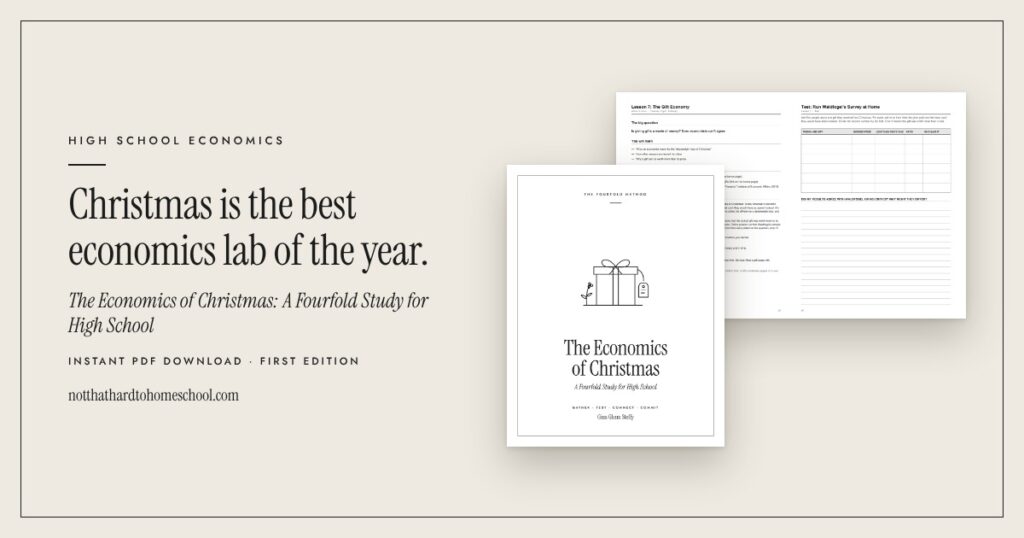
That is the kind of thing The Economics of Christmas: A Fourfold Study for High School teaches teens to notice. Built from Lisa Nehring’s holiday economics unit study, it uses the busiest shopping season of the year as a twelve-lesson economics lab: who decided what Christmas looks like, how a gift crosses an ocean, who works so everyone else can celebrate, and whether giving presents is a waste of money.
The four moves, at Christmas
The Fourfold Method fits economics because economics is full of things everyone “knows” that turn out to be wrong.
- Gather: Record the numbers and where they came from. A price tag, a label, a survey, a shop owner’s answer.
- Test: Check a claim against real evidence. Did Coca-Cola really make Santa red? (It didn’t.) Is shopping local always more expensive?
- Connect: Tie it to your family’s budget, your town and history, guided by one of Lisa’s 5 Common Topics.
- Commit: Put it in your own words, then use it. A holiday budget you actually keep is a finished Commit.
Even economists disagree
In 1993, the economist Joel Waldfogel argued that Christmas gifts destroy value, because they are usually worth less to the people who get them than they cost. Other researchers tested his claim and got the opposite answer. In Lesson 7, your student runs Waldfogel’s survey at home, reads O. Henry’s “The Gift of the Magi,” and decides who is right.
What’s inside
- 12 lessons, about six weeks: marketing, supply chains, holiday jobs, budgets, the feast, the gift economy, local business, digital marketing, why we buy, waste, and what wealth really is
- A real investigation in every lesson, using real prices, real labels and real people
- Free readings only, including A Christmas Carol, “I, Pencil” and the PNC Christmas Price Index, plus It’s a Wonderful Life
- Lisa’s hands-on activity, holiday tradition and service idea for every lesson
- A capstone: a holiday budget, a gift plan, a service project and next year’s Christmas Club savings plan
108 printable pages, 8.5 by 11, black and white for a home printer. About 40 hours, which most families count as a parent-awarded 1/4 credit in economics. Start in mid-November and you finish by Christmas. It pairs with The December Homeschool, which covers the history of the American Christmas.
This is a first edition, and your feedback shapes the next one. Every purchase includes free updates to future editions.
Get The Economics of Christmas: A Fourfold Study for High School
Gina Glenn Steffy

Lisa Nehring and her husband, Dr. David Nehring, a Clinical Psychologist, and Biblical Scholar speak together on a wide variety of topics, including education, classical education, vision, mission, parenting, marriage, and more.
- The Economics of Christmas: A Holiday Economics Study for Teens - October 14, 2026
- Homesteading as a High School Course: A Fourfold Study - October 14, 2026
- The Not That Hard to Homeschool Booklist: Every Book in Our Guides - October 9, 2026


