

Your student can summarize a book perfectly and remember nothing of it a month later.
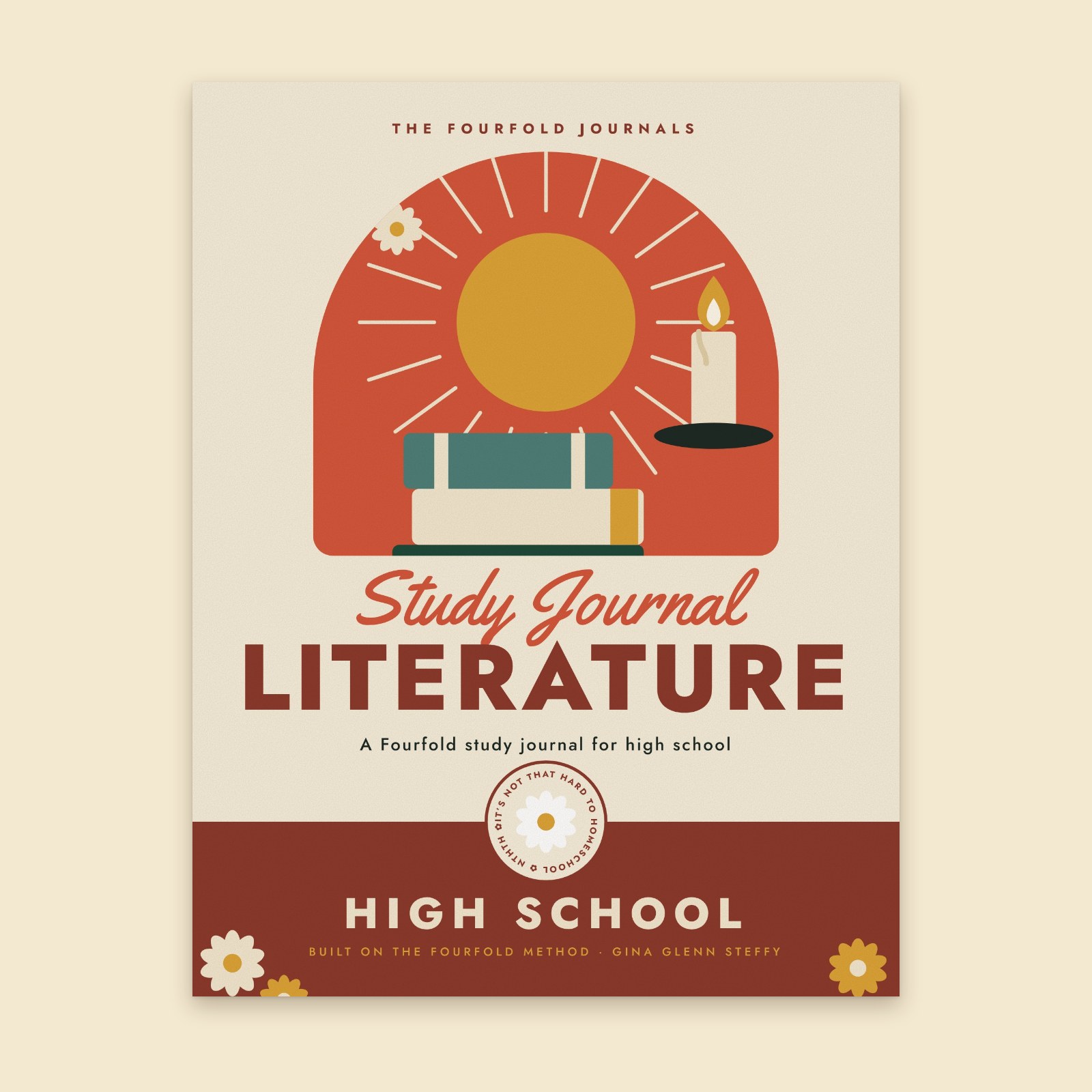
That isn’t a comprehension problem. Understanding something once and keeping it are different acts, and school almost never asks for the second one. Literature: A Fourfold Study Journal asks for it, with every book your teen reads this year.
It works for American, British, or World Literature. Your student writes in their own course title, texts, and units.
Is this a good fit for your family?
- Yes, if your teen finishes books but can’t tell you anything about them a month later.
- Yes, if you want literary analysis and essay planning without buying a guide for every book.
- Yes, if you need a works-read log, hours, and a course description for literature on the transcript.
- Yes, if you want a faith-neutral tool that fits your own reading list and worldview.
- Maybe not, if you want a guide to one specific book, with questions and answers. This journal works with any book on your list.
By the end, your student will be able to
- Gather what a text says, including what the words meant to the author
- Test an interpretation against the text
- Compare two works, which is where literary thinking actually happens
- Collect and explain key passages
- Plan a literary essay from their own notes
What a week looks like
Most students use it alongside the literature course they already have, one or two entries a week:
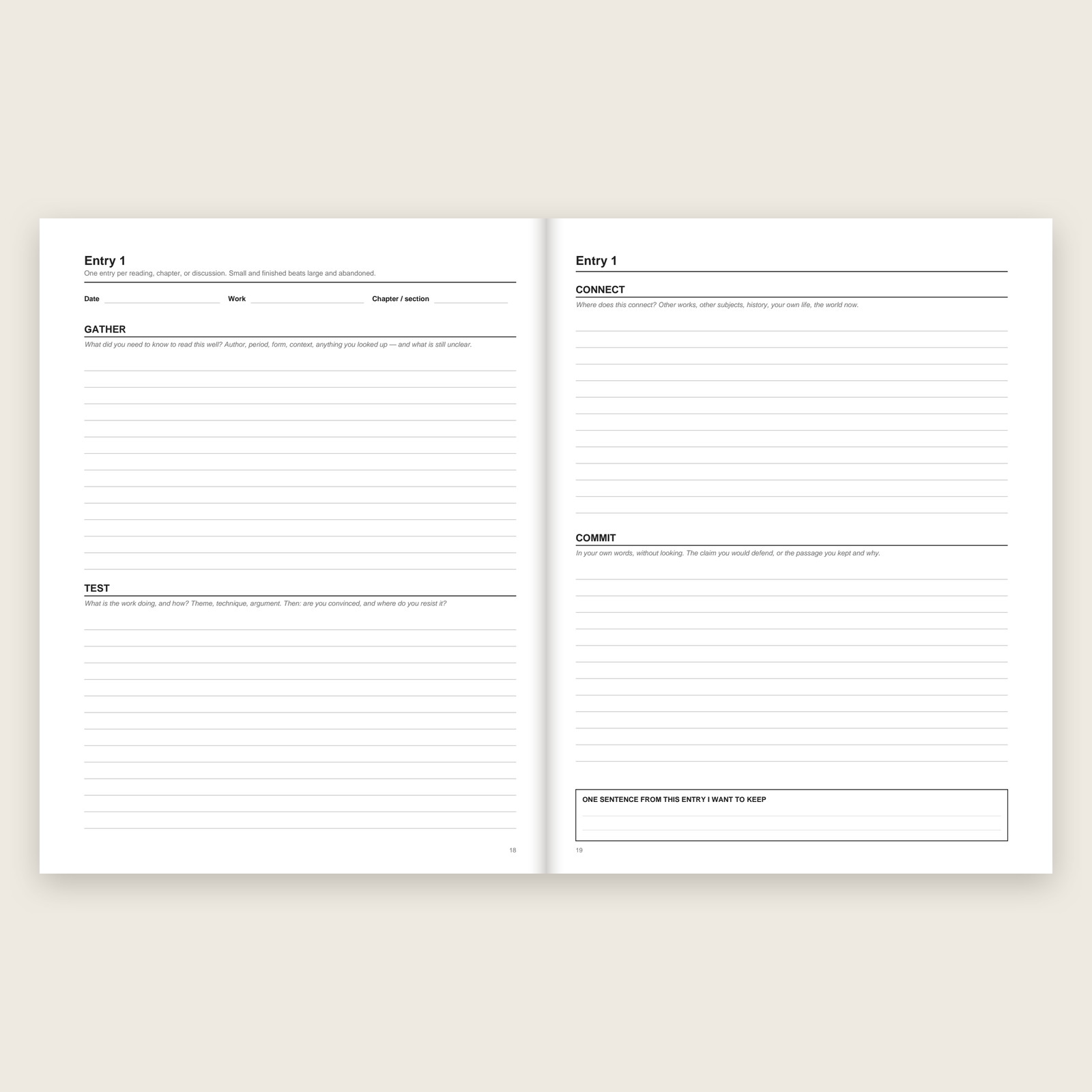
- While reading: A two-page entry spread: Gather and Test facing Connect and Commit.
- For a major book: A Work Study spread and passage collection pages.
- Between books: A comparison spread.
- Before an essay: An essay planning page built from their own entries.
Over a school year that’s 26 entry spreads, plus the special pages for the moments that need them.
What you’ll need
- This PDF and a printer (black and white is fine)
- Your reading list
What’s inside
- The method explained, with a signed note from the author
- Vocabulary pages, because reading begins with knowing what the words meant to the author
- Course map, materials, grades, and an hours log
- Works read log and literary terms
- Twenty-six two-page entry spreads
- Six Work Study spreads for major texts
- Six passage collection pages
- Three comparison spreads
- Four essay planning pages
- An index of entries, Looking Back pages, and a course description page that feeds straight onto a transcript
- A separate 22-page Parent Guide with step-by-step coaching, answer samples and writing instruction for every part of the journal
Includes a Parent Guide
Every purchase comes with a 22-page Parent Guide, a separate PDF written for you, not your student. It walks you through the journal week by week, so you always know what to prepare, what to ask and what a good answer sounds like.
- Before you start: a short prep checklist and an opening line you can read aloud.
- Step by step: how to help with Gather, Test, Connect and Commit, with check-in questions and what to listen for.
- What good work looks like: sample strong answers, and the most common stumbling point to watch for.
- A 36-week plan, what every page is for, and a full sample entry on Pride and Prejudice to show your student.
Writing is built in
Every entry ends with Commit, a claim about the book in your student’s own words, and the Essay Planning pages lead to formal literary essays. The Parent Guide shows you how to coach it: what writing looks like in this course, sentence starters, a year-long plan that practices one writing skill every three weeks, how to respond to your student’s work, and a simple rubric. You don’t have to be a writing teacher.
See inside the Parent Guide (free sample) →
Why the Fourfold Method works
Most schoolwork stops at reading the chapter and answering the questions. The Fourfold Method keeps going. Your student gathers what the source says, tests it against evidence, connects it to what they already know, and commits it in their own words. It’s the difference between “I read Pride and Prejudice” and “Elizabeth and Darcy are both wrong about each other, and here’s the passage that proves it.”
Questions moms ask
Do I need to know how to teach writing?
No. The writing is built into every entry, and the Parent Guide shows you how to coach it: what to expect at each level, sentence starters, what a helpful note sounds like and a simple rubric.
Does it replace my literature curriculum?
No. It works with any literature course, textbook, or reading list. Your student writes in their own course title, texts, and units.
How much time does it take?
One or two entries a week, usually 30–45 minutes each, as part of the work your student is already doing.
What faith perspective does it take?
It’s faith-neutral by design, so it fits whatever reading list and worldview your family brings to it.
Can more than one teen use it?
Yes. Print one journal per student, per course, per year. Your family license covers every student in your household.
Who wrote it?
Gina Steffy, creator of the Fourfold Method, who homeschooled her four children from kindergarten through graduation.
What you receive
- A printable PDF, 106 pages including the cover, 8.5 × 11 inches, designed to print clearly in black and white on a home printer.
- Parent pages on how learning works in layers, including how the Fourfold Method fits with Lisa Nehring’s 5 Common Topics.
- A family license: print as many copies as your household needs, for every child, every year.
- Your file is available only from the download page. It is not sent through a link in your order confirmation email, so please download it from the download page.
A first edition, shaped by the families who use it
This is a first edition, and we would love your help making the next one better. If a page is unclear, something is missing, or an idea would work better at your table, please tell us. Every purchase includes free updates. When a new edition is released, you will receive it at no additional cost.
Looking for something else?
Everything in our shop is an instant, printable download, with a family license and free updates.
Curriculum · Fourfold Studies · Bundles · Getting Started · High School Records · Browse the whole shop →
Ready for the next step?
Continue with Junior High & High School Study Skills, a self-paced course from True North Academy that helps teens build the study habits that make independent work stick.
Join Gina for a quick look inside




Reviews
There are no reviews yet.