
When a student hands you a finished essay, you see the one thing that tells you least about how they write: the result.
You do not see the paragraph they cut, the argument they abandoned, or the sentence they rewrote six times. And neither do they, a month later. So the next essay starts from scratch, and the same problems turn up again in new clothes.
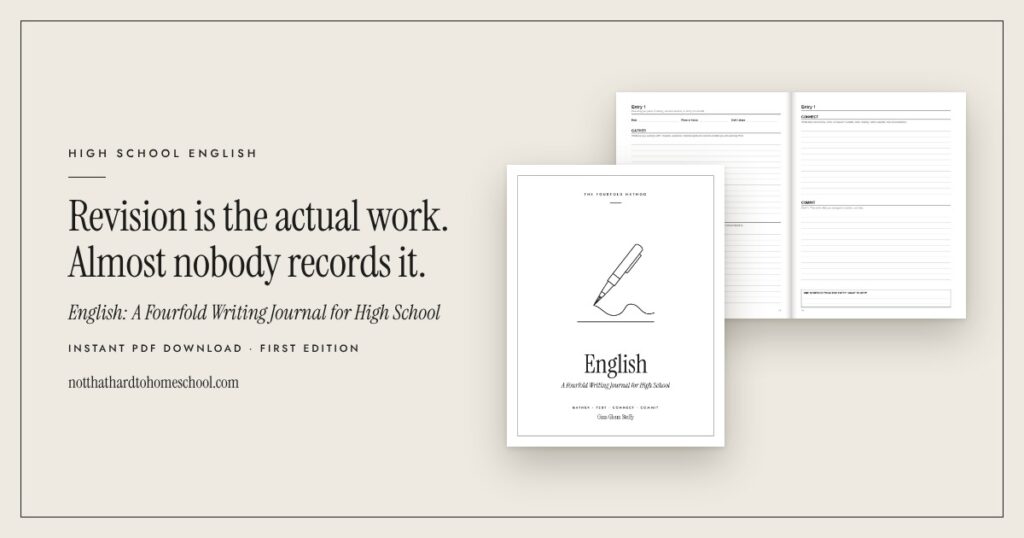
The English journal keeps a record of the process. That record is more valuable than any single finished piece, because it is the only place a writer’s process is visible.
The four moves, applied to writing
The Fourfold Method (The Fourfold Method) works on writing as well as reading.
- Gather: Purpose, audience, and models. Who is this for, what should it do, and what has someone else written that does it well?
- Test: Does the argument hold? What would a skeptical reader object to, and where?
- Connect: What does this piece borrow from, and what is it answering?
- Commit: The draft, and then a plain record of what changed in revision and why.
That last part is where most students grow. A revision log asks three questions: what changed, why, and was it actually better? Sometimes the honest answer is no, and that is worth knowing too.
Feedback, including the feedback you disagreed with
There are four feedback pages in the journal, and one of the prompts asks for feedback your student disagreed with. Writing down why you rejected a suggestion is a skill. It is also the difference between a writer with a voice and a writer who changes whatever they are told to change.
What’s inside
- The method explained, with a signed note from me
- Vocabulary pages for words met in real reading
- Course map, materials, grades, and an hours log
- A writing project log
- Twenty-six two-page entry spreads
- Eight writing project spreads, with structure and objection planning
- Six revision logs: what changed, why, and whether it was better
- Four feedback pages
- Four model studies, for taking apart writing you admire
- A rhetoric and technique reference, and a recurring-problems page
- An index of entries and Looking Back pages
- A course description page for your transcript
The recurring-problems page
Every writer has two or three habits that show up in every draft. A comma splice they cannot see. An opening paragraph that always clears its throat. A conclusion that repeats the introduction. The recurring-problems page is where your student names theirs, so they can look for them on purpose instead of having you circle them every time.
Get the journal
106 printable pages, 8.5 by 11, black and white for a home printer. It works alongside any English or composition course. Your family license covers every student in your household, every year.
This is a first edition. If something is missing for your student, tell us, and we will build the best suggestions into the next edition. Every purchase includes free updates to future editions.
Get English: A Fourfold Writing Journal for High School
Gina Glenn Steffy

Lisa Nehring and her husband, Dr. David Nehring, a Clinical Psychologist, and Biblical Scholar speak together on a wide variety of topics, including education, classical education, vision, mission, parenting, marriage, and more.
- The Not That Hard to Homeschool Booklist: Every Book in Our Guides - October 9, 2026
- Just Started Homeschooling? What to Do in Your First 30 Days - October 9, 2026
- Homeschool Portfolio and Evaluation Log: Gather the Evidence as the Year Happens - October 9, 2026


