
A student who is told a date forgets it by February. A student who found it out, and knows where they found it, keeps it.
Most high school history is told. Read the chapter, answer the questions, take the test. The facts arrive pre-sorted, with no seams showing, and they leave the same way. History is not a list of things that happened. It is an argument about what happened, built out of sources, and every source was written by somebody with a position.
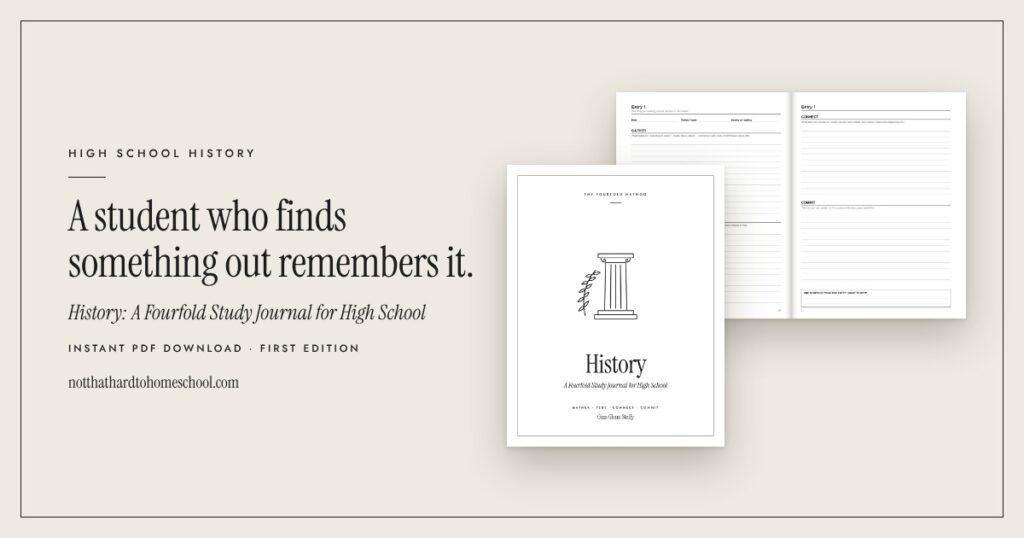
The History journal is built to make your student do history rather than receive it.
The four moves, in history
Every entry runs the Fourfold Method (The Fourfold Method).
- Gather: What happened, and according to whom? Names, dates, places, and the source each fact came from. Recording where you learned something is the habit that separates history from a collection of claims.
- Test: Why did it happen, and why then? What does this source leave out, and who benefited from telling it this way?
- Connect: Earlier causes, later consequences, the same pattern somewhere else, an argument happening right now.
- Commit: Tell it in your own words, as if to someone who has never heard of it. The places you stall are the places you do not yet understand.
The move most history courses skip is Gather, done properly. “Look it up” is not an instruction. It assumes a student already knows how. Teaching where to look, and to write down where you looked, is most of what history teaches.
Words had specific meanings
Republic, commonwealth, and liberty each meant something specific to the people using them, and the specifics are the history. The journal opens with vocabulary pages so your student defines those words the way the period did, not the way the evening news does.
What’s inside
- The method explained, with a signed note from me
- Vocabulary pages
- Course map, sources, grades, and an hours log
- A period overview and four timeline pages
- Twenty-six two-page entry spreads
- Eight primary source analysis pages: who wrote it, what they wanted, and what it can be trusted for
- Five cause-and-effect spreads
- Four competing accounts spreads, for sources that disagree
- Person studies and three map pages
- An index of entries and Looking Back pages
- A course description page for your transcript
Works with any history course
American history, world history, a classical cycle, a period you are building yourself: your student writes in their own period, texts, and units. The journal does not replace your curriculum. It is what your student does with the curriculum once it is in front of them.
If you want a second book for keeping sources and arguments across years, the Commonplace Book for History pairs with it well: The Commonplace Book for History.
Get the journal
108 printable pages, 8.5 by 11, black and white for a home printer. Your family license covers every student in your household, every year.
This is a first edition, and we would love your help shaping the next one. Tell us what works and what does not. Every purchase includes free updates to future editions.
Get History: A Fourfold Study Journal for High School
Gina Glenn Steffy

Lisa Nehring and her husband, Dr. David Nehring, a Clinical Psychologist, and Biblical Scholar speak together on a wide variety of topics, including education, classical education, vision, mission, parenting, marriage, and more.
- The Not That Hard to Homeschool Booklist: Every Book in Our Guides - October 9, 2026
- Just Started Homeschooling? What to Do in Your First 30 Days - October 9, 2026
- Homeschool Portfolio and Evaluation Log: Gather the Evidence as the Year Happens - October 9, 2026


