
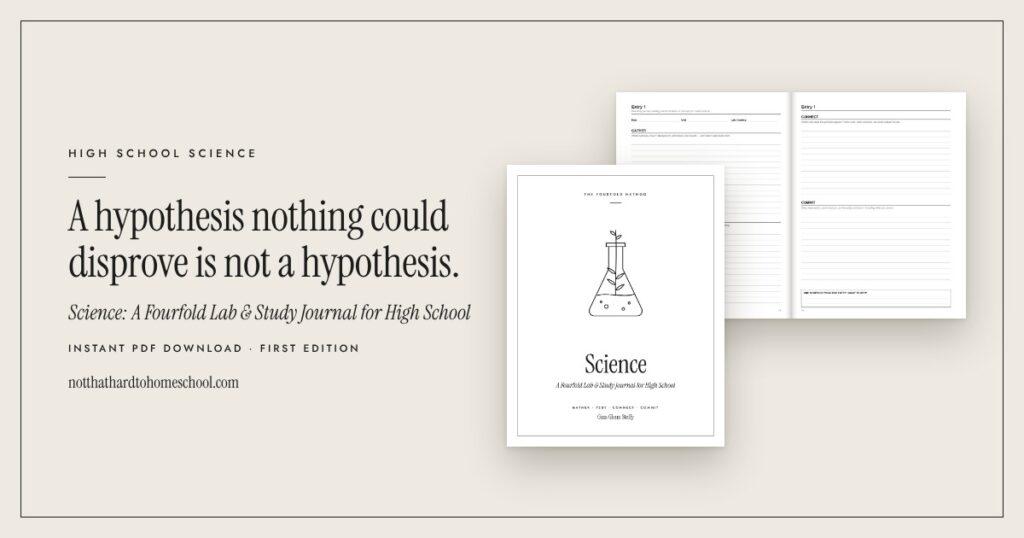
Children learn very fast that adults want the experiment to work.
So they make it work. The data gets a little tidier on the way to the page. The prediction gets written after the result. The failed trial quietly disappears. None of this is dishonest in a way they would recognize. It is just what school taught them a lab report is for.
The Science journal teaches the opposite. Recording an experiment that failed, and why you think it failed, is better science than recording only the ones that worked.
The four moves, in science
The Fourfold Method (The Fourfold Method) is already half-familiar to anyone who knows the scientific method. What it adds is the part between the lab and the test.
- Gather: What is already known, and how do we know it? Background, definitions, prior results, and the source of each.
- Test: What do you predict, and why? Then the question most students never answer: what result would prove you wrong?
- Connect: Where else does this principle show up? Another unit, another science, the kitchen. A law usually appears in three places before anyone notices it is the same law.
- Commit: Data, observations, and what you can honestly conclude, including what you cannot.
That last phrase matters. “It doubled in an hour at room temperature. I only tested it once, so I cannot say that is typical.” The second sentence is the scientific part.
Science has its own vocabulary
In science, theory means nearly the opposite of what it means in conversation, and most public arguments about science are arguments about that one word. The journal opens with vocabulary pages and a formulas page that asks your student to write what each symbol actually means, not just the formula.
What’s inside
- The method explained, with a signed note from me
- Vocabulary pages, plus formulas with what each symbol means
- Course map, materials, grades, and an hours log
- Twenty-six two-page entry spreads
- Nine full two-page lab reports: question, background, hypothesis and reasoning, method, data, observations, sources of error, and conclusion
- Four long-run observation logs
- Four graphing grids, because plotting by hand shows you things a table hides
- Four concept study pages for ideas that are not labs
- A running page of questions you cannot yet answer
- An index of entries and Looking Back pages
- A course description page for your transcript
Questions you cannot yet answer
My favorite page in the journal is the running list of questions your student cannot yet answer. It grows all year. Some get answered in a later unit. Some never do. A student who keeps that list is learning the most important thing science teaches: what we do not know yet is the interesting part.
Get the journal
112 printable pages, 8.5 by 11, black and white for a home printer. Biology, chemistry, physics, earth science: it works with any course. Your family license covers every student in your household, every year.
This is a first edition, and your feedback shapes the next one. Every purchase includes free updates to future editions.
Get Science: A Fourfold Lab & Study Journal for High School
Gina Glenn Steffy

Lisa Nehring and her husband, Dr. David Nehring, a Clinical Psychologist, and Biblical Scholar speak together on a wide variety of topics, including education, classical education, vision, mission, parenting, marriage, and more.
New here? Start with our free guide, The Fourfold Method: A Guide for Homeschool Families. Four simple moves that help your children keep what they learn, in every subject and at every age.
- What Can You Honestly Conclude? The Commit Step for High School Science - November 28, 2026
- Tell It to Someone Who Has Never Heard It: The Commit Step for High School History - November 27, 2026
- Say It Without the Book: The Commit Step for High School Literature - November 26, 2026


