
Ask your student where they learned something, and most of the time the honest answer is “I don’t know. Somewhere.”
That is how most of us carry history around: as a pile of claims with the labels torn off. We cannot say who wrote them, what that person wanted, or whether anyone disagreed. History taught that way is not really history. It is a list of things someone told us.
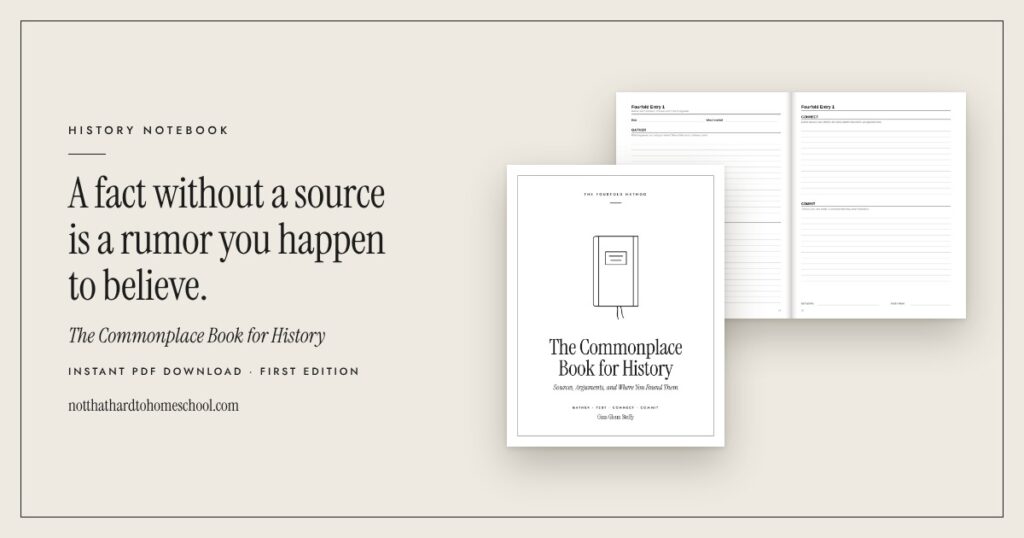
History is an argument about what happened, built out of documents, and every document was made by somebody who wanted something. The Commonplace Book for History is where your student keeps the documents, the arguments, and always where each one came from.
An old habit that still works
Commonplace books are one of the oldest study tools there is. Milton kept one. Jefferson kept three. In 1706 John Locke published his method for indexing one, because he had gathered so much he could no longer find any of it.
Locke’s index is at the back of this book, and it still works. It lets a student find any entry by topic in seconds, years later, without the book ever being organized in advance.
What your student does in it
The book is built around a few kinds of page, each used again and again.
- Source pages. What the document says, who made it, and what it can be trusted for. That last question is the one that changes how a student reads.
- Accounts That Disagree. Two sources on one event, side by side. Where do they differ, and why might that be?
- Argument pages. A claim, the evidence with citations, and an answer to the best objection.
- Fourfold Entry spreads. For a period, a question, or a hard chapter, run through Gather, Test, Connect, and Commit (The Fourfold Method).
What’s inside
- What a commonplace book is, and the long pattern of keeping one
- The four moves of the Fourfold Method, applied to history
- Reading a Source: four questions to ask of every document
- Twenty-four Source pages
- Six Accounts That Disagree spreads
- Six Argument pages
- Six two-page Fourfold Entry spreads
- A running timeline, People pages, and Words of the Period
- Open ruled pages throughout, a Sources I Have Used list, and Locke’s index at the back
How to use it
It works alongside any history curriculum, or as the backbone of a history course you build yourself. A simple rhythm: one Source page a week, one Accounts That Disagree spread a month, and an Argument page at the end of each unit. Use the open ruled pages for whatever does not fit anywhere else. That is what a commonplace book is for.
It pairs well with the History journal, if you want one book for the course and one for the sources: History: A Fourfold Study Journal.
Get the book
100 printable pages, 8.5 by 11, black and white for a home printer. Your family license covers every student in your household, every year.
This is a first edition. Tell us what your student needed and did not find, and we will build the best suggestions into the next edition. Every purchase includes free updates to future editions.
Get The Commonplace Book for History
Gina Glenn Steffy

Lisa Nehring and her husband, Dr. David Nehring, a Clinical Psychologist, and Biblical Scholar speak together on a wide variety of topics, including education, classical education, vision, mission, parenting, marriage, and more.
New here? Start with our free guide, The Fourfold Method: A Guide for Homeschool Families. Four simple moves that help your children keep what they learn, in every subject and at every age.
- The Snack Table, Ep. 5: If I don’t give tests, how do I know they learned anything? - November 3, 2026
- The Snack Table, Ep. 3: Do I really need a separate curriculum for every subject? - November 3, 2026
- Before You Plant It, Can It, or Build It: The Gather Step for Homeschool Homesteading - November 2, 2026


