Here is the most useful writing assignment I know: write down how to make something, hand it to a person who has never made it, and do not help.
Watch where they stop. Watch where they frown, or reach for the wrong bowl, or ask “how much is a little?” Every one of those moments is a sentence that failed. No red pen required. The reader found it.
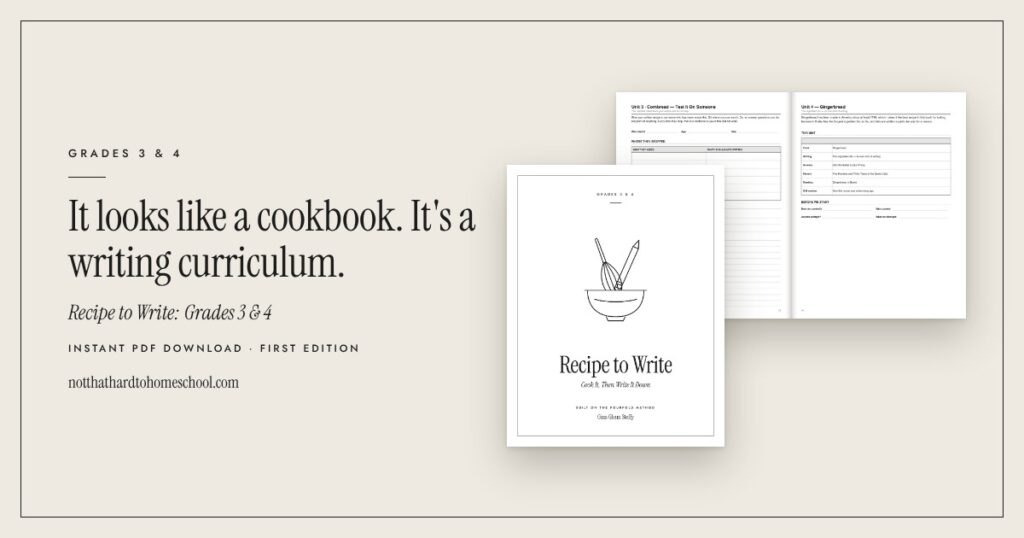
That is the whole idea behind Recipe to Write. A recipe is the most testable writing there is. An essay can be vague and still pass. A recipe cannot.
Test It On Someone
Every unit has a page called Test It On Someone. Your child hands their written recipe to a real person, a sibling, a grandparent, you, and watches them follow it without help. Then they write down where the reader got stuck and what they should have written instead.
This does something no grammar workbook can. It makes your child care whether their writing is clear, because they just watched someone struggle with it.
A writing ladder across six units
Each unit adds one skill, in an order that builds:
- Sequence. Pancakes. First, next, then.
- Exact amounts. Drop cookies. “Some sugar” is not an amount.
- Describing doneness. Cornbread. How do you know it is ready? Golden at the edges, a toothpick comes out clean.
- The ingredient list as its own form. Gingerbread, the longest list in the book.
- Writing about waiting. Bread. How do you tell someone to wait for something they cannot see happening?
- “To taste.” Soup. The hardest instruction in cooking, and the last unit for that reason.
More than writing
Every unit has a science page (why does the batter look wrong before it looks right?), a history page, and a reading list. Your child also sees how the same recipe was written a century or more ago, which is a lesson in itself about how much old recipes assumed the reader already knew.
The four moves of the Fourfold Method (The Fourfold Method) appear here on facing pages as Gather, Measure, Fold In, Serve.
What’s inside
- Six units: pancakes, drop cookies, cornbread, gingerbread, bread, and soup
- A science page, history page, and reading list in every unit
- How the same recipe was written a century or more ago
- Vocabulary pages, because writing begins with the right words
- Gather, Measure, Fold In, Serve on facing pages
- A Test It On Someone page in every unit
- A page for you in every unit, written to the parent
- A recipe section in larger type, plus three variants that each change one thing
Cook together across ages
The same six recipes run through all five Recipe to Write volumes, from K–2 to high school. Siblings can cook together and each write at their own level.
Get Recipe to Write 3–4
106 printable pages, 8.5 by 11, black and white for a home printer. Your family license covers every child in your household, every year.
This is a first edition, and we want to hear how it goes in your kitchen. Every purchase includes free updates to future editions.
Get Recipe to Write: Grades 3 & 4
Gina Glenn Steffy
Pair it with
Night Zookeeper: writing practice that feels like a game
Recipe to Write gives your child real lessons at the kitchen table. Night Zookeeper keeps the pencil moving between them. Kids write stories, poems and reports inside an online world they help build, and a real tutor sends written feedback on their work, so you don’t have to be the bad guy. It covers reading, writing, spelling, grammar and punctuation for Grades 1 to 6, and there’s a free trial so you can see if your child takes to it.
This box contains an affiliate link. If you sign up through it, It’s Not That Hard to Homeschool may earn a small commission at no extra cost to you.

Lisa Nehring and her husband, Dr. David Nehring, a Clinical Psychologist, and Biblical Scholar speak together on a wide variety of topics, including education, classical education, vision, mission, parenting, marriage, and more.
- The Economics of Christmas: A Holiday Economics Study for Teens - October 14, 2026
- Homesteading as a High School Course: A Fourfold Study - October 14, 2026
- The Not That Hard to Homeschool Booklist: Every Book in Our Guides - October 9, 2026


