
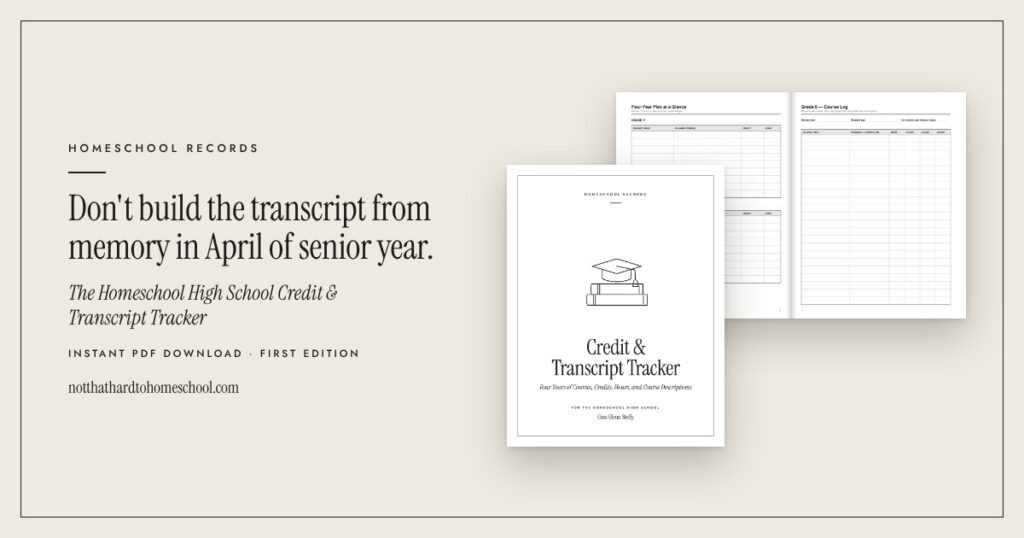
The hardest homeschool transcript to build is the one you assemble from memory in April of senior year.
I have watched families do it. A shelf of half-finished curriculum, a stack of spiral notebooks, a laptop, and a parent trying to remember whether ninth-grade biology had a lab component and how many hours it really was. It is miserable, and it is almost entirely avoidable.
Most families start their high school records too late. Not from carelessness, but from not knowing what to write down, or when.
What to record, and when
A transcript is a summary. What colleges, scholarship committees, and employers actually trust is what sits behind it: what your student studied, how you measured it, and how you assigned credit. If you write that down as you go, the transcript almost builds itself.
Three habits do most of the work:
- Choose one credit method and hold to it. Hours, textbook completion, or mastery. Any of them can work. Switching between them year to year is what causes problems.
- Log each course the year it happens. Texts, major projects, labs, and hours, while you still remember them.
- Write course descriptions every year. This is the section most families skip and colleges most want. A short paragraph per course, written in June, is far easier than twenty-four paragraphs written in a panic.
What’s inside
- A page for your state’s requirements, filled in from your own research
- Course logs for grades 9 through 12
- Hours and attendance records
- Reading lists, projects, and labs by year
- Dual enrollment and outside course tracking
- Standardized test and exam records
- Activities, service hours, awards, and work experience
- Six course description pages
- A cumulative transcript worksheet that pulls it all together
- College and scholarship application tracking
Written for the first-timer
If this is your first time through high school at home, start with the opening pages. They explain how credit is awarded, why you must pick one method and stick to it, and what a course description actually needs to contain.
Requirements differ from state to state and change over time, so the book gives you a page to record your own state’s rules from an official source, with the date you checked.
Pairs well with
The high school Fourfold journals for Literature, History, English, and Science each include a course description page that feeds straight into this tracker: Fourfold Method.
Get the tracker
60 printable pages, 8.5 by 11, black and white for a home printer. Your family license covers every student in your household.
This is a first edition. If you hit a record-keeping question it does not answer, tell us. Every purchase includes free updates to future editions.
Get The Homeschool High School Credit & Transcript Tracker
Gina Glenn Steffy

Lisa Nehring and her husband, Dr. David Nehring, a Clinical Psychologist, and Biblical Scholar speak together on a wide variety of topics, including education, classical education, vision, mission, parenting, marriage, and more.
- The Not That Hard to Homeschool Booklist: Every Book in Our Guides - October 9, 2026
- Just Started Homeschooling? What to Do in Your First 30 Days - October 9, 2026
- Homeschool Portfolio and Evaluation Log: Gather the Evidence as the Year Happens - October 9, 2026


