
Breaking Open the Fourfold Method · Economics · Step 1 of 4
This post contains affiliate links. If you buy through them, It’s Not That Hard to Homeschool may earn a small commission at no extra cost to you.
Ask a teenager where Santa’s red suit came from, and there’s a good chance you’ll hear “Coca-Cola.” It’s one of those things everybody knows.
Is it true? The only way to find out is to go look: old magazine covers, old postcards, old ads, and what Coca-Cola says about itself. Write down each piece of evidence and where it came from. Then decide.
That’s the first move of the Fourfold Method, and it’s called Gather. In The Economics of Christmas, the Gather instruction is four verbs and one warning: “Read, watch, ask and count. Record what you found and where it came from: a primary source, a price tag, a label, a survey, an interview. In economics, numbers without sources are just guesses.”
This post is part of a series that opens up the Fourfold Method one step at a time, one subject at a time, using the actual pages students fill in. Today it’s high school economics, and step one. The timing is good. The course is built for November and December, “when the economy you are studying is happening all around you.”
Free guide
One method for every subject, economics included.
Our free guide walks you through all four moves (Gather, Test, Connect, Commit) and how they turn what your teen reads, watches, and counts into something they keep. It works in every subject, at every age.
Get the free Fourfold guideWhat “Gather” means in economics
Lisa introduces the course with a picture every family knows: the tree glowing, presents stacked high, cookies in the oven. Then she asks where all of it came from.
“The holiday season isn’t just about tinsel and tidings. It’s a real-world economics lab where consumer behavior, global trade and financial literacy collide.”
Lisa Nehring, The Economics of Christmas
In a lab, you collect data before you draw conclusions. That’s Gather. The course names four ways to do it:
- Read. Free readings like the National Retail Federation’s holiday facts, Leonard Read’s essay “I, Pencil,” and the PNC Christmas Price Index.
- Watch. Two films: It’s a Wonderful Life, and (optional) Miracle on 34th Street.
- Ask. Family members, and one local shop owner.
- Count. Price tags, labels, receipts, and the things in your own house.
No textbook to buy. As the course puts it, the materials are “real prices, real labels and real people.”
What it looks like on the page
Each entry is “one entry per reading, film, interview or investigation.” It opens with Date, Lesson, and Source. Then the Gather box asks: What did you read, watch, count or hear, and where did it come from? Record the facts, the numbers and the source, including what is still unclear.
Here’s what a filled-in Gather box might look like in Lesson 2, Marketing and the Making of Christmas:
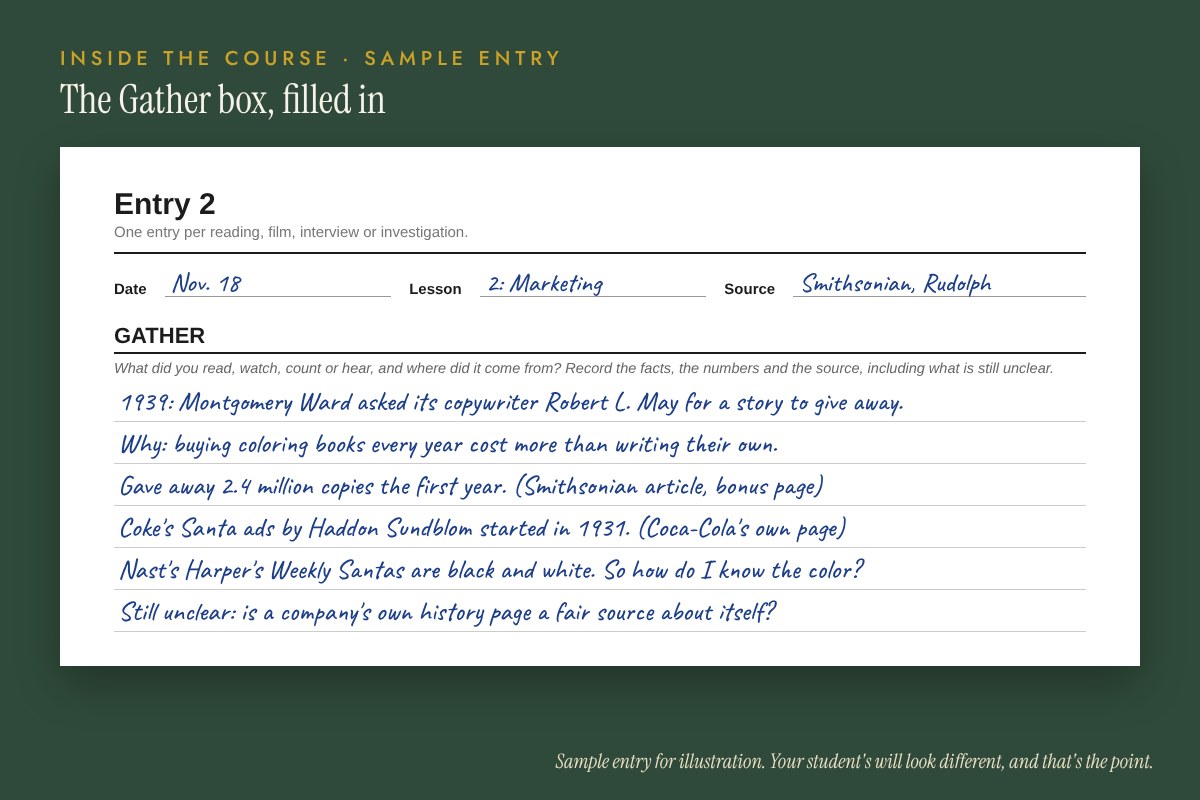
Two lines in that entry are questions, not facts. “So how do I know the color?” and “Is a company’s own history page a fair source about itself?” Those are the most valuable lines on the page. The second one is exactly where Lesson 2 is headed, because its Common Topic is Authority.
The pages that do the gathering
1. My Holiday Money Questions
Your teen starts here in Lesson 1 and comes back after Lesson 12. The prompts ask what questions they have about money and the holidays, what they guess their family spends the most on at Christmas, and whether they think Christmas is too commercial, and why. The last blank waits until the end: “Which questions did I answer, and did my view change?”
2. Economics Vocabulary
“Define each word in your own words when you meet it, not before.” The list starts with economics, scarcity, opportunity cost, supply, and demand, and runs through words like deadweight loss, anchoring, and externality. Each word gets your teen’s own definition and the lesson or source where they met it.
3. The evidence pages
Many lessons send your teen out to collect real data. In Lesson 1, it’s a scavenger hunt around the house: something shipped from far away (check the labels), a receipt from a holiday purchase, something that will become holiday waste. In Lesson 3, they check ten labels for the country of origin. And in Lesson 2, they gather the evidence on Santa’s suit:
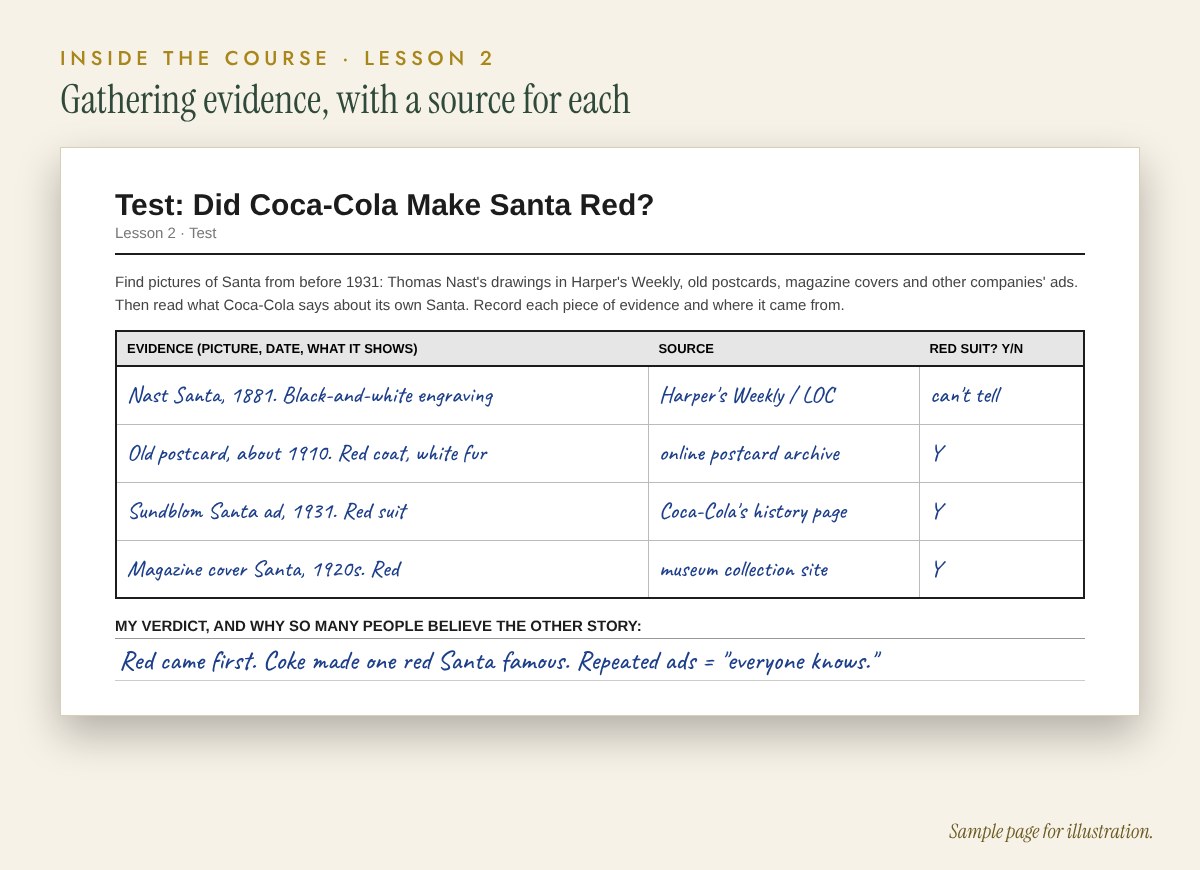
The page is labeled Test, and the verdict at the bottom is a Test move. But look at what fills most of it: evidence, a date, and a source for every row. That’s Gather doing its job so the Test has something to stand on.
Gathering starts with the words
Each lesson in the course names one of Lisa’s 5 Common Topics. Lesson 1’s is Definition, and it lives right here in Gather. The course opens with one sentence your teen will lean on all season: “Economics is the study of how people use scarce resources.”
Scarce, the background explains, means there is not enough of something for everyone to have all they want: money, time, toys, turkeys, delivery trucks. Once your teen can define scarcity and opportunity cost in their own words, every gift list in the house becomes an economics problem.
“Start with definition, because definition is so great and it’s simple.”
Lisa Nehring, It’s Not That Hard to Homeschool podcast
A reindeer, a department store, and a budget
Here’s one of the stories your teen will gather in Lesson 2.
In 1939, the Montgomery Ward department store had been buying coloring books to give away to shoppers every Christmas. It decided its own book would cost less. So it asked one of its copywriters, Robert L. May, to write a Christmas story. He wrote Rudolph the Red-Nosed Reindeer, and the store gave away 2.4 million copies the first year.
That’s a marketing story, a cost decision, and a piece of American Christmas, all at once. Your teen reads the Smithsonian’s short history, writes down the facts and the numbers with the source, and notes what’s still unclear. That’s a complete Gather. What it means comes later.
How to help without hovering
- Bring them shopping. Let them photograph price tags and labels. Have them write down the store and the date with every number.
- Ask “How do you know?” The course’s fix for students who skip ahead is one question, then wait.
- Ask for 15, not 5. As Lisa puts it, “Anybody can come up with five. But when you start saying 15 to 20 to 30, you have to really start thinking very creatively.”
- Let them interview you. Your family’s holiday budget, your memories of past Christmases, and what things used to cost are all real sources.
- Keep it to the season. Two lessons a week for six weeks, starting in mid-November, finishes by Christmas.
Resources for the Gather step
Every reading in the course is free and linked on the bonus page. These are good companions if you want a small economics shelf.
- Scroogenomics by Joel Waldfogel. The economist behind the gift research in Lesson 7, where your teen runs Waldfogel’s survey at home. Short and very readable.
- Economics in One Lesson by Henry Hazlitt. A classic for teens on looking past the obvious effect of a decision to the ones that are harder to see.
- Basic Economics by Thomas Sowell. A plain-English reference with no graphs or equations, good for looking up a term your teen meets in the vocabulary pages.
- A Christmas Carol by Charles Dickens (Dover Thrift). The Lesson 12 reading. It’s free online, but an inexpensive paperback is easier to mark up.
- Mead Composition Notebook. A pocket price log for store trips, so every number gets written down with its source on the spot.
You’ll find more on our Amazon storefront.
Next up: Test
Gather collects the numbers and the evidence. Test asks: Is it true? What evidence supports it, and what would you check before trusting it? Next time we’ll open the Test pages, including the verdict on Santa’s suit, and see why “economics is full of things everyone ‘knows’ that turn out to be wrong.”
From our shop
Every page in this post, ready to print
The Economics of Christmas: A Fourfold Study for High School · $15
Twelve lessons and a capstone, about 40 hours, built for November and December. No textbook to buy. Includes an hours log and a course description that goes straight onto the transcript as a quarter credit in economics.
See what’s insideNext step
When your teen wants a teacher, too
True North Academy’s classes build the same habits of careful thinking about evidence and sources, with a teacher alongside. Live online, accredited, and built for homeschool families.
Explore True North Academy
Save this to Pinterest for later.

Lisa Nehring and her husband, Dr. David Nehring, a Clinical Psychologist, and Biblical Scholar speak together on a wide variety of topics, including education, classical education, vision, mission, parenting, marriage, and more.
New here? Start with our free guide, The Fourfold Method: A Guide for Homeschool Families. Four simple moves that help your children keep what they learn, in every subject and at every age.
- Numbers Without Sources Are Just Guesses: The Gather Step in High School Economics - November 4, 2026
- The Snack Table, Ep. 6: We’re so far behind. Can we ever catch up? - November 3, 2026
- Most of December Lives in Gather: Teaching Real Research in a Christmas Homeschool Term - November 3, 2026


