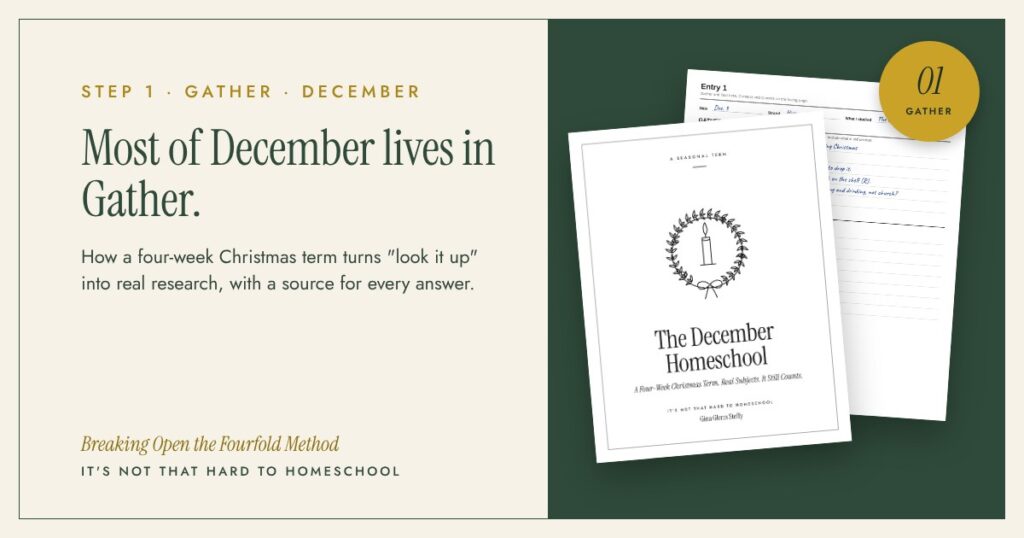
Breaking Open the Fourfold Method · December Term · Step 1 of 4
This post contains affiliate links. If you buy through them, It’s Not That Hard to Homeschool may earn a small commission at no extra cost to you.
Ask a room of children how old Christmas trees, stockings, and Santa’s red suit are, and most will say “forever.” Most adults will too.
A lot of the American Christmas is younger than we think. Some of it was invented in the 1800s. Some of it was once against the law. That’s what makes December such a good month for real research, and it’s why The December Homeschool is built the way it is.
The book says it plainly: “There are very few facts asserted in this book and a great many questions, because a student who finds out that Massachusetts once fined people for celebrating Christmas remembers it, and a student who is told that forgets it by February.”
Finding out is the first move of the Fourfold Method. It’s called Gather. And as the book puts it, “Most of this book lives here, because December history is full of things students assume are ancient and are not.”
This post is part of a series that opens up the Fourfold Method one step at a time, one subject at a time, using the actual pages students fill in. Today it’s the December term, and step one.
Free guide
A December they’ll still remember in spring.
Our free guide walks you through all four moves (Gather, Test, Connect, Commit) and how they turn what your children read and make into something they keep. It works in every subject, at every age.
Get the free Fourfold guideWhat “Gather” means in December
The book defines Gather in one line: “What is there. Sources, facts, dates, context — and where each came from.”
In a December term, that means your children don’t get handed the history of Christmas. They go find it. Every strand (history, literature, science, math, geography, art and music, and service) is “built as research rather than as reading.” Each week of the history spine has five questions, and none of them can be answered without looking something up.
Here are a few from Week 1, Before It Was Christmas:
- “What did the Puritans of the Massachusetts Bay Colony think about Christmas, and what did they actually do about it? Find the year the law changed.”
- “Dutch settlers in New Amsterdam brought Sinterklaas. What happened to that tradition after the English took the colony?”
- “Find one primary source — a diary, a letter, a sermon, a law — written in America before 1800 that mentions Christmas. What does it tell you that a textbook would not?”
That last question is Gather in its purest form. Go to the source. Write down what it says and where you found it.
What it looks like on the page
Each entry runs across two facing pages, with Gather and Test on the left and Connect and Commit on the right. The top line asks for the Date, the Strand, and What I studied. Then the Gather box asks: What is there? Sources, dates, people, context — and where each came from. Include what is still unclear.
Here’s what a filled-in Gather box might look like for an older student working on that first Week 1 question:

Notice the last line: “Did anyone actually pay the fine?” That’s exactly what Gather should produce. A real fact, a real source, and a real question to carry into the next step.
Younger children do the same move a different way. The book has Draw It pages for every week of history, because “a drawn answer is a real answer.” The thinking is the same; only the output changes.
The pages that teach your children where to look
1. Where To Look
This is the page most research assignments skip. The book says “look it up” is not an instruction. It’s an assumption that children already know how. “Most children do not, and most adults were never taught either.”
So it shows them. Start with your own research shelf. Then the library, properly: ask a reference librarian, check the children’s nonfiction around 394 for holiday customs, and use the newspaper and reference databases that come free with most library cards. Then the free primary sources, like Chronicling America’s digitized newspapers from the Library of Congress, the Library of Congress prints and photographs (Thomas Nast’s Santa drawings are there), the National Archives, and Project Gutenberg.
“Teach the source, not just the fact. It is the part of this month that lasts.”
The December Homeschool
2. Our Sources
One running log for the whole month: What I was looking for, Where I found it, Type of source, and Trustworthy? Why? The book calls it “the record of how you knew things.”
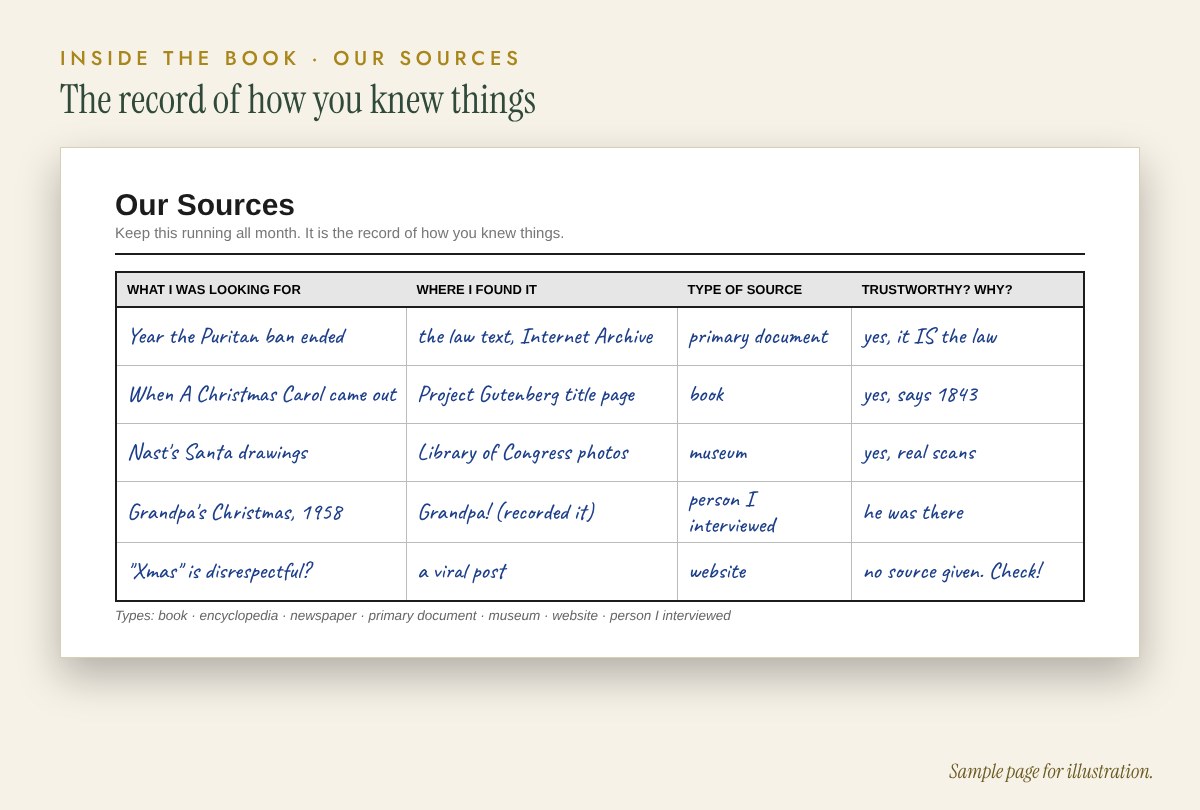
Look at the last row. A viral post with no source is something a child will meet a hundred times before Christmas. Learning to write “no source given, check!” is worth the whole month.
3. The interview
Two questions in the book ask your child to interview someone. Take those seriously. The book says a recorded conversation with a grandparent about the Christmases of their childhood “is a primary source that did not exist before your child made it, and it will outlast everything else in this book.”
Four questions to ask of anything you find
The Where To Look pages end with four questions. Put them on the fridge for December:
- Who made this, and when?
- How do they know? Were they there, or are they repeating someone?
- What did they want the reader to think?
- Does anything else say the same thing?
These line up with Lisa’s 5 Common Topics. In this book, Definition and Authority both live in Gather. Definition asks, “What did ‘Christmas’ mean to the people of each period?” Authority sends your children to “the research shelf, a librarian, and the oldest person you know.”
“Start with definition, because definition is so great and it’s simple.”
Lisa Nehring, It’s Not That Hard to Homeschool podcast
A holiday that was once against the law
Here’s the story behind that first research question, so you know what your children are walking into.
In 1659, the Massachusetts Bay Colony passed a law that fined anyone caught keeping Christmas five shillings. To the Puritans, the holiday wasn’t in the Bible, and the way many people kept it in England, with feasting, drinking, and rowdy celebration, was exactly what they had left behind. The law stayed on the books until 1681, when the colony repealed it under pressure from England.
When your child finds that law for themselves, reads it, writes down where it came from, and wonders whether anyone ever paid, they’ve done more history than a textbook chapter could hand them. And they’ll still remember it in February.
How to help without hovering
- Do the history together. The book recommends doing the history strand with everyone, whatever their ages. Output differs; the content does not need to.
- Read Where To Look first. Before the first research page. It’s what makes the questions answerable.
- Ask for 15, not 5. As Lisa puts it, “Anybody can come up with five. But when you start saying 15 to 20 to 30, you have to really start thinking very creatively.”
- If they only want the crafts, do the crafts. The book’s advice: “Ask one question while hands are busy.”
- Keep it light. About two hours a day, four days a week. Four strands done well beats seven done resentfully.
Resources for the Gather step
The book’s own advice is to borrow your research shelf from the library, and most of the reading list is free online. If you’d like to own a few research-shelf titles, these are the ones the book recommends.
- The Battle for Christmas by Stephen Nissenbaum. The scholarly history of the American Christmas, and the book’s top pick for the teaching parent. Read it one level deeper than your children are researching.
- The Man Who Invented Christmas by Les Standiford. How A Christmas Carol was written and what it did. Very readable for high schoolers working on Week 2.
- Truce by Jim Murphy. A nonfiction account of the 1914 Christmas truce for middle grades. Directly supports Week 4.
- Christmas: A Candid History by Bruce David Forbes. Short, readable, and even-handed about origins.
- Post-it Flags. For the research shelf. Flag the page, use the part you need, put the book back.
You’ll find more on our Amazon storefront, including A December Homeschool: The Christmas Term.
Next up: Test
Gather tells your children what is there. Test asks: Why did it happen that way, and why then? Argue with it. Being wrong here is allowed. Next time we’ll open the Test box and see what happens when a child tries to explain why a colony would ban Christmas, and why it gave up.
From our shop
Every page in this post, ready to print
The December Homeschool · $15
A four-week Christmas term across seven strands, with research questions, drawing pages for younger children, a reading plan, and an hours log and subject record so December counts.
See what’s insideNext step
When your teen wants a teacher, too
True North Academy’s classes build the same habits of careful research and real sources, with a teacher alongside. Live online, accredited, and built for homeschool families.
Explore True North Academy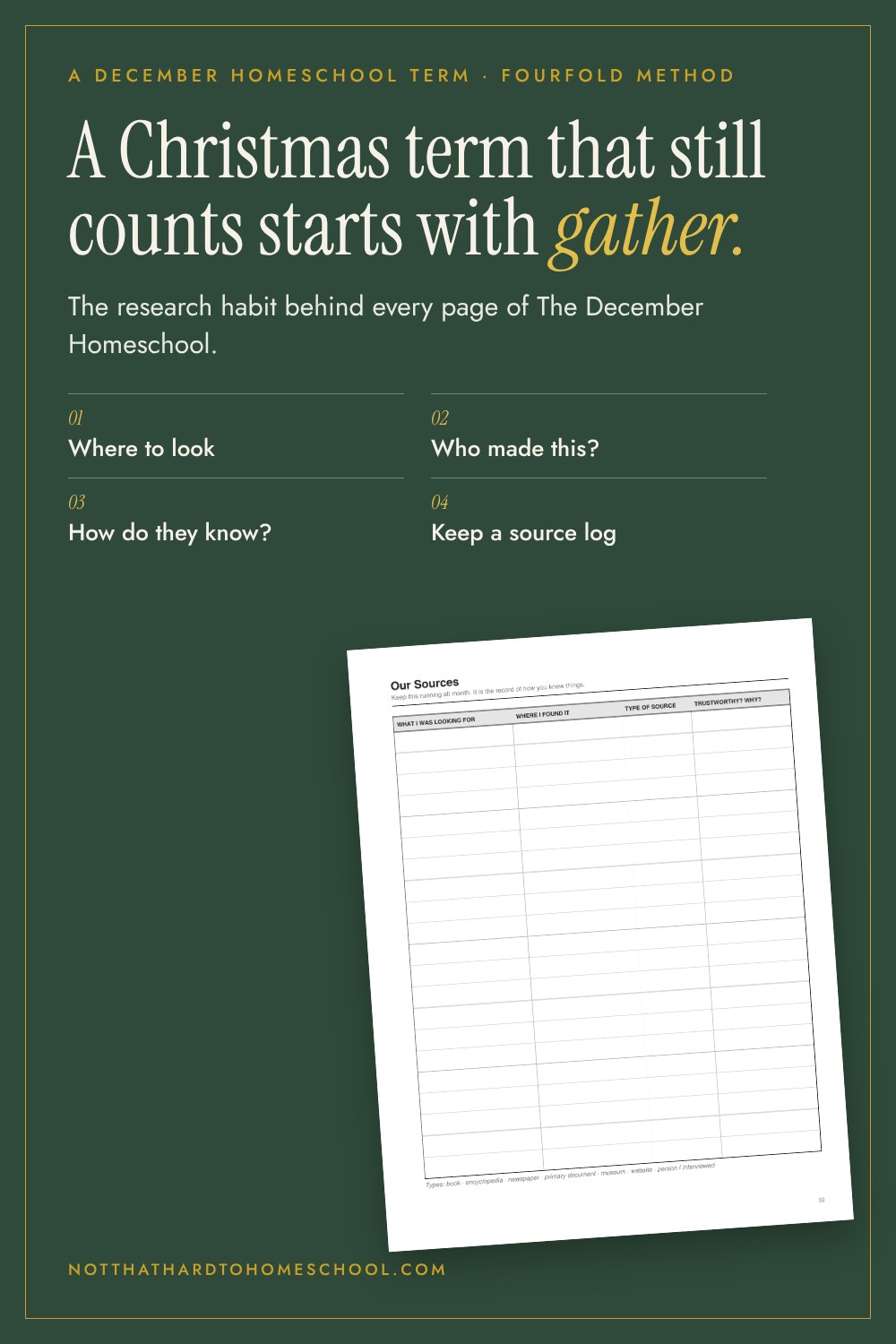
Save this to Pinterest for later.

Lisa Nehring and her husband, Dr. David Nehring, a Clinical Psychologist, and Biblical Scholar speak together on a wide variety of topics, including education, classical education, vision, mission, parenting, marriage, and more.
New here? Start with our free guide, The Fourfold Method: A Guide for Homeschool Families. Four simple moves that help your children keep what they learn, in every subject and at every age.
- Numbers Without Sources Are Just Guesses: The Gather Step in High School Economics - November 4, 2026
- The Snack Table, Ep. 6: We’re so far behind. Can we ever catch up? - November 3, 2026
- Most of December Lives in Gather: Teaching Real Research in a Christmas Homeschool Term - November 3, 2026


