

“Did you study?” “Yes.” “How?” “I read the chapter again.”
Our kids don’t always know what we mean when we tell them to study. They stare at the page, highlight half the book, or spend an hour making beautiful notes, and still can’t explain what they learned. Study skills are skills we can teach, and you don’t need to be an expert in every subject to teach them. You need a few good questions and a plan for the next step.
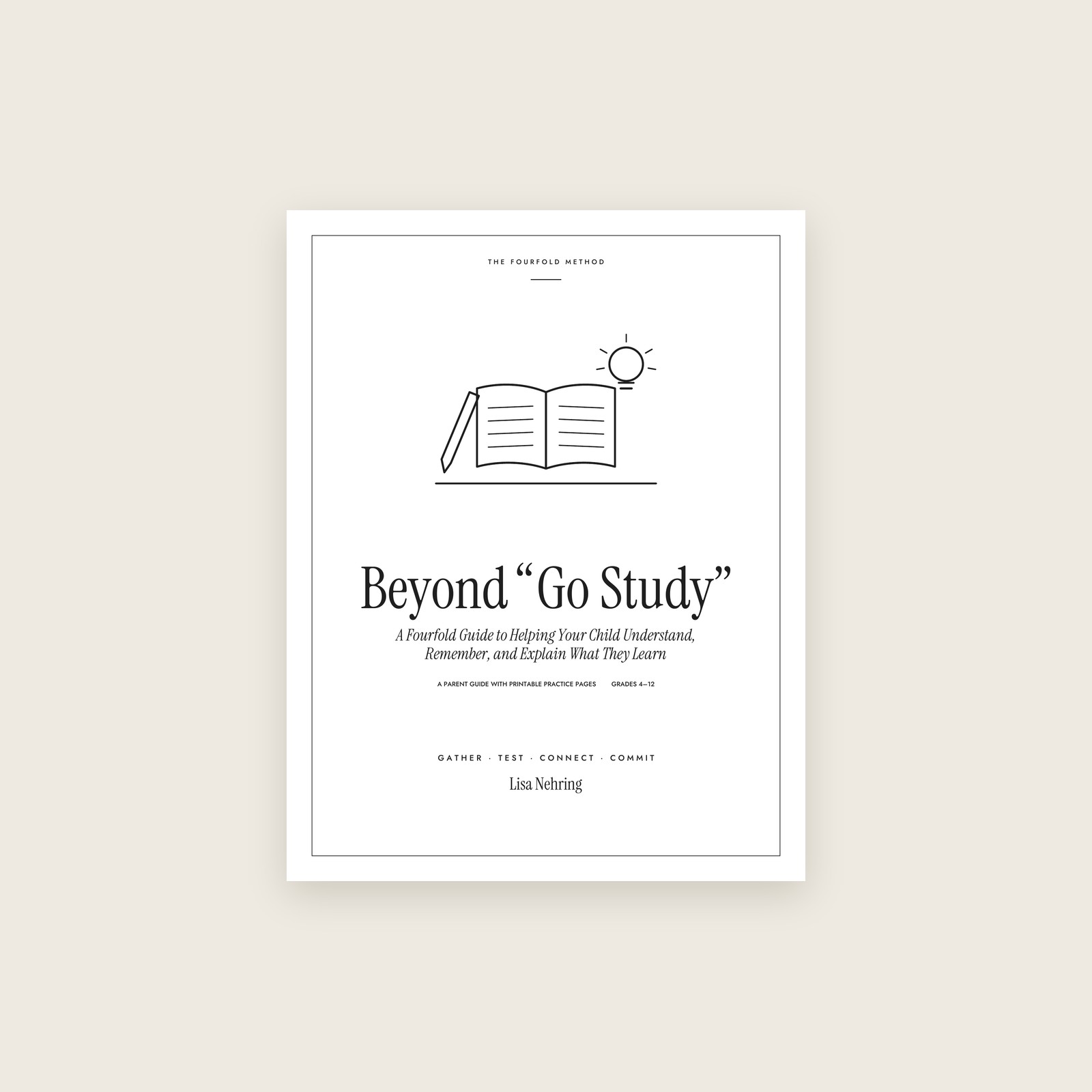
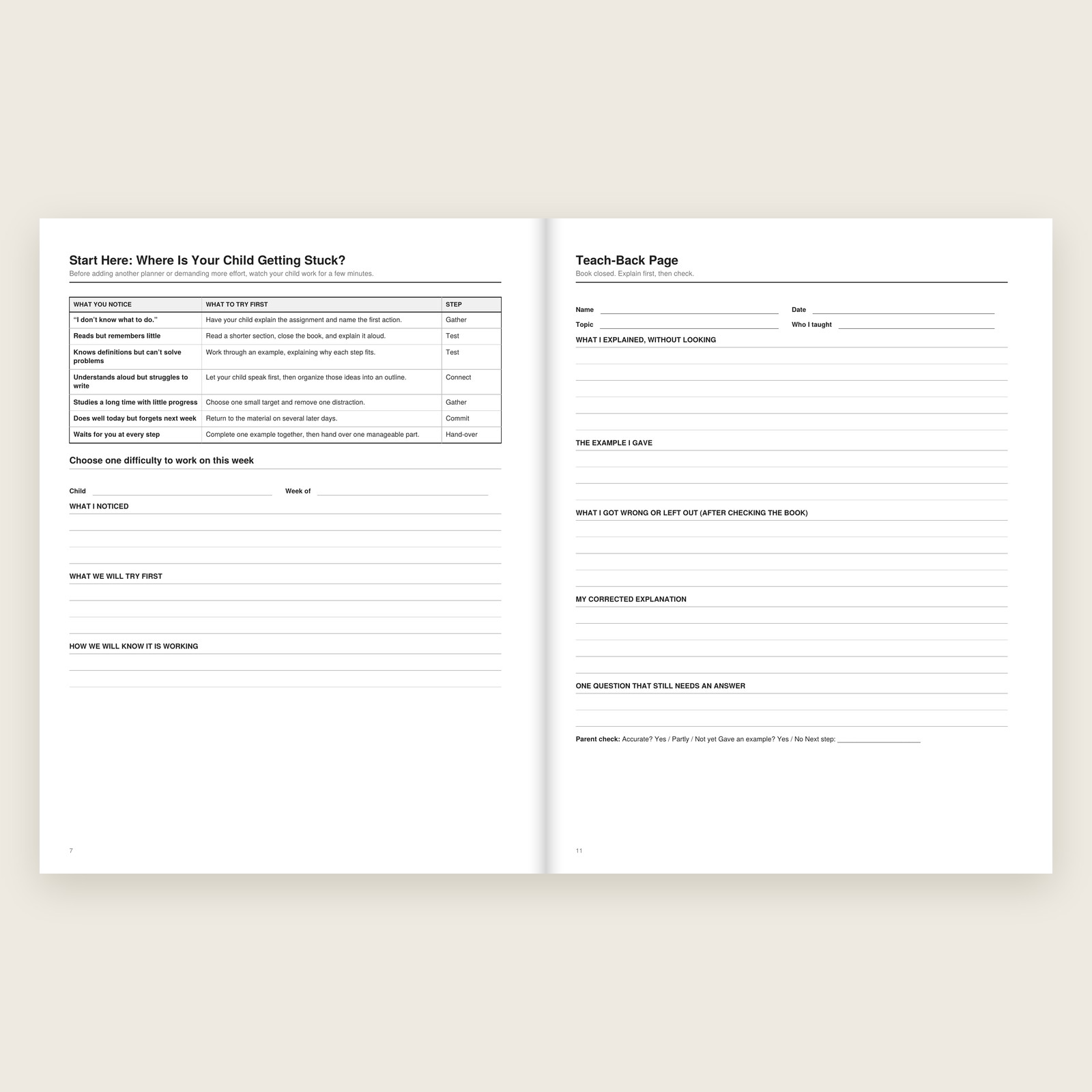
Beyond “Go Study” gives you that plan in four steps: Gather (get clear about the task), Test (check understanding with the book closed), Connect (make the learning useful), and Commit (practice, remember, and act). Each step comes with words to say, a technique to teach, and a printable page your child can fill in. It is short on purpose. You can read it in an evening and use it the next morning.
Is this a good fit for your family?
- Yes, if your child “studies” for an hour and still freezes on the test.
- Yes, if you’re teaching several ages and need one approach that works from 4th grade through high school.
- Yes, if you want your child to take over more of their own learning, a little at a time.
- Yes, if you want a quick win for $5, not another curriculum to schedule.
- Maybe not, if you want a full study skills course with graded lessons. This is a parent guide with practice pages; True North Academy’s self-paced Study Skills course is the next step for that.
By the end, your student will be able to
- Say exactly what an assignment is asking before starting it
- Check their own understanding with the book closed, instead of rereading
- Explain what they learned in two minutes, using five classical skills
- Plan an assignment in four steps and keep a ten-minute weekly review
- Memorize a passage of Scripture, poetry, or a speech with a simple plan
- Take on more responsibility for their schoolwork, one step at a time
What a week looks like
Most families use it inside the schoolwork they’re already doing, about ten minutes a day:
- Monday: Use the Gather questions before a new assignment: what is it asking, and what does “done” look like?
- Tuesday: Try a teach-back. Your child explains the lesson to you with the book closed.
- Wednesday: Make one useful connection: where else does this show up?
- Thursday: Short spaced practice on something from last week, plus memory work.
- Friday: The ten-minute weekly review and a check-in on the habit tracker.
Want a jump start? The four-week family challenge in the back walks your whole family through one step a week.
What you’ll need
- This PDF and a printer (black and white is fine)
- Your child’s regular schoolwork in any subject
- A Bible or a poem for memory work (optional)
What’s inside
- A “Where is my child getting stuck?” chart, with what to try first for each problem
- Active reading, the teach-back, useful connections, and spaced practice, each with its own printable page
- Five classical skills for explaining what you have learned, with a two-minute Explain It planner
- One assignment walked through all four steps, plus examples for math, history, writing, and vocabulary
- A four-step assignment planner, a daily check-in, and a ten-minute weekly review
- A habit plan and tracker, a focus session log, and a tracker for handing over responsibility gradually
- Lisa’s memory work assignment, with a plan and tracker for memorizing Scripture, poetry, or speeches
- A 28-word study skills vocabulary and note-taking pages for short talks about learning
- A four-week family challenge and cut-out bookmarks to keep beside the schoolbooks
Why the Fourfold Method works
Most schoolwork stops at reading the chapter and answering the questions. The Fourfold Method keeps going. Your student gathers what the source says, tests it against evidence, connects it to what they already know, and commits it in their own words. It’s the difference between “I read it again” and “I can explain it to you with the book closed.”
Questions moms ask
Is this a curriculum?
No. It’s a short parent guide with practice pages. It works alongside whatever curriculum you already use, in any subject.
What ages is it for?
Grades 4–12. Younger children do the steps out loud with you; older students use the planners on their own.
How much time does it take?
You can read the guide in an evening. After that, most of the steps take five to ten minutes inside work your child is already doing.
Can I use it with more than one child?
Yes. Your family license lets you print the practice pages for every child in your household, every year.
What faith perspective does it take?
It’s written from a Christian perspective, and the memory work plan suggests Scripture, poetry, or famous speeches.
Who wrote it?
Lisa Nehring, founder of True North Academy and host of the It’s Not That Hard to Homeschool podcast.
What you receive
- A printable PDF, 40 pages including the cover, 8.5 × 11 inches, designed to print clearly in black and white on a home printer.
- A family license: print as many copies of the practice pages as your household needs, for every child, every year.
- Your file is available only from the download page. It is not sent through a link in your order confirmation email, so please download it from the download page.
A first edition, shaped by the families who use it
This is a first edition, and we would love your help making the next one better. If a page is unclear, something is missing, or an idea would work better at your table, please tell us. Every purchase includes free updates. When a new edition is released, you will receive it at no additional cost.
Looking for something else?
Everything in our shop is an instant, printable download, with a family license and free updates.
Curriculum · Fourfold Studies · Bundles · Getting Started · High School Records · Browse the whole shop →

Lisa Nehring and her husband, Dr. David Nehring, a Clinical Psychologist, and Biblical Scholar speak together on a wide variety of topics, including education, classical education, vision, mission, parenting, marriage, and more.
New here? Start with our free guide, The Fourfold Method: A Guide for Homeschool Families. Four simple moves that help your children keep what they learn, in every subject and at every age.
- State It in One Sentence: The Test Step for High School English - November 5, 2026
- Numbers Without Sources Are Just Guesses: The Gather Step in High School Economics - November 4, 2026
- The Snack Table, Ep. 6: We’re so far behind. Can we ever catch up? - November 3, 2026


Reviews
There are no reviews yet.