Breaking Open the Fourfold Method · Homesteading · Step 2 of 4
This post contains affiliate links. If you buy through them, It’s Not That Hard to Homeschool may earn a small commission at no extra cost to you.
Last time, your teen learned to write down where every piece of homestead advice came from. Carla Emery, the extension office, a seed packet, Grandma. (If you missed it, start with the Gather step for homeschool homesteading.)
Knowing who said it is half the job. The other half is finding out whether it’s right.
A homestead is an honest teacher. The bread rises or it doesn’t. The beans keep in the jar or they don’t. Advice that sounds wonderful at the kitchen table meets this soil, these animals, and this year, and some of it doesn’t survive the trip. That’s the second move of the Fourfold Method, and it’s called Test.
Our homesteading course gives your teen three questions to ask, every single time: Is it true, safe and workable here? What evidence supports it? What would you check before trusting it?
Free guide
Four moves that work on a homestead and at a desk
Our free guide walks you through all four moves (Gather, Test, Connect, Commit) and how they turn what your teen reads, watches and tries into something they keep.
Get the free Fourfold guideWhat “Test” means on a homestead
In most subjects, Test means weighing a claim: what’s actually shown, and what was only assumed. On a homestead, that question has a sharper edge, because some wrong answers cost you a garden and a few could make someone sick.
The three parts of the Test box each do a different job:
- Is it true? Does the claim match the evidence, or just the story everyone tells?
- Is it safe? The course says plainly that homesteading involves “heat, sharp tools, animals, lye and food that can make people sick if it is handled wrong.” Safety gets checked before anything else gets tried.
- Is it workable here? Advice can be true and safe and still wrong for a suburban lot, a short growing season, or a family with no time on Tuesdays.
Then come the two questions that make it a real test: what evidence supports it, and what would you check before trusting it?
What it looks like on the page
Every unit in the course has its own Test page, built around one claim worth checking. Unit 1’s is called Test: Was the Homestead Act a Success?, and it starts with a challenge: “The Act is often told as a simple success story. Test that.”
Your teen looks up how many people filed claims and how many “proved up” after five years, using the National Park Service and the National Archives. Then they find who gained and who lost: “families, speculators, railroads, and the Native nations whose homelands the land had been.” Last, they find out why so many claims failed on the Great Plains, and the page gives them a nudge: “Think about rainfall, distance and money.”
Remember the student from the Gather post, whose last line was “Could a woman file? What did ‘head of a household’ mean?” Here’s what the same student’s Test page might look like a week later:
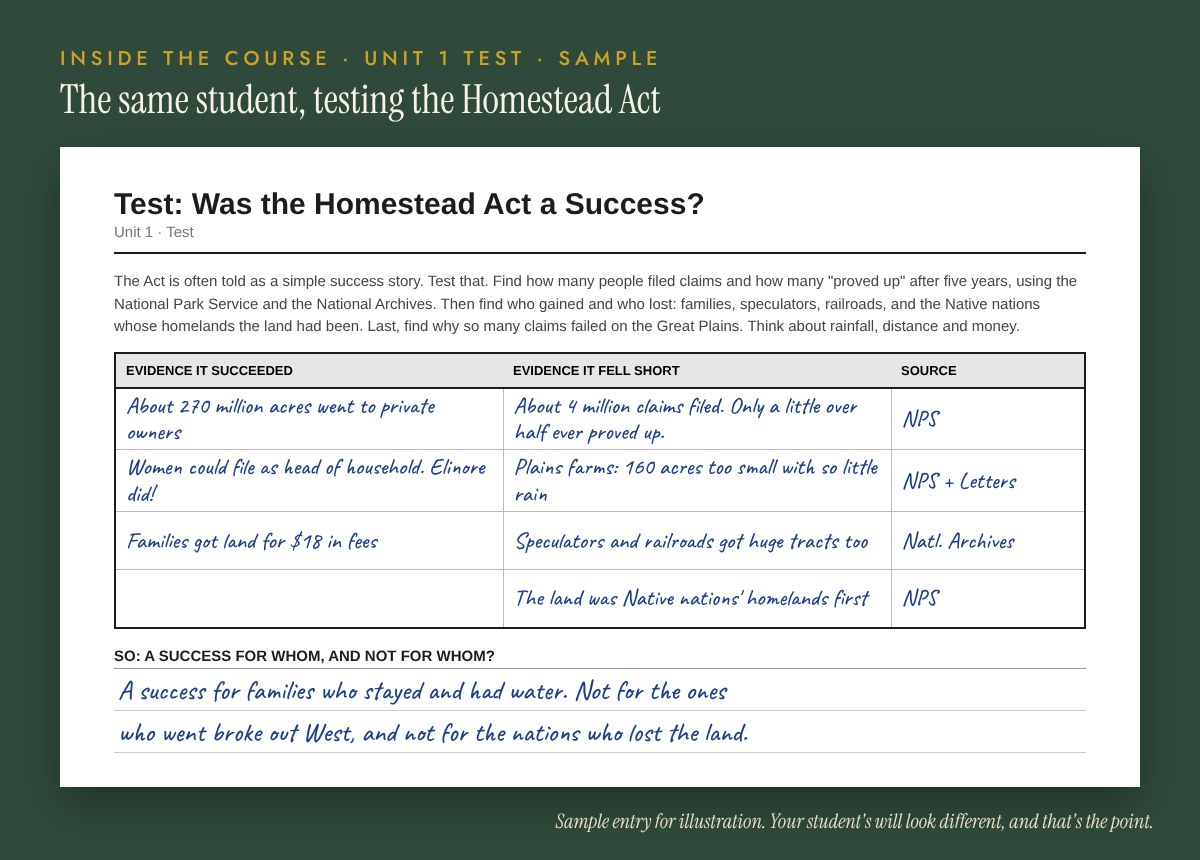
Look at what happened to the open question. In Gather, it was a gap. In Test, it became evidence. Elinore Pruitt Stewart, whose letters are one of the unit’s readings, filed a claim of her own and wrote about working it. So yes, some women could.
Look at the last prompt, too: “So: a success for whom, and not for whom?” That question doesn’t let your teen settle for “yes” or “no.” It’s the Common Topic for Unit 1, Compare & Contrast, at work. The same law looks very different from a family farm in Nebraska, a railroad office, and a Native nation’s homeland.
Ten units, ten claims to test
The course doesn’t test one thing and move on. Every unit hands your teen a new claim, and most of them get tested with real hands in real dirt:
- Unit 1: Was the Homestead Act a Success?
- Unit 2: Is My Goal Realistic?
- Unit 3: A Home Soil Test
- Unit 4: Does This Garden Claim Hold Up?
- Unit 5: The Real Cost of a Dozen Eggs
- Unit 6: Old Method vs. Current Guidance
- Unit 7: Scratch vs. Store-Bought
- Unit 8: How Much Rain Falls on My Roof?
- Unit 9: What Can I Legally Sell?
- Unit 10: Interview a Homesteader
Three of them are worth a closer look.
Is My Goal Realistic?
Your teen picks one goal, “such as six laying hens, a 4 x 8 foot garden bed or a rain barrel,” and tests it “against your real circumstances before you plan it.” The page walks through the questions every dreamer skips: Is it allowed here? How much space? Hours per week? Start-up cost? Monthly cost? Who helps? What could go wrong? Is it still worth it? It ends with “My goal, adjusted to fit what I found.” That last line is the whole lesson. A test isn’t a failure when the plan changes. That’s the test doing its job.
Does This Garden Claim Hold Up?
Your teen picks three companion planting or gardening claims “from books, seed packets or the internet,” and finds the best evidence for each: “a university extension page, a study, or your own side-by-side trial.” Five columns: the claim, where they read it, evidence for, evidence against, and a verdict. The page closes with a question that lasts far longer than the garden: “What this taught me about garden advice.”
Old Method vs. Current Guidance
This is the one that matters most. Your teen takes “one preserving recipe from your family or an old cookbook” and checks “every step against the USDA guide.”
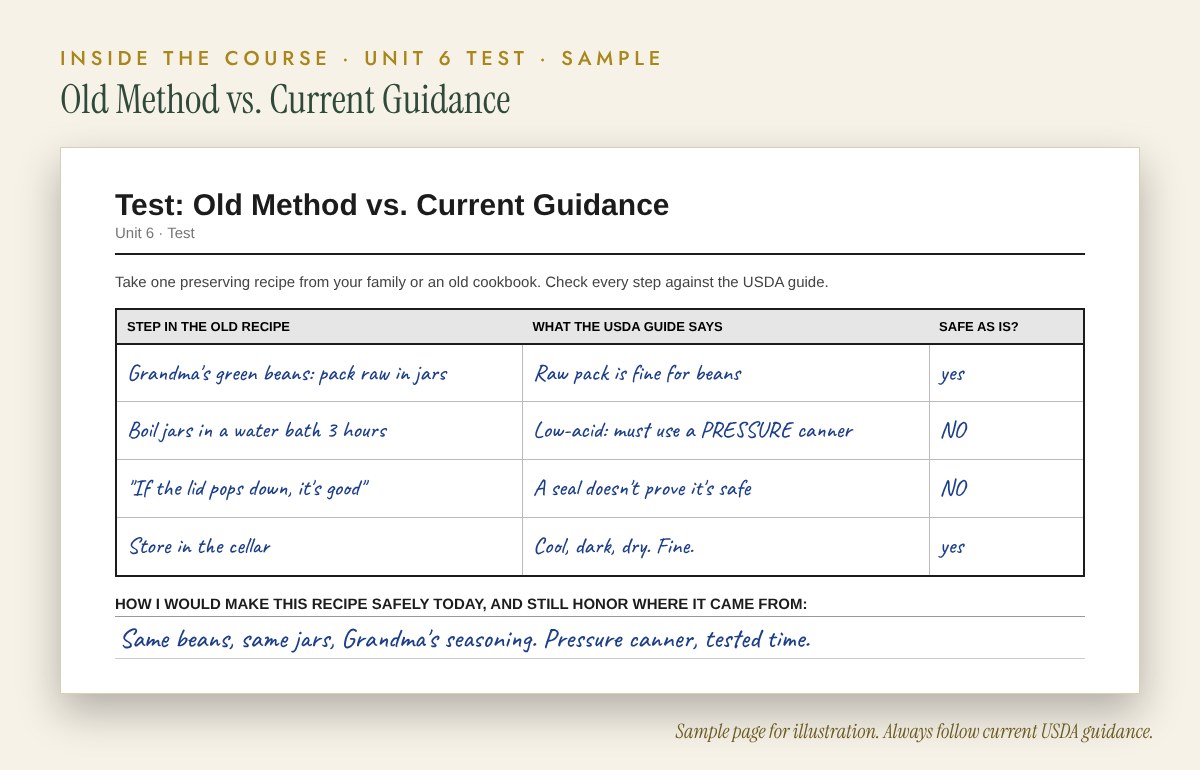
Green beans are a low-acid food, and current USDA guidance is to put them up in a pressure canner, not a water bath. Plenty of family recipes still say otherwise. Notice the page doesn’t ask your teen to throw Grandma’s recipe away. It asks: “How I would make this recipe safely today, and still honor where it came from.” Same beans, same jars, same seasoning. Tested method.
That’s what Test teaches. Respect for where advice came from, and the nerve to check it anyway.
Where tested advice comes from
In the Gather post we told the story of the Cooperative Extension Service, created in 1914 to carry what the land-grant colleges learned out to farm families. Extension offices are still doing exactly that, and their publications are written from tested research rather than from what worked once for somebody.
That’s why “a university extension page” is the first source the garden-claim Test page suggests. When your teen finds that a seed-packet promise and an extension bulletin disagree, they’ve found the most interesting line on the page. Which one has evidence behind it? And would a side-by-side trial in your own backyard settle it?
How to help without hovering
- Ask “How do you know?” and then wait. It’s the one question that turns a confident claim into a test.
- Safety first, every time. Every unit has a safety note. Read it together before the project starts, and keep a grown-up close “for anything involving a canner, an oven, a saw or lye.”
- Let the plan change. If the hens turn into a single raised bed after the Is My Goal Realistic? page, that’s a successful test.
- Let them be wrong in writing. A prediction that fails, written down honestly, is still a good entry. Being wrong on paper is how the thinking gets done.
- Ask for 15, not 5. If the evidence columns look thin, ask for more. Lisa’s rule of thumb is that the first five ideas are easy, and the real thinking starts after that.
Resources for the Test step
The USDA canning guide and the course’s other readings are free and linked on the bonus page. These books help a teen weigh homestead advice instead of just collecting it.
- The Truth About Garden Remedies by Jeff Gillman. A horticulture professor tests popular garden advice and reports what works, what doesn’t, and why. A perfect model for the Does This Garden Claim Hold Up? page.
- Decoding Gardening Advice by Jeff Gillman and Linda Chalker-Scott. The science behind 100 common gardening recommendations, sorted by how well each one holds up.
- Teaming with Microbes by Jeff Lowenfels and Wayne Lewis. What’s actually going on in the soil, for teens who want to understand the results of A Home Soil Test.
- Mini Farming: Self-Sufficiency on 1/4 Acre by Brett Markham. Full of real numbers on space, time and yield to test a goal against.
- The Encyclopedia of Country Living by Carla Emery. Still the course’s one required book. On Test pages, it’s often the first source your teen weighs against the others.
You’ll find more on our Amazon storefront, including The Homesteading Study Shelf.
Next up: Connect
Gather tells your teen what the advice says and who said it. Test asks whether it holds up here. Connect asks the question that makes it stick: who did this before us, and why? Next time we’ll open the Connect pages and see what the homesteaders of 1862 and the families planting gardens today have in common.
From our shop
Every Test page in this post, ready to print
Homesteading: A Fourfold Study for High School · $19
Ten units, about 18 weeks and 70 hours, built around Carla Emery’s The Encyclopedia of Country Living. Entry pages, a Test page for every unit, projects, safety notes, an hours log, and a course description that goes straight onto the transcript.
See what’s insideNext step
Want a teacher to grade it?
Homesteading can be taken as a True North Academy self-paced add-on, with the work graded for a half credit. True North is accredited, online, and built for homeschool families.
Explore True North Academy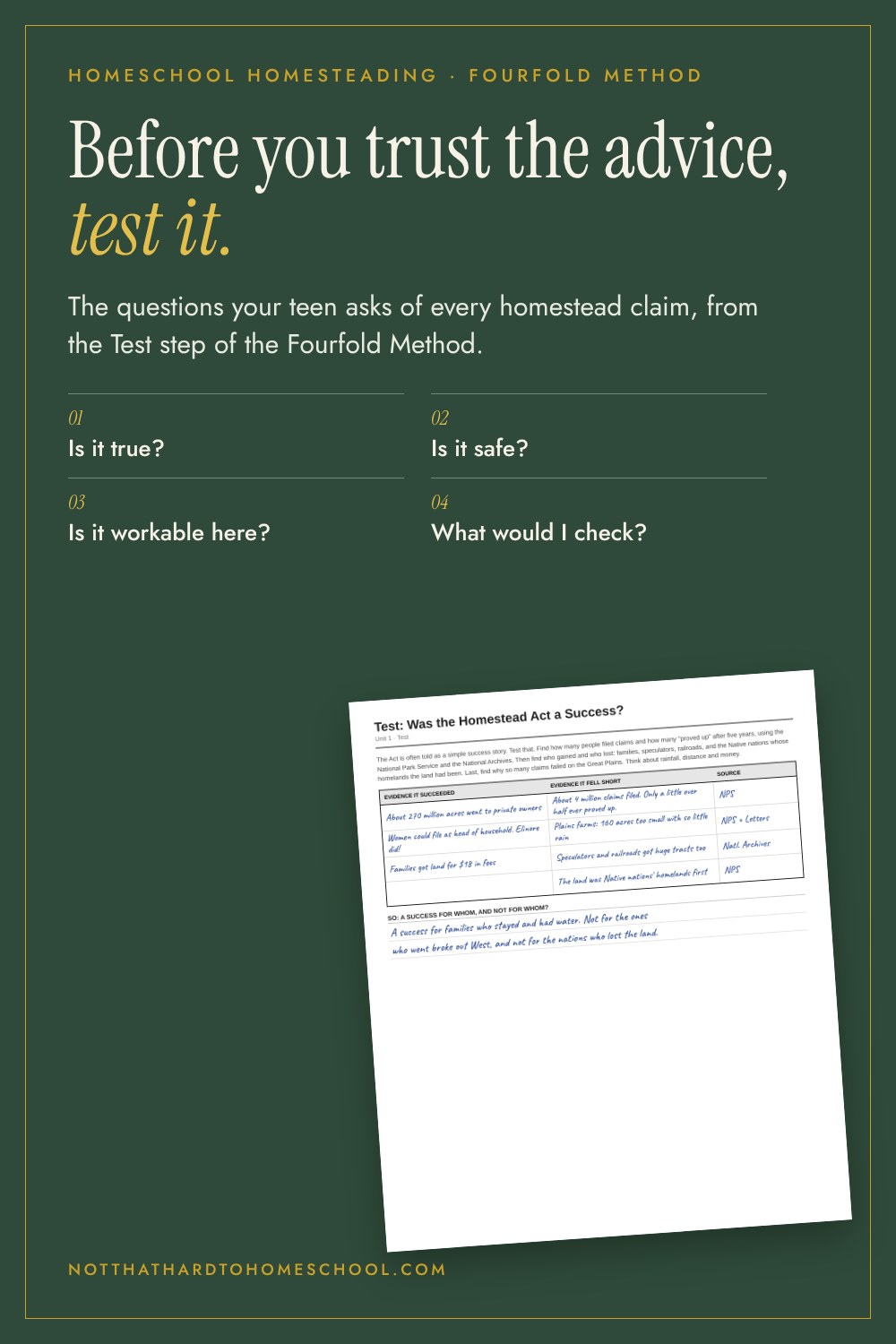
Save this to Pinterest for later.

Lisa Nehring and her husband, Dr. David Nehring, a Clinical Psychologist, and Biblical Scholar speak together on a wide variety of topics, including education, classical education, vision, mission, parenting, marriage, and more.
New here? Start with our free guide, The Fourfold Method: A Guide for Homeschool Families. Four simple moves that help your children keep what they learn, in every subject and at every age.
- Argue With It: The Test Step in a Christmas Homeschool Term - November 13, 2026
- Is It True, Safe and Workable Here? The Test Step for Homeschool Homesteading - November 12, 2026
- The Snack Table, Ep. 8: My teenager argues with everything. Is that a problem? - November 11, 2026


