

Breaking Open the Fourfold Method · History · Step 1 of 4
This post contains affiliate links. If you buy through them, It’s Not That Hard to Homeschool may earn a small commission at no extra cost to you.
Ask most teenagers what they learned in history this year and you’ll get a list. A war, a treaty, a president, a date or two. Ask them how they know any of it, and you’ll get “it was in the book.”
That’s the gap. History isn’t a list of things that happened. It’s a set of accounts of things that happened, each written by somebody, for somebody, with a reason. A student who never asks “says who?” is memorizing claims, not studying history.
The History journal in our Fourfold line puts the whole subject into one opening question: “What happened, and according to whom?” That’s the first of the four moves in the Fourfold Method, and it’s called Gather.
This is the third post in our series opening up the Fourfold Method one step at a time, one subject at a time, using the actual pages students fill in. Today: high school history, step one.
Free guide
History that sticks past the test.
Our free guide walks you through all four moves (Gather, Test, Connect, Commit) and how they turn a history chapter into something your student keeps. It works with any curriculum or spine you already use.
Get the free Fourfold guideWhat “Gather” means in history
The journal describes it like this: “Names, dates, places, and the source each fact came from. Getting into the habit of recording where you learned something is what separates history from a collection of claims.”
So in history, Gather has two halves, and the second one is the one students skip:
- What happened. The people, the dates, the places, the sequence. The plain facts, written down plainly.
- According to whom. Where each of those facts came from. A textbook? A letter written that week? A speech given forty years later? A painting made to sell newspapers?
That second half is what makes history a subject you can think in. Once your student is writing down sources, they start noticing when two sources don’t agree. That noticing is where all the real history work begins.
What it looks like on the page
Every entry runs across two facing pages, Gather and Test on the left, Connect and Commit on the right. At the top, the student fills in the date, the period or topic, and the source or reading. Then the Gather box asks: What happened, according to whom? People, dates, places, and where each piece of information came from.
Here’s what a filled-in Gather box might look like for a student studying the Boston Massacre:
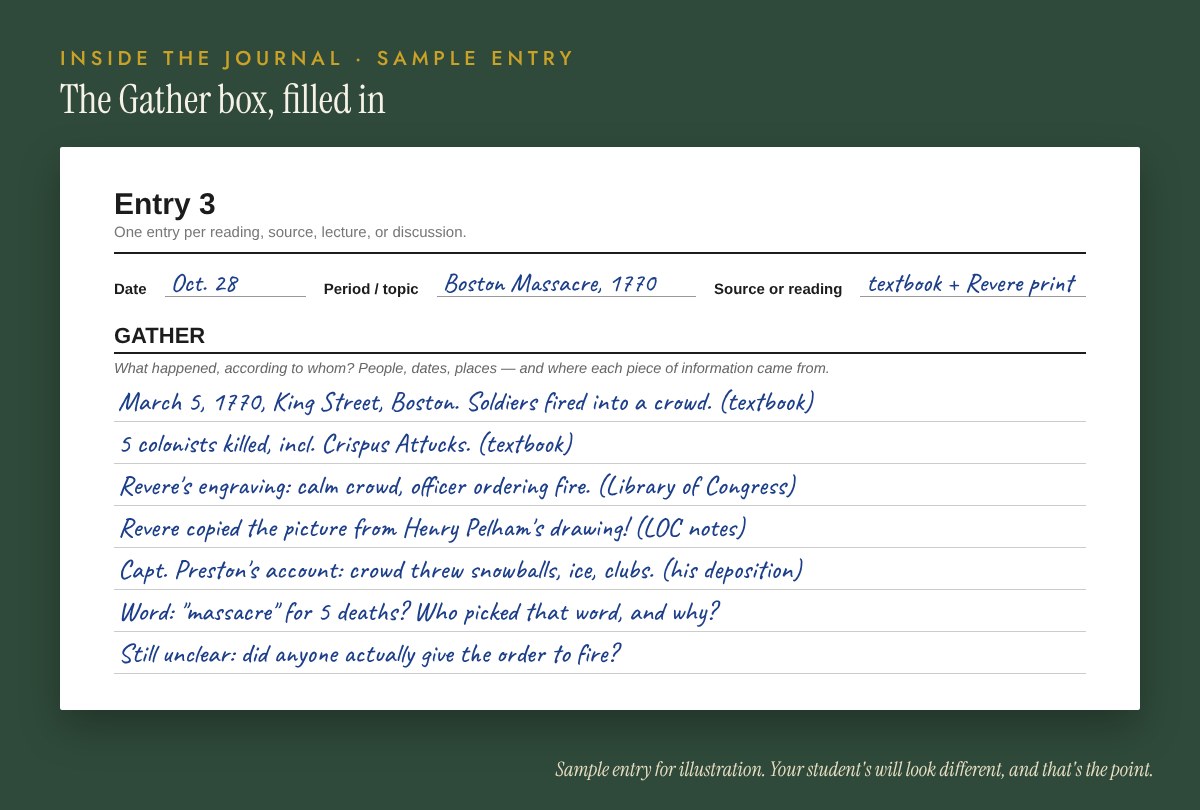
Look at what this student did. Every fact has a source next to it. They noticed that the most famous picture of the event was made by a man with a side in the argument. They flagged a word, massacre, and asked what it meant to the people who chose it. And they ended with an honest question: “Still unclear: did anyone actually give the order to fire?”
That last line isn’t a gap in the entry. It’s the start of the next step. Historians still argue about it, and Test is where your student gets to weigh in.
More pages that do the gathering
Beyond the entry spreads, the History journal has several pages built for this step.
1. Primary Source Analysis
The journal calls this “the single most important skill in this subject,” and there are eight of them in the book. The top of the page is Gather: source, author, date created, type, audience, and where I found it. Then What it says, followed by two questions side by side: Who wrote it, and what did they want? and What is left out or hidden?
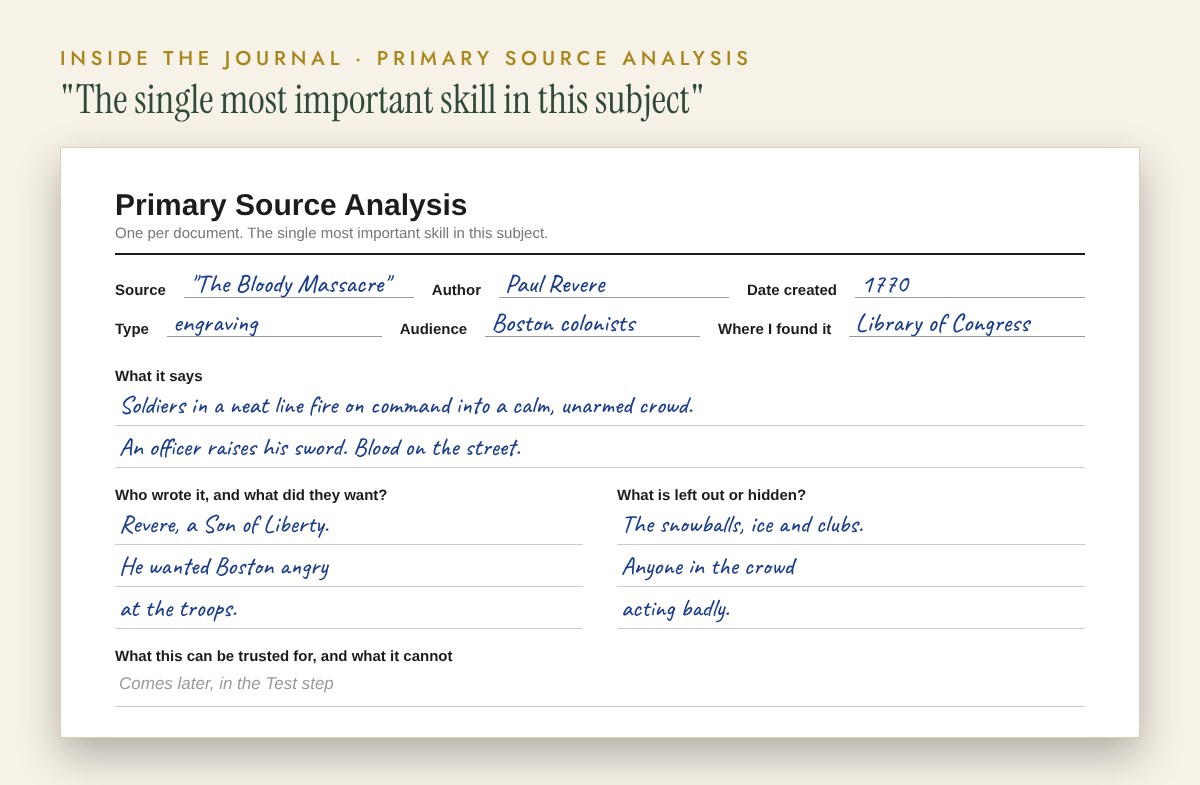
“Audience” is the field that changes everything. Paul Revere’s engraving wasn’t made for a jury. It was made for angry Bostonians, and it shows.
2. Timeline
“Dates on the left, what happened on the right. Add as you learn.” Each row has room for where, who, and why it mattered. A timeline gives every new fact a place to hang. The journal’s own fix for a student who can’t make connections is simple: “Start with a timeline. A new fact needs somewhere to hang.”
3. Period Overview
“Fill this in as you go. It becomes the spine everything else hangs on.” Era, roughly when, where, and why it matters. It’s the big picture, built one row at a time.
4. Terms
Three columns: the term, my definition in my own words, and a sentence the author uses it in. The journal points out that “in history, republic, commonwealth, and liberty each meant something specific to the people using them, and the specifics are the history.”
5. Materials & Sources
Every source used all year, with author, type, what it was used for, and whether it was worth keeping. By spring, your student has their own bibliography, and the beginnings of a course description.
Gathering starts with the words, and with who said them
If you know Lisa’s 5 Common Topics, two of them live here. Definition belongs to Gather: “Define the terms of the subject before anything else.” And Authority sits across Gather and Test: “Who said it, how they would know, and whether to trust them.”
“The thing about textbooks that I think is limited is they don’t go too deep. They’re telling the student what to think about a situation.”
Lisa Nehring, It’s Not That Hard to Homeschool podcast
Gathering from more than one source is how your student stops being told what to think.
“Facts are stubborn things”
After the Boston Massacre, the soldiers who fired were put on trial for murder. Their defense lawyer was John Adams, a patriot who opposed British policy in the colonies. He took the case anyway, because he believed everyone deserved a fair trial.
In his closing argument, Adams told the jury: “Facts are stubborn things; and whatever may be our wishes, our inclinations, or the dictates of our passions, they cannot alter the state of facts and evidence.”
Most of the soldiers were acquitted. Two were convicted of manslaughter, a lesser charge. Adams had asked the jury to separate what happened from how people felt about it, and they did.
That’s the Gather step in one sentence. Write down what the evidence actually shows, and where it came from, before your wishes get a vote.
How to help without hovering
- Ask “says who?” every time. Make it a family joke if you have to. The habit matters more than any single answer.
- Ask for 15, not 5. If the Gather box is thin, ask for more facts, each with a source. As Lisa puts it, “Anybody can come up with five. But when you start saying 15 to 20 to 30, you have to really start thinking very creatively.”
- Pair every textbook chapter with one primary source. A letter, a speech, a diary entry, a newspaper. Most are free online, and the Primary Source Analysis pages give your student a way in.
- Don’t grade the Gather box. “Nobody is grading the journal.” An entry that admits confusion is worth more than one that performs understanding.
- Keep it small. One reading, one source, or one discussion per entry. Small and finished beats large and abandoned.
Resources for the Gather step
You don’t need any of these to use the journal. But if you want a small history shelf that helps a high schooler gather well, these are good places to start.
- A Little History of the World by E. H. Gombrich. A warm, readable walk through world history. Great for filling in the Period Overview page before diving deep.
- The Timechart History of the World. A fold-out wall chart covering about 6,000 years. Hang it where everyone walks past, and the Timeline pages suddenly have a big brother.
- Narrative of the Life of Frederick Douglass (Dover Thrift). A short, powerful primary source, and an ideal first Primary Source Analysis. Ask who Douglass was writing for, and why.
- The Boston Massacre: A History with Documents by Neil L. York. If the example in this post hooked your student, this book collects the trial testimony and accounts in one place. It’s priced like a college text, so check your library first.
- Webster’s 1828 American Dictionary of the English Language (Facsimile). For the Terms page. When your student meets liberty or republic in a founding-era document, this is how the people writing it used the word.
You’ll find more on our Amazon storefront, including our Commonplace Books and Journaling Supplies list.
Next up: Test
Gather tells your student what happened and who said so. Test asks why it happened, and why then. Next time we’ll open the Test box: weighing causes and motives, and asking what a source leaves out and who benefited from telling it that way.
From our shop
Every page in this post, ready to print
History: A Fourfold Study Journal for High School · $15
Twenty-six entry spreads, eight primary source analyses, timeline and period overview pages, cause and effect, competing accounts, person studies, map work, and a course description page that goes straight onto the transcript.
See what’s insideNext step
When your teen wants to argue history with someone besides Mom
True North Academy’s history classes build the same habits of reading sources and weighing evidence, with a teacher and classmates to debate with. Live online, accredited, and built for homeschool families.
Explore True North Academy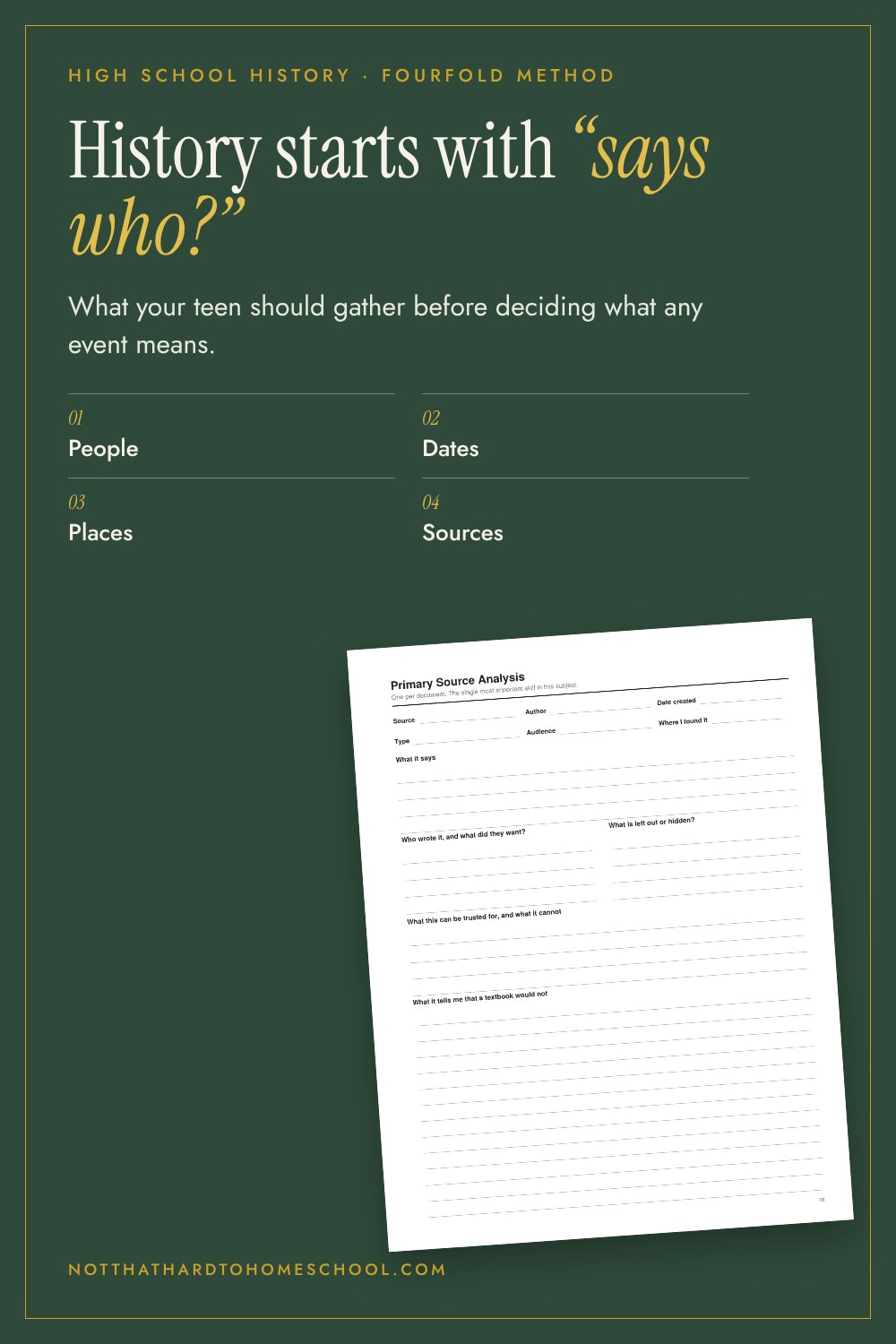
Save this to Pinterest for later.

Lisa Nehring and her husband, Dr. David Nehring, a Clinical Psychologist, and Biblical Scholar speak together on a wide variety of topics, including education, classical education, vision, mission, parenting, marriage, and more.
New here? Start with our free guide, The Fourfold Method: A Guide for Homeschool Families. Four simple moves that help your children keep what they learn, in every subject and at every age.
- The Snack Table, Ep. 2: My kid reads the chapter and remembers nothing a week later. - October 28, 2026
- What Happened, and According to Whom? The Gather Step for High School History - October 28, 2026
- The Snack Table, Ep. 1: I have four kids at four levels. How do I teach them all? - October 27, 2026


