Breaking Open the Fourfold Method · Recipe to Write · Grades K–12 · Step 3 of 4
This post contains affiliate links. If you buy through them, It’s Not That Hard to Homeschool may earn a small commission at no extra cost to you.
Our fifth grader has been working on one pancake recipe for two posts now. In Gather, he set out his ingredients, his tools, and what he already knew, and he decided who he was writing for: his cousin Sam, who has never cooked anything. In Measure, his mom followed his recipe exactly as written, and he found the holes. How hot is the pan? How much butter? When do you flip?
He knows how to fix those sentences now. But there’s a bigger question waiting: why does any of it work?
That’s the job of the third move. Recipe to Write calls it Fold In, and it asks: “Where does this join something you already know? Folding is how two separate things become one thing.”
This is the next post in our series opening up the Fourfold Method one step at a time, using the actual pages children fill in. Today it’s Recipe to Write, for kindergarten through high school, and step three.
Free guide
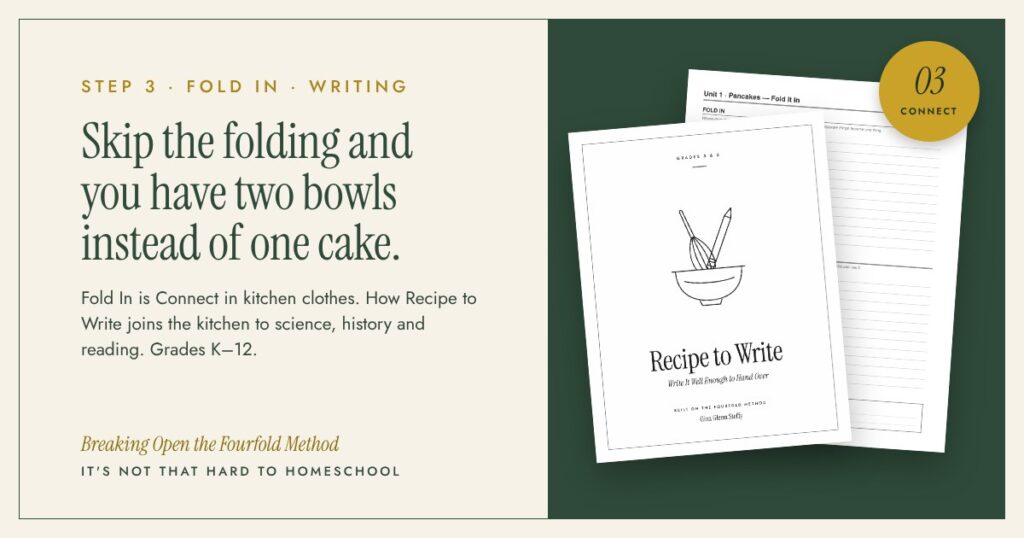
Skip the folding and you have two bowls instead of one cake.
Our free guide walks you through the four moves of the Fourfold Method and why the connecting move is the one that makes learning stay. It works in every subject, at every age.
Get the free Fourfold guideFold In is Connect, in kitchen clothes
Recipe to Write uses the Fourfold Method with kitchen names: Gather, Measure, Fold In, Serve. Fold In is what our other books call Connect.
The book explains the name with a cooking lesson:
“When you fold egg whites into a batter you are joining two separate things without knocking the air out of either. Do it too roughly and you lose what made it worth doing. Skip it and you have two bowls instead of one cake.”
Recipe to Write, “Why folding is the important one”
Then it makes the point about learning: “Most schoolwork stops after gathering — you find something out, you write it down, and a week later it is gone. Folding it into what you already know is the move that makes it stay, and it is the one almost everybody skips.”
One recipe, five subjects
Here’s what makes Fold In easy in this book: the unit has already done half the folding for you. Every unit is built around one recipe, and that recipe runs through several subjects at once. In the Grades 5 & 6 pancake unit, your child cooks, then works through a Science page, a History page, a Reading list, and The Old Version, a recipe written before 1900, before writing a single word of their own.
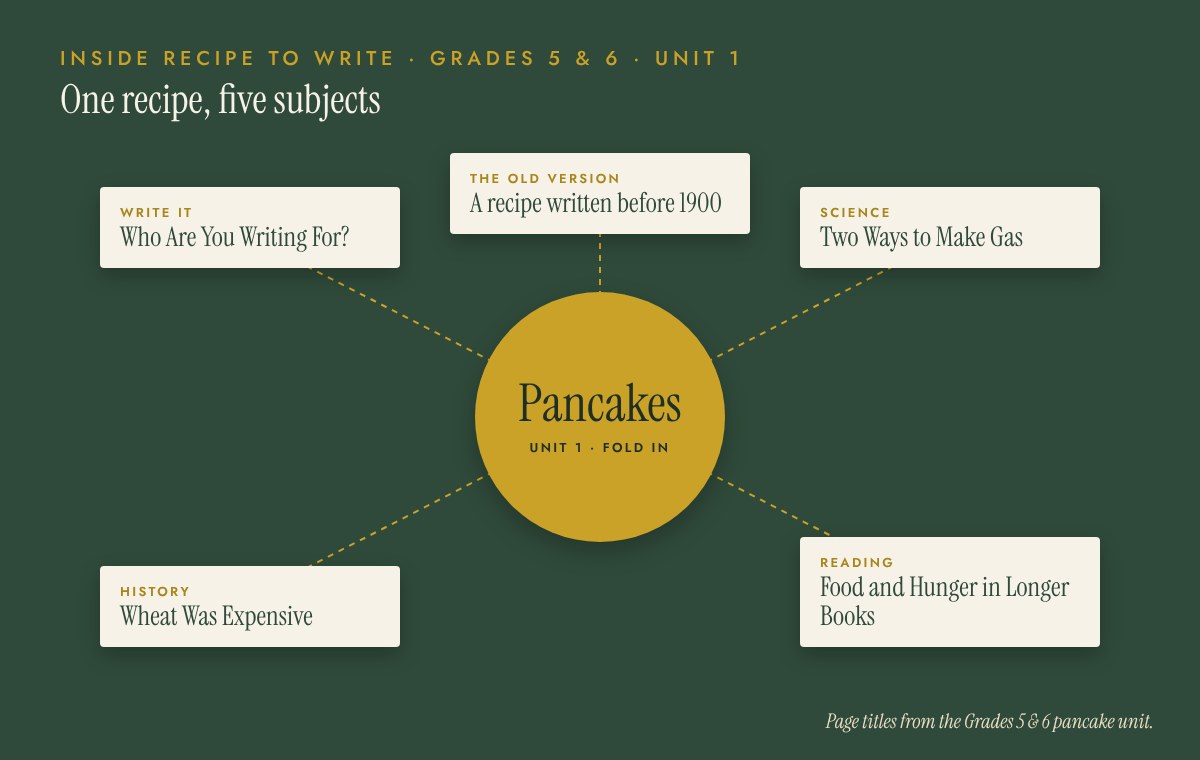
Look at what each page brings to a plate of pancakes:
- Science: Two Ways to Make Gas. “Baking powder contains both an acid and a base, kept apart by cornstarch until liquid brings them together.” Baking soda “is only the base. It needs an acid from somewhere else — buttermilk, molasses, yogurt — or it will not work and will taste soapy.”
- History: Wheat Was Expensive. “Early American griddle cakes were often made from cornmeal or buckwheat rather than wheat, because wheat cost more and grew badly in some regions.”
- Reading: Food and Hunger in Longer Books. Farmer Boy, Homer Price, Understood Betsy, or The Cricket in Times Square. The question: “Farmer Boy spends pages on meals. Why do you think Wilder wrote about food so much?”
- The Old Version. “Find this recipe as it was written before 1900,” then list every question you’d have to answer before you could cook it.
Fold In is where your child stops treating those as separate assignments and asks how they fit together.
What it looks like on the page
The Fold It In spread runs across two pages. Gather and Measure share the first. The second holds Fold In and Serve, with one line at the bottom: One thing from this unit I want to keep.
The book’s own example of Fold In for this unit is a good one. In its “Two Children, One Afternoon” comparison, the second child “compares them to a grandparent’s pancakes and works out why they differ.” Here’s what our fifth grader’s Fold In box might look like after he does exactly that:
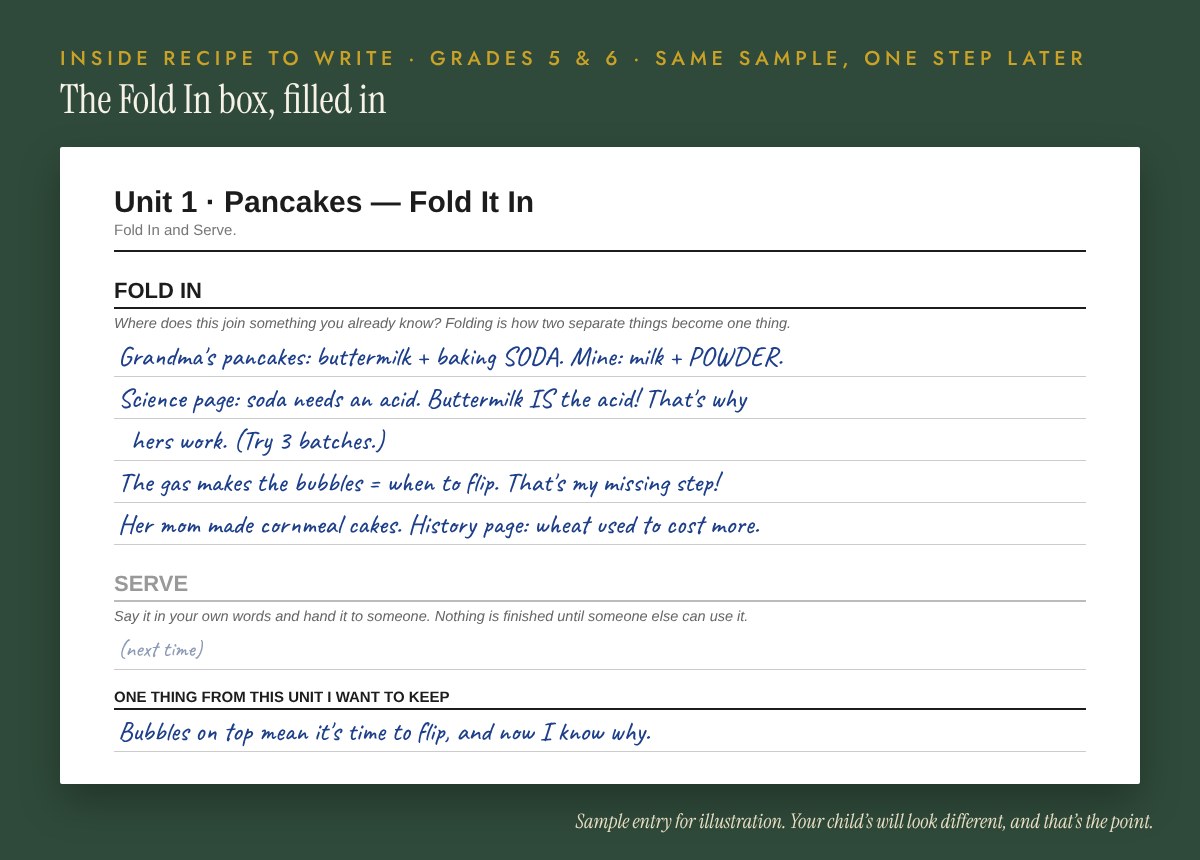
Look at what happened. His grandma’s recipe uses buttermilk and baking soda. His uses milk and baking powder. A week ago, that would have been a fun fact. Now he has the science page, and he can explain it: soda needs an acid, and the buttermilk is the acid. Two separate things just became one thing.
And look at the line about bubbles. In Measure, Sam didn’t know when to flip. The science page says the gas makes the bubbles. Now his fix for the recipe (“flip when bubbles pop on top”) isn’t just a rule he memorized. He knows why it’s true.
That’s the difference Fold In makes. His recipe is going to be better, and he’s going to remember why.
Fold In grows with your child
The same recipes come back at every level, and the Fold In prompt grows up with them.
Grades K–2: Draw them next to each other
For the youngest cooks, the Fold In box asks: “What does this remind you of? Draw them next to each other.” The science page is called simply “Bubbles,” and it ends with something a five-year-old can do: “When you see bubbles on top, it is time to flip.”
Grades 3 & 4 through 7–9: Science, history, and reading join in
The science deepens from “Why Bubbles Mean It Is Working” to “Gelatinization, Coagulation, and Browning.” The history moves from cooking on hot stones to “What Regional Food Actually Means.” Every level asks the same Fold In question, and every level has more to fold.
High School: Reading the research
Teens meet the same pancakes as a door into real scholarship. The science page is “Reading the Chemistry Literature,” the history page is “Diet, Milling, and Public Health,” and the reading page treats “Food Writing as a Genre.” Folding in now means connecting a recipe to a research paper and a century of changing dietary advice.
Fold In lives in two Common Topics
If you know Lisa’s 5 Common Topics, the book places two of them here. Circumstance: “Where does this dish come from, and who first cooked it?” And Relationship: “Why did the recipe work, or fail? What happens if one step changes?”
The grandma’s-pancakes connection is both at once. Circumstance explains why her family cooked that way. Relationship explains why her recipe works.
“Even if you’re watching a movie together, you could just have these conversations about the movie. Let’s define what we were talking about, or what is the relationship to this person or that person?”
Lisa Nehring, It’s Not That Hard to Homeschool podcast
In the kitchen, the relationship question is simple: “What happens if we change this one thing?” Try it with one batch and see.
How to help without hovering
- Call a grandparent. The History page says it directly: “the best source is often a person: ask someone older than you.” Ask how their family made pancakes, and where the food came from.
- Do the science page before Fold In. The experiment gives your child something real to connect. Three small batches, three pancakes, one clear answer.
- Ask “What does this remind you of?” It’s the K–2 prompt, and it works at every age.
- Let the “one thing I want to keep” be theirs. Don’t suggest it. Whatever they choose is the connection that stuck.
- Ask for 15, not 5. As Lisa says, “Anybody can come up with five. But when you start saying 15 to 20 to 30, you have to really start thinking very creatively.”
Resources for the Fold In step
Fold In joins the kitchen to science, history, and reading. These are good companions for each.
- Pancakes, Pancakes! by Eric Carle. Jack has to cut the wheat, grind the flour, and gather the egg before he gets his pancake. A perfect Fold In for little ones about where food comes from.
- Pancakes for Breakfast by Tomie dePaola. A wordless picture book about one woman’s quest for pancakes. Your K–2 child tells the story, which is a writing lesson all by itself.
- Kitchen Science Lab for Kids by Liz Heinecke. Kitchen experiments that pair well with the science page in every unit.
- Cooking for Geeks by Jeff Potter. The science of cooking for curious teens, from leavening to browning. A good bridge to the high school science pages.
- Bread, Bread, Bread by Ann Morris. Photographs of bread from around the world. A lovely companion to “Almost every country has a kind of pancake.”
Historic American cookbooks for The Old Version are free to read at Michigan State’s Feeding America collection and at the Library of Congress. You’ll find more on our Amazon storefront, including The Kitchen Is Our Classroom.
Next up: Serve
Gather is what you need before you start. Measure asks whether it holds together. Fold In joins it to everything else your child knows. Next time we’ll open Serve, the move our other books call Commit: “Say it in your own words and hand it to someone. Nothing is finished until someone else can use it.”
From our shop
One kitchen, every age
Recipe to Write: The Complete Series, Grades K–12 · $59
All five levels in one download, so the whole family can cook the same recipes and write at their own level. Or buy one level: Grades K–2, Grades 3 & 4, Grades 5 & 6, Grades 7–9, or High School.
See what’s insideNext step
When your writer is ready for a teacher, too
True North Academy’s classes build the same habits of careful writing for a real reader, with a teacher who reads every draft. Live online, accredited, and built for homeschool families.
Explore True North Academy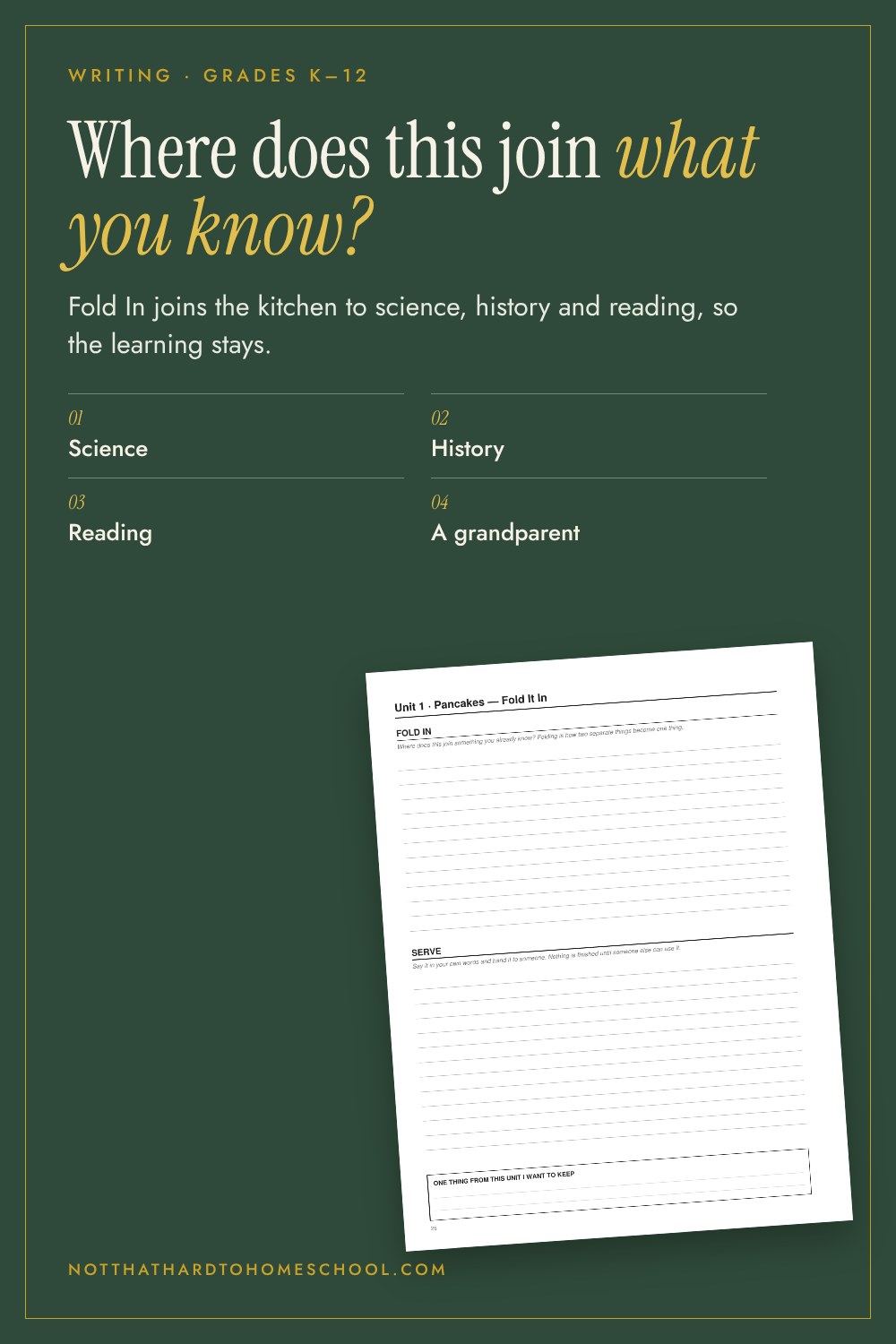
Save this to Pinterest for later.

Lisa Nehring and her husband, Dr. David Nehring, a Clinical Psychologist, and Biblical Scholar speak together on a wide variety of topics, including education, classical education, vision, mission, parenting, marriage, and more.
New here? Start with our free guide, The Fourfold Method: A Guide for Homeschool Families. Four simple moves that help your children keep what they learn, in every subject and at every age.
- Who Did This Before Us, and Why? The Connect Step for Homeschool Homesteading - November 22, 2026
- Two Bowls or One Cake: The Fold In Step in Recipe to Write - November 21, 2026
- Why Is There a Tea Party at All? The Fold In Step in Recipe to Read - November 20, 2026


