


This looks like a cookbook. It’s a writing curriculum.
In every unit your child cooks something and then writes it down so another person could make it without asking a single question. A recipe is the most testable writing there is. An essay can be vague and still pass. A recipe can’t. Hand it to someone, watch them stop and ask what you meant, and you’ve found the exact sentence that failed.
The same recipes run through all five volumes of Recipe to Write, so children at different ages can cook together and write at their own level.
The writing ladder at this level: genre analysis, procedural writing to a publishable standard, the researched essay on identity and place, historiography, the long essay, and criticism with its ethics.
Is this a good fit for your family?
- Yes, if writing time ends in tears or a blank page.
- Yes, if you want writing practice with a real audience and an instant result.
- Yes, if you’re teaching several ages and want them in the kitchen together.
- Yes, if you need a writing course with a course description and portfolio for the transcript.
- Maybe not, if you want a grammar program. Recipe to Write teaches composition; pair it with the grammar you already use if you need one.
By the end, your student will be able to
- Write a recipe that passes a blind test in a stranger’s kitchen
- Write a researched essay on identity and place
- Explain how a historical account is built, and why honest historians differ
- Write a 2,000-word essay and cut it to 1,500 without losing substance
- Write criticism fairly
How a unit works
Every unit follows the same rhythm:
- Cook and read: Food science, documented history, and substantial reading.
- Write: The unit’s form, from procedure to the long essay.
- Blind test: A recipe that fails in a stranger’s kitchen has failed, and the failure is the writing.
- Revise and file: Add the finished piece to the writing portfolio.
Work at your own pace. A unit can take one week or several, depending on how much reading and research you add. Pairs with Recipe to Read: High School.
What you’ll need
- This PDF and a printer (black and white is fine)
- Your kitchen and basic ingredients
- Library books from the reading lists (optional)
What’s inside
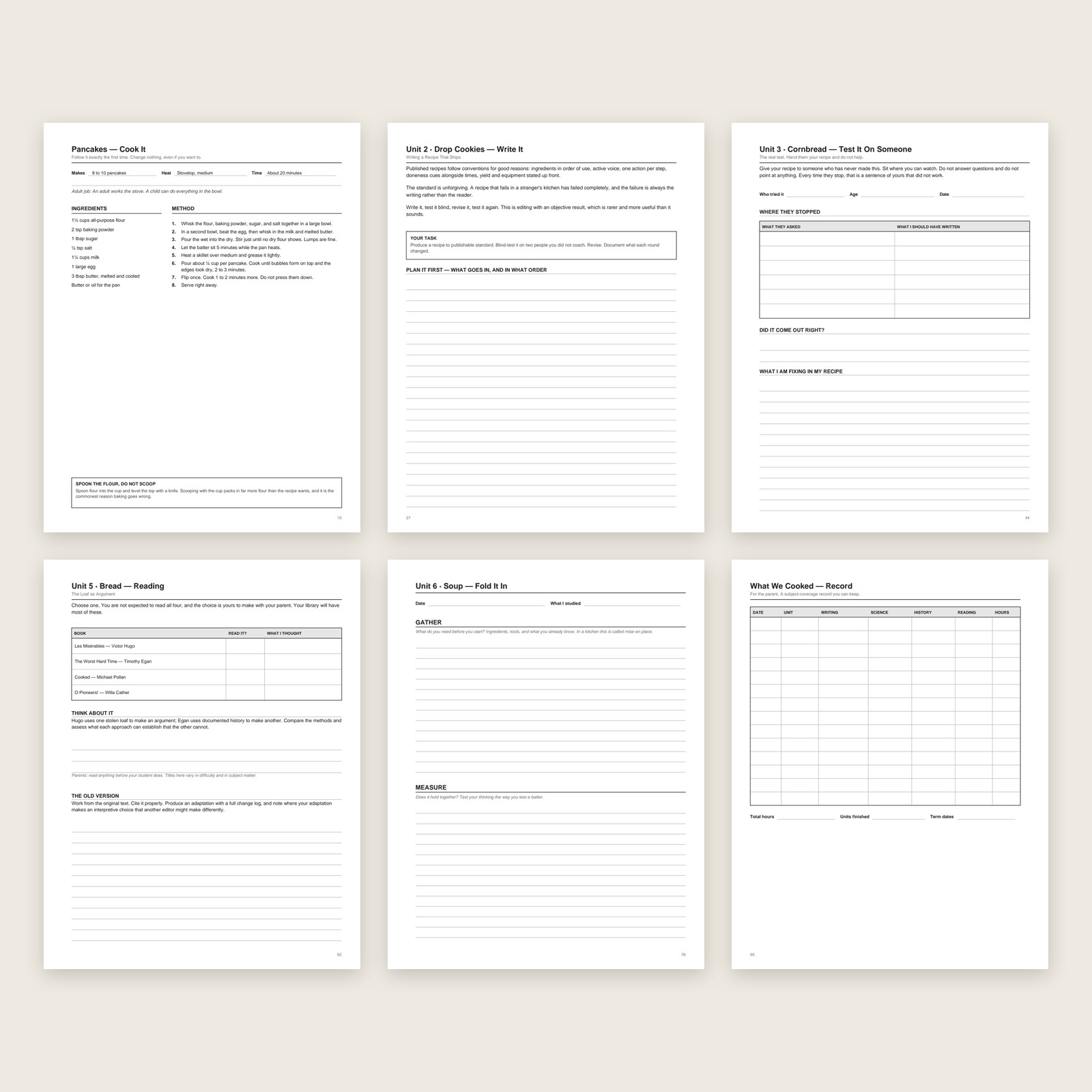
- Six units with food science, documented history, and substantial reading
- Vocabulary pages
- Blind-tested recipe writing
- A 2,000-word essay, cut to 1,500
- Historiography
- A final unit on criticism and what you owe the person whose work you judge
- A page for you in every unit, about reading your student’s work as a reader
- A course description page and a writing portfolio tracker
- A separate 28-page Parent Guide with step-by-step coaching, answer samples and writing instruction for every unit
Includes a Parent Guide
Every purchase comes with a 28-page Parent Guide, a separate PDF written for you, not your student. It walks you through your child’s book unit by unit, so you always know what to prepare, what to ask and what a good answer sounds like.
- Before you start: a short prep checklist and an opening line you can read aloud.
- Step by step: how to help with Gather, Test, Connect and Commit, with check-in questions and what to listen for.
- What good work looks like: sample strong answers, and the most common stumbling point to watch for.
- Every level from K–2 to high school side by side for each recipe, with kitchen safety and what to do when a unit goes sideways.
Writing is built in
Recipe to Write is a writing curriculum, and the Parent Guide coaches it unit by unit: the writing skill each unit teaches, how to run Test It On Someone, what strong writing looks like at each level, and how to respond without taking over.
See inside the Parent Guide (free sample) →
Why it works
Every unit runs on the Fourfold Method in kitchen clothing: Gather, Measure, Fold In, Serve. And the blind test gives your student something most writing assignments never do: a real reader who either can or can’t follow the instructions.
Questions moms ask
I’m not confident teaching writing. Will I be able to do this?
Yes. The Parent Guide tells you what each unit’s writing skill is, what to say, what strong writing looks like at each level and how to respond without rewriting it for them.
Is this a complete writing curriculum?
It teaches composition from the ground up across the grades. Many families pair it with a separate grammar or spelling program.
What if we have food allergies?
The recipes use common pantry ingredients, and you can substitute as needed. Writing about a substitution is good writing practice too.
Does it count for high school credit?
It can count toward an English or writing credit, with a course description page and portfolio tracker for the transcript. You award the credit.
Can I use it with more than one child?
Yes. Your family license lets you print as many copies as your household needs, for every child, every year.
Who wrote it?
Gina Steffy, creator of the Fourfold Method, who homeschooled her four children from kindergarten through graduation.
What you receive
- A printable PDF, 112 pages including the cover, 8.5 × 11 inches, designed to print clearly in black and white on a home printer.
- Parent pages on how learning works in layers, including how the Fourfold Method fits with Lisa Nehring’s 5 Common Topics.
- A family license: print as many copies as your household needs, for every child, every year.
- Your file is available only from the download page. It is not sent through a link in your order confirmation email, so please download it from the download page.
A first edition, shaped by the families who use it
This is a first edition, and we would love your help making the next one better. If a page is unclear, something is missing, or an idea would work better at your table, please tell us. Every purchase includes free updates. When a new edition is released, you will receive it at no additional cost.
Looking for something else?
Everything in our shop is an instant, printable download, with a family license and free updates.
Curriculum · Fourfold Studies · Bundles · Getting Started · High School Records · Browse the whole shop →
Ready for the next step?
Continue with Baking, a self-paced, one-credit high school course from True North Academy built around hands-on bakes.


Reviews
There are no reviews yet.