
If you pulled your child out of school in the last few weeks, I can guess what you are doing right now. You are second-guessing the decision. You are trying to buy the right curriculum. And you are attempting to run a full school day at your kitchen table.
Two of those three are a mistake.
You can do this. You are just trying to do the wrong thing. Homeschooling is not school moved into your house, and the sooner you stop trying to rebuild a classroom, the sooner it starts working.
Don’t start school on Monday
This is the advice that surprises new homeschoolers most. Do not start a full schedule right away. Your child just left one way of learning, and you have not yet found out how they learn at home. Week one is for finding out: observing what they gravitate to, what frustrates them, when they focus and when they fade.
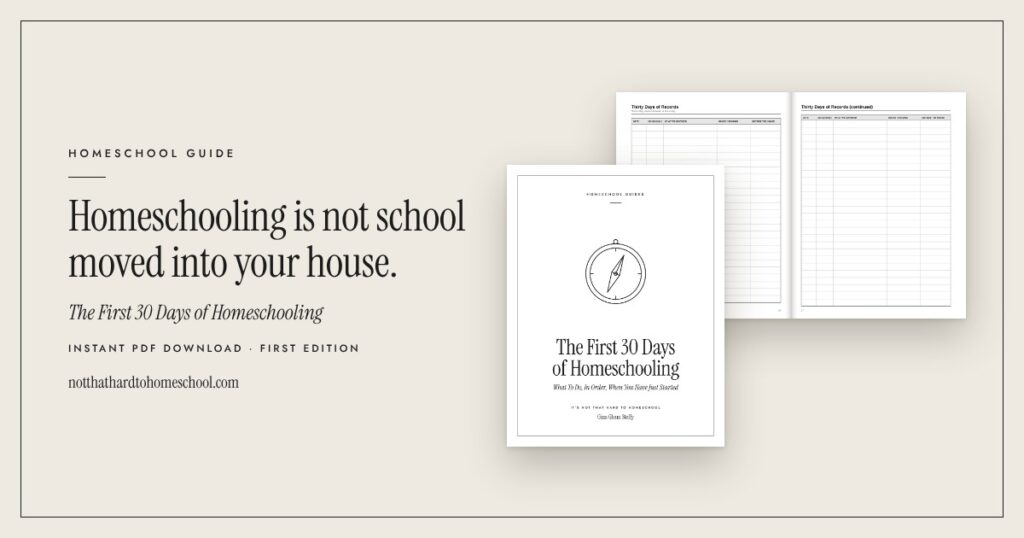
The guide includes observation logs for exactly that, because you cannot plan well for a child you have not watched learning.
Start smaller than you think
Two subjects. Then add one more each week. A homeschool day is considerably shorter than a school day, because there is no lining up, no roll call, and no waiting for twenty-five other children. Families are often surprised how much gets done in a focused morning.
Before you buy anything
You probably already have more than you think: a library card, books on the shelf, a kitchen, the outdoors. The guide has you take stock of what you already have before you spend a dollar on curriculum. The right curriculum is much easier to choose a month from now, when you know your child as a student.
Know what’s actually required
Homeschool law varies by state, and some states require notice by a deadline. The guide does not tell you your state’s rules, because those change. It tells you where to find them from an official source and gives you pages to record your requirements and deadlines. Do this in week one.
What’s inside
- What you are actually required to do, and where to find out
- Why you should not start school on Monday, and what week one looks like instead
- How to find out who you are teaching, with observation logs
- What a homeschool day actually looks like
- What you already have, before you spend anything
- Starting small: two subjects, then one more a week
- The questions you are being asked, and the ones you ask yourself at two in the morning
- Records to start today, even if your state requires none
- Building a week that survives a bad day
- Teaching while other children need you
- A vocabulary page, because homeschooling has its own language nobody explains
- The thirty-day review
Read it in an evening, then work the weeks
46 printable pages, 8.5 by 11, black and white for a home printer. It is short on purpose. You have enough to read right now.
This is a first edition. If you are in your first month and something in here did not match your situation, please tell us. Every purchase includes free updates to future editions.
Get The First 30 Days of Homeschooling
When you are ready to think about how your child will actually learn, not just what they will cover, the free Fourfold Method guide is a good next step.
Gina Glenn Steffy

Lisa Nehring and her husband, Dr. David Nehring, a Clinical Psychologist, and Biblical Scholar speak together on a wide variety of topics, including education, classical education, vision, mission, parenting, marriage, and more.
- A December Homeschool Plan: A Four-Week Christmas Term That Still Counts - October 9, 2026
- Just Started Homeschooling? What to Do in Your First 30 Days - October 9, 2026
- Homeschool Portfolio and Evaluation Log: Gather the Evidence as the Year Happens - October 9, 2026


