When we were homeschooling, I had four very different personalities at one table. This was before smartphones. Our screen problem was the computer and the television, which sounds quaint now and did not feel quaint then.
So we leaned on the thing I loved, which was books. And I watched something happen that I suspect is happening at your table too. My children read constantly, and kept almost nothing.
Learning does not come from reading. It comes from struggling with the content and forming an opinion about it. Do that, and the book sticks. Skip it, and a child can finish a hundred books and keep almost none of them. But wanting your children to think is not a method. You need an actual way to ask for it.
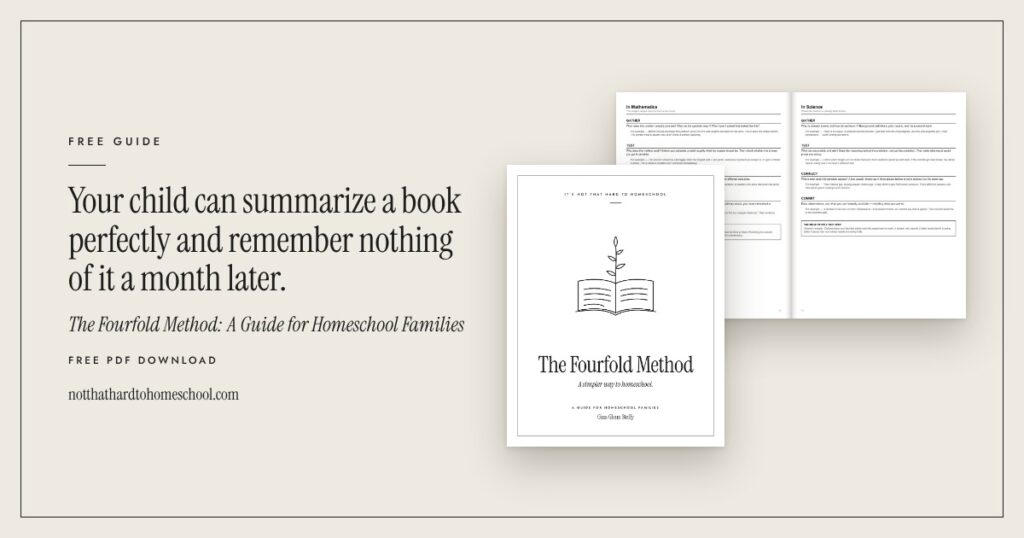
This free guide is that way.
What the guide teaches
The Fourfold Method is four moves: Gather what is there, Test it, Connect it to what you already know, and Commit it in your own words. If you have not read the full explanation yet, start with The Fourfold Method.
The guide takes those four moves and makes them practical. It shows what each one looks like on paper, then works them through mathematics, science, history, and language arts so you can see that this is not a reading method with other subjects bolted on.
Math is the one that surprises people. Most math instruction goes straight from Gather to Commit: here is the method, now do thirty of them. Asking a child to predict the answer before calculating takes ten seconds, and it is the single cheapest improvement available in the subject.
Inside the guide
- A personal note on why I am giving it away
- The four moves explained, with what each one looks like on paper
- Why gathering begins with the words, and how to teach vocabulary that sticks
- The method worked through mathematics, science, history, and language arts
- How it changes from a five-year-old to a high school senior
- How it fits a boxed curriculum, unit studies, Charlotte Mason, classical, or unschooling
- Pages for the voracious reader and the reluctant reader
- Mom School: how to learn this way yourself first, with a few friends
- Practice pages to try it tonight, including drawing pages for younger children
Two children it helps most
The voracious reader finishes a book in an afternoon and could not tell you much about thirty-five of the forty books they read this year. For this child the method is a brake. You do not slow down their reading. You pick one book a month for the treatment and let the rest stay unexamined.
The reluctant reader freezes at “write a book report” because they have no idea what shape the answer is supposed to be. For this child the method is a handrail. Nobody can answer “what did you think of the book.” Everybody can answer four small questions.
Try it tonight
Pick whatever your child is reading now. Ask four questions: What happened? What did you make of it? What does it remind you of? What would you tell someone who has never read it? Write down the answers, or let your child draw them. That is the whole method, at its smallest.
Download it free
The guide is 26 printable pages, black and white, made for a home printer. It is free and it always will be. The method is not mine to sell.
It is also a first edition. If something is unclear, or you used it in a way I did not think of, please tell us. Every download includes free updates to future editions.
When you are ready to build the method into a full year, the high school journals and the Recipe to Write and Recipe to Read series do that for you.
Gina Glenn Steffy

Lisa Nehring and her husband, Dr. David Nehring, a Clinical Psychologist, and Biblical Scholar speak together on a wide variety of topics, including education, classical education, vision, mission, parenting, marriage, and more.
New here? Start with our free guide, The Fourfold Method: A Guide for Homeschool Families. Four simple moves that help your children keep what they learn, in every subject and at every age.
- Draft It, Then Show Your Work: The Commit Step for High School English - November 25, 2026
- Every Source Wants Something: The Connect Step in High School Economics - November 24, 2026
- A Fact Needs Somewhere to Hang: The Connect Step in a Christmas Homeschool Term - November 23, 2026


