

They’ll stop being afraid of Shakespeare, and start arguing about him at dinner.
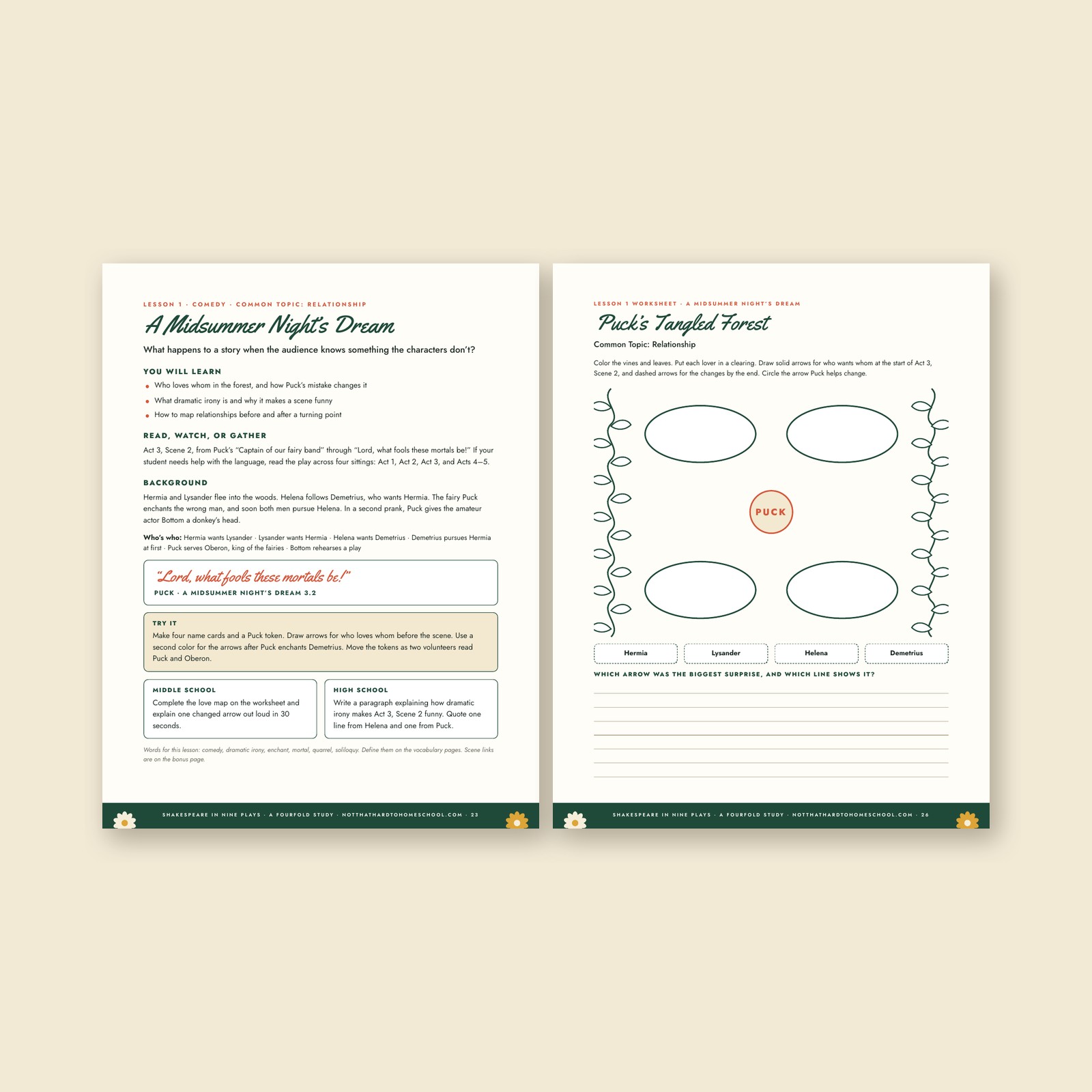
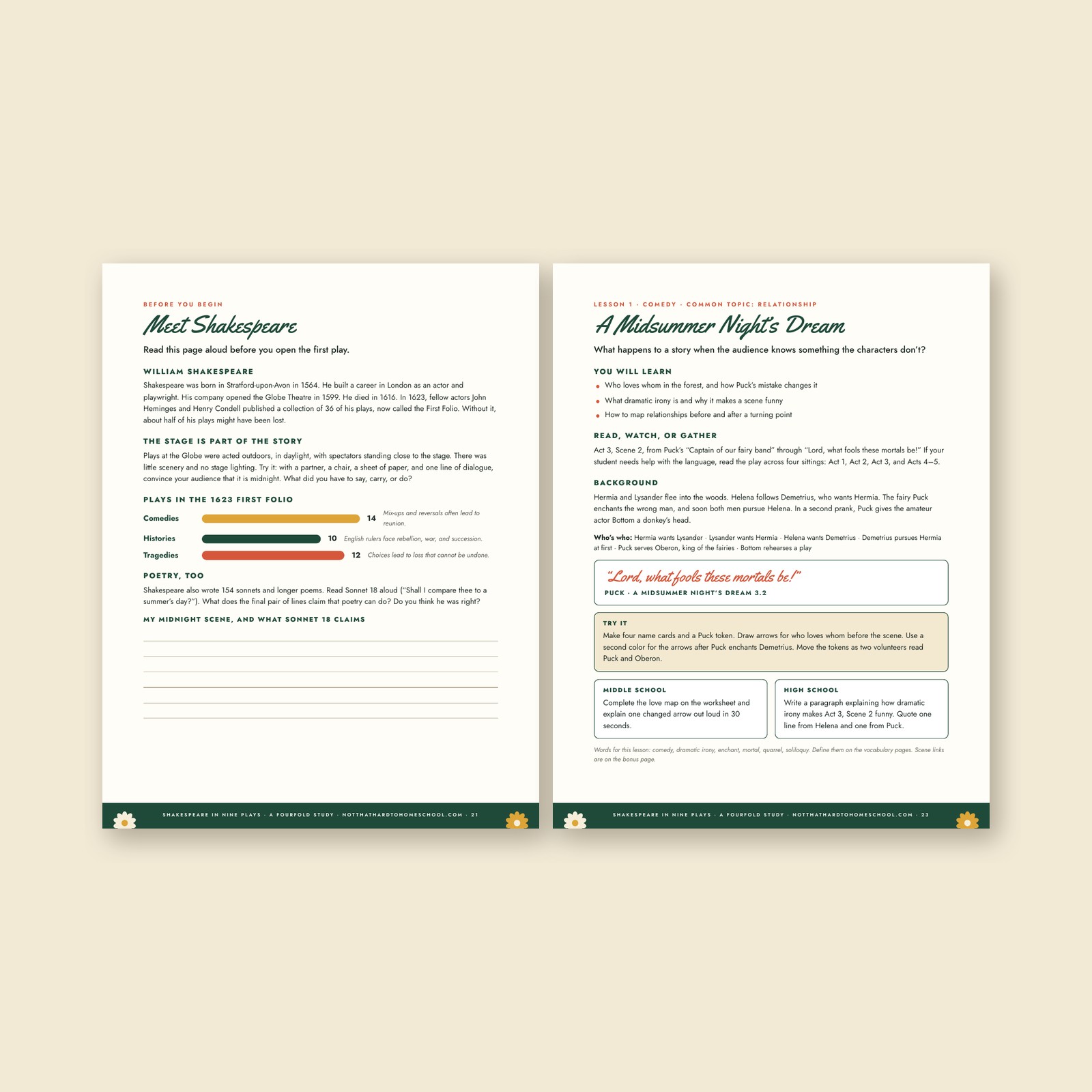
Most kids meet Shakespeare as a wall of “thees” and “thous” and a study guide that explains the jokes. A month later all they remember is that it was hard. Shakespeare in Nine Plays starts where his own audiences started: with the story, out loud. Your student reads the plot, hears the scene, and then makes something with it: a love map of Puck’s mix-up, a rumor newsroom for Much Ado, a battle speech of their own, a stage plan for Lady Macbeth by candlelight.
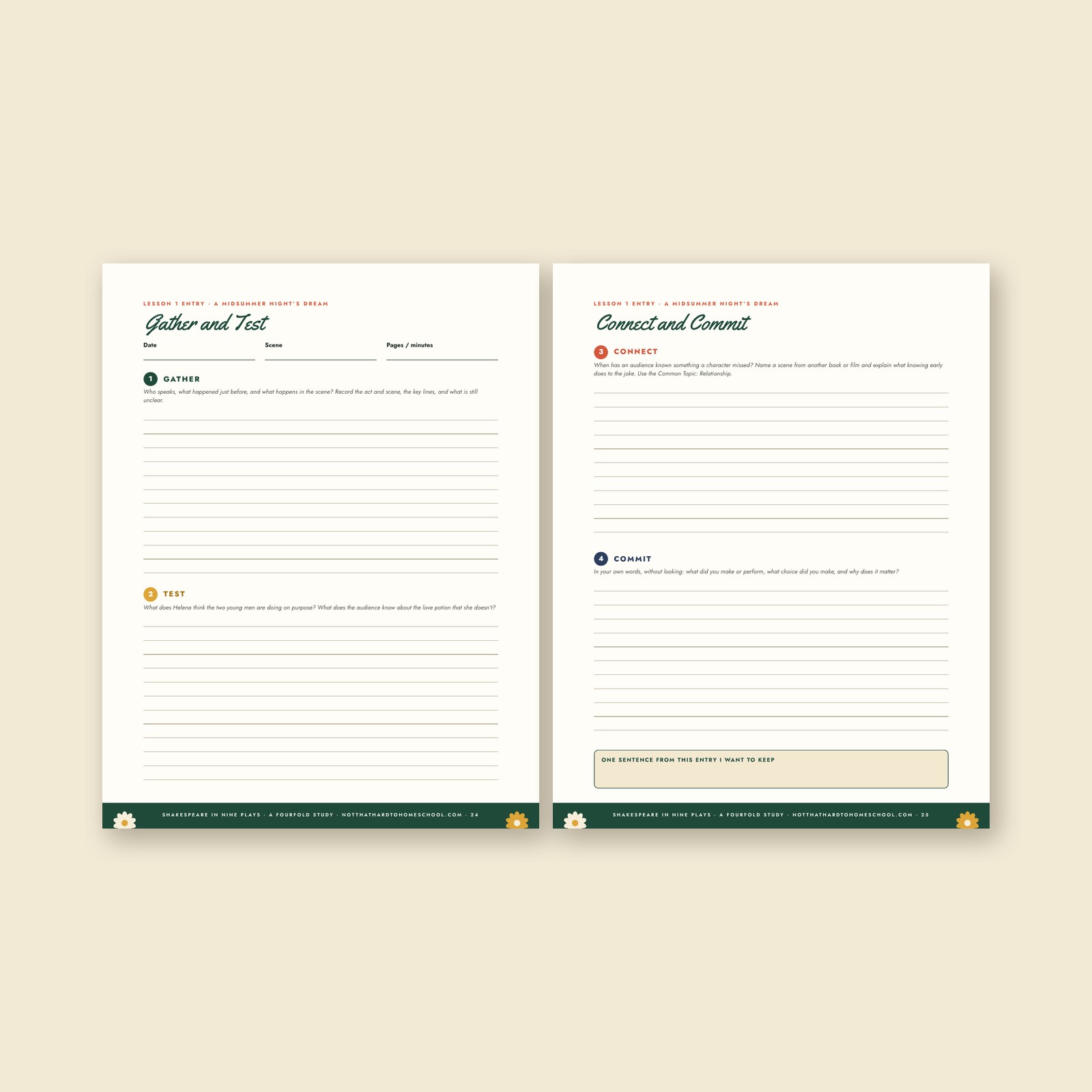
It is built on the Fourfold Method (Gather, Test, Connect, Commit), the same four moves that turn reading into something a student keeps. You don’t need to be a Shakespeare expert to teach it. Every lesson gives you the plot, the cast, the exact lines to read, and an answer key.
Is this a good fit for your family?
- Yes, if your student has never read Shakespeare, or tried once and gave up. Every lesson starts with a plain-English plot and a who’s who.
- Yes, if you’re teaching more than one age. Every lesson has a Middle School line and a High School line, so a 7th grader and an 11th grader can work side by side.
- Yes, if you need English literature hours for a transcript. The book includes an hours log and a course description page.
- Yes, if you want literature taught from a Christian perspective that still asks students to weigh evidence and think for themselves.
- Maybe not, if you want every play read cover to cover. This study works one key scene from each play deeply. Families who want more can read the full plays free alongside it.
By the end, your student will be able to
- Explain dramatic irony, and why Helena’s fury in A Midsummer Night’s Dream is funny instead of sad
- Separate what they heard from what they checked, using the rumors in Much Ado About Nothing
- Define honor through two characters who disagree about it, Prince Hal and Falstaff
- Write and revise a short persuasive speech using the moves in Henry V’s “band of brothers”
- Tell the historical record from the drama in Richard III
- Tell an observation from an inference, and decide whether Claudius is guilty
- Direct one scene two ways and explain the choice to an audience
What a week looks like
Each lesson takes about three hours. Here is one lesson spread over a week, at about 30–40 minutes a day:
- Monday: Read the lesson page, the plot, and the cast together. Read the famous line aloud.
- Tuesday: Gather. Read the scene aloud, taking parts, and fill in the first journal page.
- Wednesday: Test. Answer the lesson’s question with a line from the play as evidence.
- Thursday: Connect and Commit. Do the hands-on project on the worksheet and write it in their own words, without looking.
- Friday: Perform it for the family, watch a suggested film clip, or add the play to the timeline.
Prefer a faster pace? Two lessons a week finishes in about six weeks, with a capstone performance at the end. Shakespeare’s birthday, April 23, makes a fine performance day.
What you’ll need
- This PDF and a printer (black and white is fine)
- The plays, free to read online at the Folger Shakespeare Library (scene links are on the free bonus page)
- Colored pencils, scissors, index cards, and a paper brad for the hands-on worksheets
- A Bible, for one short Scripture connection (quotations are from the ESV)
- Optional: the books and films on the Reading and Viewing page. Parents get a clear note on ratings and which scenes to preview.
What’s inside
- Nine lessons in three parts: The Comedies (A Midsummer Night’s Dream, Much Ado About Nothing, Twelfth Night), The Histories (Henry IV, Part 1, Henry V, Richard III), and The Tragedies (Romeo and Juliet, Macbeth, Hamlet). Each has a lesson page, two journal pages, and a worksheet.
- Hands-on worksheets: Puck’s Tangled Forest love map, a rumor ledger, a cut-and-turn identity wheel, two shields of honor, a thirty-second rally, a museum label, a message relay, a candlelight stage plan, and an observation-or-inference chart
- A capstone: One Scene, Two Ways. Your student directs the same lines two different ways and asks the audience what changed, with a parent rubric
- Parent pages that explain the Fourfold Method in plain language, what to do when the language feels impossible, and an answer key with a “Who Said It?” game
- For your records: a course map, a six-week plan, an hours log, a Shakespeare timeline, vocabulary pages, a Looking Back page, and a ready-to-finish course description for a transcript
- Free bonus page: links to every scene at the Folger Shakespeare Library, a historical account of the Battle of Bosworth, and printable tokens, shields, and wheel circles
- A separate 32-page Parent Guide with step-by-step coaching, answer samples and writing instruction for every lesson
Includes a Parent Guide
Every purchase comes with a 32-page Parent Guide, a separate PDF written for you, not your student. It walks you through the student journal lesson by lesson, so you always know what to prepare, what to ask and what a good answer sounds like.
- Before you start: a short prep checklist and an opening line you can read aloud.
- Step by step: how to help with Gather, Test, Connect and Commit, with check-in questions and what to listen for.
- What good work looks like: sample strong answers, and the most common stumbling point to watch for.
- An answer key for every play, notes on previewing mature scenes, and a “Who Said It?” game for the last day.
Writing is built in
Middle schoolers quote a line and explain it. High schoolers write an analytical paragraph for every play, citing act and scene. The Parent Guide shows you how to coach it: a named writing skill for every lesson, sentence starters for each level, sample strong answers, what a helpful note sounds like, and a simple rubric for paragraphs and essays. You don’t have to be a writing teacher.
See inside the Parent Guide (free sample) →
Why the Fourfold Method works
Most literature study stops at reading the chapter and answering the questions. The Fourfold Method keeps going. Your student gathers what the scene says, tests an interpretation against the text, connects it to what they already know, and commits it by making and explaining a choice. It’s the difference between “I read Macbeth” and “I can show you why Lady Macbeth keeps washing her hands.” Each lesson also uses one of Lisa’s 5 Common Topics (Definition, Compare and Contrast, Circumstance, Relationship, and Authority) to guide the discussion.
Questions moms ask
Do I need to know how to teach writing?
No. The writing is built into every lesson, and the Parent Guide shows you how to coach it: what to expect at each level, sentence starters, what a helpful note sounds like and a simple rubric.
Is this a complete course?
It’s a complete Shakespeare study, about 35 hours. Most families count it as a quarter credit in English literature for high school, or a literature unit for middle school. You award the credit; the hours log and course description make it easy.
I never read Shakespeare myself. Can I teach this?
Yes. Every lesson gives you the plot in plain English, the cast, the exact lines to read, and the questions to ask. The answer key covers every lesson.
Can I use it with more than one child?
Yes. One book serves grades 7–12, and your family license lets you print as many copies as your household needs, every year. The performance projects work even better with siblings.
What about the content in the tragedies?
Each tragedy lesson tells you exactly what to preview: Romeo and Juliet, Macbeth, and Hamlet include murder, suicide, and grief. You can use the plot summary in place of any scene you’d rather skip.
What faith perspective does it take?
It’s written from a Christian perspective. Scripture connections are short and clearly marked, and students are asked to test claims against evidence, a theme that runs through several of the plays.
Do I need to buy other books?
No. Every play is free to read online. The retellings and films are optional extras.
Who wrote it?
Lisa Nehring, founder of True North Academy and host of the It’s Not That Hard to Homeschool podcast.
What you receive
- A printable PDF, 71 pages including the cover, 8.5 × 11 inches, designed to print clearly in black and white on a home printer.
- A family license: print as many copies as your household needs, for every child, every year.
- Your file is available only from the download page. It is not sent through a link in your order confirmation email, so please download it from the download page.
A first edition, shaped by the families who use it
This is a first edition, and we would love your help making the next one better. If a page is unclear, something is missing, or an idea would work better at your table, please tell us. Every purchase includes free updates. When a new edition is released, you will receive it at no additional cost.
Looking for something else?
Everything in our shop is an instant, printable download, with a family license and free updates.
Curriculum · Fourfold Studies · Bundles · Getting Started · High School Records · Browse the whole shop →


Reviews
There are no reviews yet.