
Breaking Open the Fourfold Method · Commonplace Book for History · Step 3 of 4
This post contains affiliate links. If you buy through them, It’s Not That Hard to Homeschool may earn a small commission at no extra cost to you.
Our student has been working on one letter for two posts now. In Gather, she copied out what Abigail Adams wrote in March of 1776 and noted where she found it. In Test, she set it beside John’s reply and asked why then, what’s left out, and who benefited.
She knows this letter well now. Here’s the honest question: will she remember it in March?
Not unless it’s attached to something. A single letter from 1776, however well understood, is still a single date floating in space. The third move is what gives it somewhere to land.
The Commonplace Book for History describes it in one line: “Earlier causes, later consequences, the same pattern somewhere else, an argument happening now. This is the move that turns a date into something you keep.”
This is the next post in our series opening up the Fourfold Method one step at a time, using the actual pages students fill in. Today it’s history, through the commonplace book, and step three: Connect.
Free guide
A date with nothing around it is a date they’ll forget.
Our free guide walks you through all four moves of the Fourfold Method (Gather, Test, Connect, Commit) and why Connect is the one that makes learning stay. It works in every subject, at every age.
Get the free Fourfold guideWhy Connect is the move that matters
The book’s parent pages explain why students forget, and the first reason is simple: a new fact needs “something to attach it to. A new fact sticks when it hooks onto something already known. A detail with nothing to hold it slides away.”
That’s why the book calls Connect “the move that makes knowledge stay.” It’s also the move most students skip. In the book’s “Two Students, One Afternoon” comparison, the first student finishes the chapter and “moves on to the next assignment.” The second “links it to something learned earlier this year.” A month later, only one of them “can explain it, defend it, and show where it fits.”
Connect isn’t extra credit. It’s the reason the first two moves were worth doing.
Four directions to connect
The Connect box in every Fourfold Entry gives your student four directions to look:
- Earlier causes. What made this possible, or necessary?
- Later effects. What happened because of it, or after it, that it helped shape?
- The same pattern elsewhere. Where else has this kind of thing happened?
- An argument now. Where are people still arguing about the same question today?
Your student doesn’t need all four every time. One real connection beats four forced ones. But each direction is a different way out of the single date and into the larger story.
What it looks like on the page
The Fourfold Entry runs across two facing pages. Gather and Test are on the left. The right-hand page holds Connect and Commit, with a prompt that couldn’t be shorter: “Earlier causes, later effects, the same pattern elsewhere, an argument now.”
Here’s what our student’s Connect box might look like for the Adams letters:
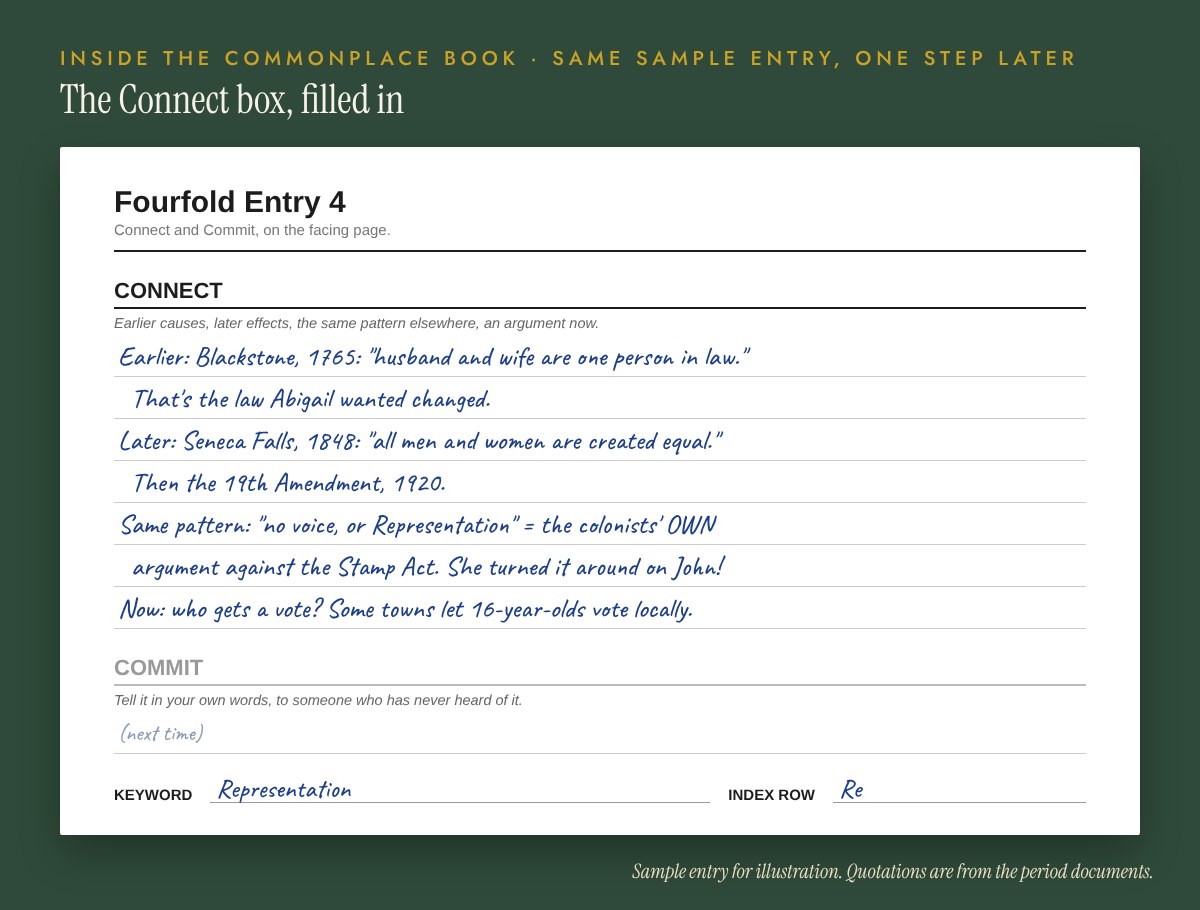
Look at the third line. That’s the connection that changes how she reads the whole letter.
Abigail wrote that the ladies “will not hold ourselves bound by any Laws in which we have no voice, or Representation.” Those are the colonists’ own words. For more than a decade, since the Stamp Act of 1765, Americans had argued that they shouldn’t be bound by laws they had no voice in making. Abigail took her husband’s argument and turned it around on him.
A student who sees that isn’t remembering a date anymore. She’s remembering an argument, and arguments are much easier to keep.
Now look at the second line. Seventy-two years later, at Seneca Falls, the Declaration of Sentiments was modeled on the Declaration of Independence, with a few words added: “We hold these truths to be self-evident: that all men and women are created equal.” The question Abigail raised in a private letter became a public document. Her student-historian now has a line running from 1765 to 1848 to 1920, and the letter sits right in the middle of it.
The Timeline: pegs to hang things on
The book’s fix for when “Connect feels forced” is four words long: “Start with a timeline. A new fact needs somewhere to hang.”
The commonplace book’s Timeline isn’t printed in advance. It’s “running,” and your student adds entries “as you meet them, with the source for each.” The page even says so up front: “It will not be in order, and that is fine.”
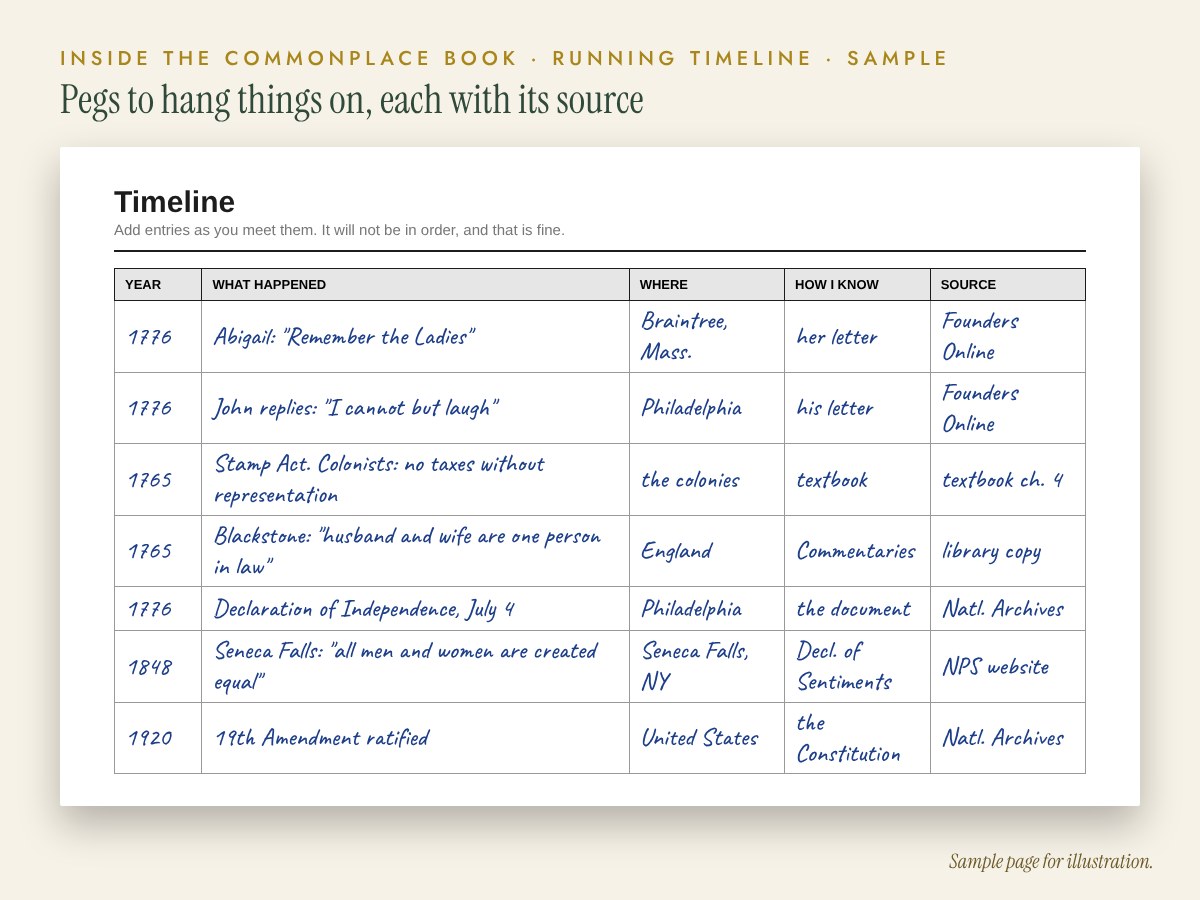
The parent pages describe a timeline as “pegs” to hang things on. Your student won’t memorize every date. But she’ll know the letter came after the Stamp Act and before the Declaration of Independence, in the very same spring. That’s the flow of history, and it’s what makes the next thing she reads easier to place.
Notice the columns, too: Where, How I know, and Source. Even the timeline keeps the Gather habit. Every peg is attached to evidence.
Two more pages that do the connecting
1. Locke’s index
Every Fourfold Entry ends with a keyword and an index row, and the index at the back of the book uses John Locke’s 1706 method so nothing gets lost. The book’s advice on choosing keywords is a lesson in Connect all by itself: “Themes travel further than events. Taxation will collect entries from four centuries. Stamp Act will collect three.”
If our student files this entry under Representation rather than Abigail Adams, that one keyword will pull the Stamp Act, the letter, and Seneca Falls into the same row. Her index becomes a map of connections she built herself.
2. Words of the Period
This page asks “what a word meant then, which is often not what it means now,” and reminds your student that “republic, commonwealth, liberty, and virtue all meant something specific to the people using them. The specifics are the history.” When the same word shows up in 1776 and 1848, checking whether it meant the same thing both times is one of the sharpest connections a student can make.
Connect lives in two Common Topics
If you know Lisa’s 5 Common Topics, the book places two of them right here. Circumstance: “When and where it happened, and what else was going on.” And Relationship: “Cause and effect, and how it fits the larger story.”
Circumstance is why the timing of Abigail’s letter matters. Congress was about to write the laws of a new country. Relationship is the line from the colonists’ argument to hers, and from hers to Seneca Falls.
“Even if you’re watching a movie together, you could just have these conversations about the movie. Let’s define what we were talking about, or what is the relationship to this person or that person?”
Lisa Nehring, It’s Not That Hard to Homeschool podcast
That’s Connect at the dinner table. “What does this remind you of?” is the easiest history question there is, and one of the best.
How to help without hovering
- Start with the timeline. It’s the book’s own fix. If your teen can’t think of a connection, ask where the event sits between two dates they already know.
- Ask “Where have we heard this argument before?” History repeats its questions far more often than its events.
- Let one connection be enough. One real link is worth more than four that only fill the box.
- Bring in other subjects. A novel from the same decade, a hymn, a scientific discovery. The book says Connect can reach “in this subject and others.”
- Ask for 15, not 5. If the box looks thin, ask for more. As Lisa says, “Anybody can come up with five. But when you start saying 15 to 20 to 30, you have to really start thinking very creatively.”
Resources for the Connect step
You don’t need any of these to use the commonplace book. But if you want to help your student follow a question across a century, these are good ones.
- Founding Mothers: The Women Who Raised Our Nation by Cokie Roberts. Abigail Adams in the company of the other women of the Revolution, with plenty of their own words. Great for “the same pattern elsewhere.”
- Dear Abigail by Diane Jacobs. Abigail and her two sisters, and the letters among them. A fuller picture of the world the famous letter came from.
- Seneca Falls and the Origins of the Women’s Rights Movement by Sally McMillen. Where the argument went next. Perfect for the “later effects” line.
- The Annotated U.S. Constitution and Declaration of Independence edited by Jack Rakove. Set the Declaration beside the Declaration of Sentiments and compare them line by line.
- Abigail Adams by Woody Holton. A biography for a strong reader, or for a parent who wants the whole story behind the letters.
The Declaration of Sentiments is free to read online from the National Park Service, and the Adams letters are free at the National Archives’ Founders Online. You’ll find more on our Amazon storefront.
Next up: Commit
Gather finds what the source says. Test asks why. Connect gives it a place to live. Next time we’ll open the last move, Commit: “Tell it in your own words, to someone who has never heard of it. Where you stall is where you do not yet understand.”
From our shop
Every page in this post, ready to print
The Commonplace Book for History: Sources, Arguments, and Where You Found Them · $15
Source pages with the four questions, Accounts That Disagree, An Argument, a running Timeline, People, Words of the Period, Fourfold Entry spreads, and John Locke’s index at the back so nothing gets lost.
See what’s insideNext step
When your teen wants a history teacher, too
True North Academy’s classes build the same habits of weighing sources and arguing from evidence, with a teacher who reads every paper. Live online, accredited, and built for homeschool families.
Explore True North Academy
Save this to Pinterest for later.

Lisa Nehring and her husband, Dr. David Nehring, a Clinical Psychologist, and Biblical Scholar speak together on a wide variety of topics, including education, classical education, vision, mission, parenting, marriage, and more.
New here? Start with our free guide, The Fourfold Method: A Guide for Homeschool Families. Four simple moves that help your children keep what they learn, in every subject and at every age.
- Earlier Causes, Later Effects: The Connect Step in a Commonplace Book - November 19, 2026
- The Same Law in Three Places: The Connect Step for High School Science - November 18, 2026
- The Snack Table, Ep. 10: Can cooking, gardening or raising chickens really count as high school? - November 17, 2026


